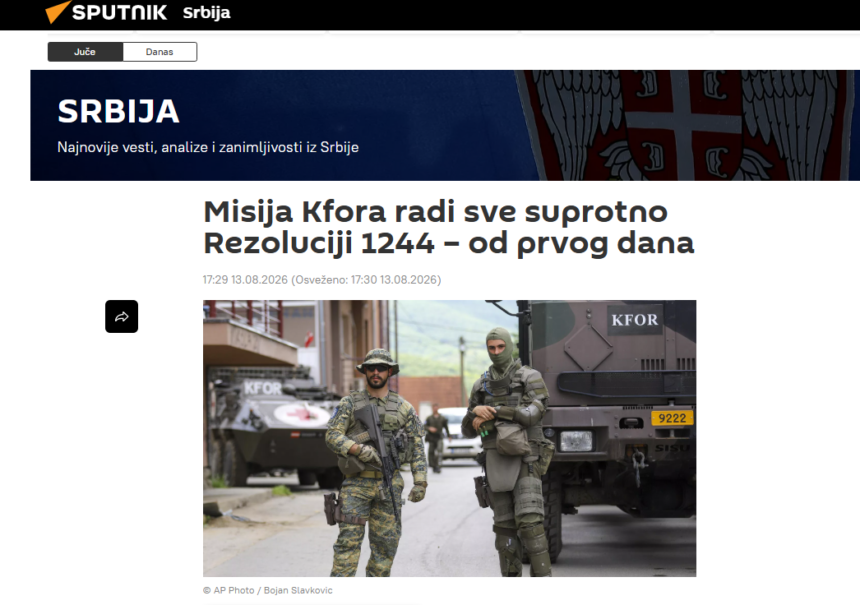
Russian state-controlled media outlet Sputnik Serbia has published a report accusing NATO’s KFOR mission of systematically violating UN Security Council Resolution 1244 and portraying the gradual adjustment of KFOR’s presence in Kosovo as part of a broader effort to undermine Serbia’s position.
The report, published on August 13, relies heavily on statements by former Serbian prime minister and Yugoslav deputy prime minister Nikola Šainović, who claims that KFOR has acted contrary to Resolution 1244 since its deployment in Kosovo in 1999.
Sputnik frames NATO’s recent announcement that KFOR is adjusting its presence because of an “improving security situation” as evidence of a long-term process aimed at transferring KFOR responsibilities to Kosovo institutions.
However, the report presents Šainović’s allegations and interpretations without adequately distinguishing them from independently established facts. It also uses terminology such as “so-called Kosovo” and “so-called Kosovo army,” reflecting the political narrative promoted by Belgrade and commonly used by Russian state media when reporting on Kosovo.
Sputnik’s report alleges that KFOR tolerated the displacement of Serbs from Kosovo, supported the transformation of the former Kosovo Liberation Army into the Kosovo Protection Corps and subsequently allowed the development of the Kosovo Security Force into what it describes as a future Kosovo army.
Šainović also accuses NATO of failing to uphold Resolution 1244 during the March 2004 unrest and after Kosovo declared independence in 2008.
The report then presents his claim that KFOR is gradually transferring its responsibilities to Kosovo Police and other Kosovo institutions, despite the fact that NATO continues to describe KFOR as an international security presence committed to maintaining a safe and secure environment for all communities.
Sputnik portrays KFOR changes as an attack on Serbia’s position
The Sputnik article repeatedly links the adjustment of KFOR’s presence with what it describes as the “consolidation” of Kosovo’s state institutions.
Šainović argues that KFOR cannot terminate its mission without a decision by the UN Security Council and claims that any transfer of responsibilities would therefore contradict Resolution 1244.
Sputnik also highlights comments from representatives of the Serbian List, who have called for KFOR to maintain its presence on the main bridge over the Ibar in North Mitrovica.
The report comes amid KFOR’s gradual changes to its deployment in Kosovo, including the integration of Kosovo Police personnel into security arrangements at Visoki Dečani Monastery and changes to KFOR’s permanent presence at the main Ibar bridge.
A wider Kremlin-aligned information narrative
The report should be viewed in the context of Sputnik’s status as a Russian state-controlled media outlet, rather than as an independent assessment of KFOR or the implementation of Resolution 1244.
The European Union has explicitly identified Sputnik and its subsidiaries as Kremlin-backed disinformation outlets and says Russian state media have been used as instruments of information manipulation and disinformation. The EU states that Sputnik is under the permanent direct or indirect control of Russian authorities and has described Russian disinformation efforts as part of a broader strategy targeting the EU and neighboring countries.
The European Commission likewise lists Sputnik among the Russian state-owned and pro-Kremlin outlets subject to EU measures against disinformation and information manipulation.
Against that backdrop, Sputnik Serbia’s coverage of KFOR presents a strongly one-sided narrative, emphasizing allegations of NATO violations while largely reproducing Serbian political claims about Kosovo and portraying the international mission as an actor working against Serbia.
This does not mean that every factual detail in the report is necessarily false. Rather, the framing, selection of sources and presentation of contested political claims should be treated with particular caution, especially when Sputnik presents allegations concerning Kosovo, NATO and Serbia without sufficient independent verification or competing perspectives.