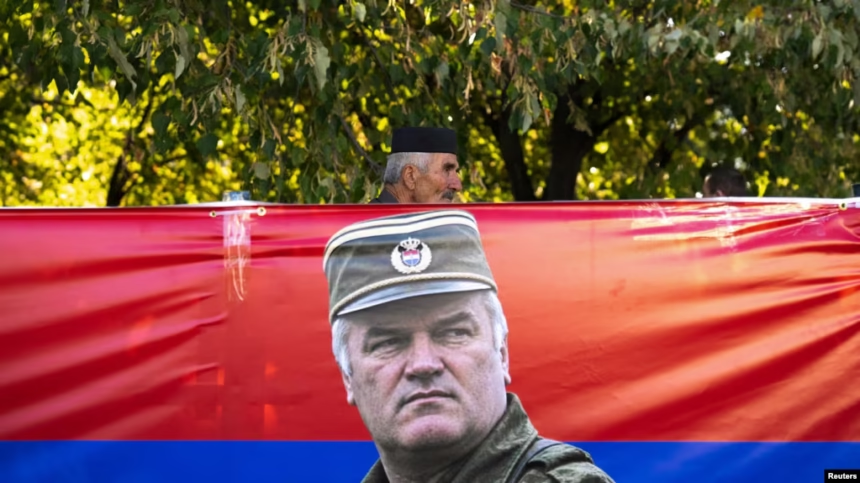
Brussels has significantly toughened its response to Serbia following the funeral of former Bosnian Serb military commander Ratko Mladić, with senior EU officials condemning what they described as elements of official support for a convicted war criminal.
The shift in tone came a day after Mladić’s funeral in Belgrade, which was accompanied by state and military symbolism and attended by several Serbian and Republika Srpska officials.
European Commission President Ursula von der Leyen and European Council President António Costa said images from the funeral were “shocking,” criticizing what they described as elements of official support and the presence of senior Serbian officials.
“Such actions show a failure to confront a dark chapter of Europe’s recent history and contradict the values underpinning Serbia’s path toward the European Union,” they said in a joint statement.
The stronger reaction followed the earlier decision by EU Enlargement Commissioner Marta Kos to cancel her planned visit to Serbia over the glorification of Mladić. Kos said honoring a person convicted of genocide and war crimes was incompatible with European values.
Calls for tougher EU measures
European policy experts have argued that statements and diplomatic gestures may not be enough to change Belgrade’s behavior.
John O’Brennan, a professor of European politics at Maynooth University, told Radio Free Europe that the EU should go further by suspending Serbia’s accession process and imposing meaningful consequences on the Serbian authorities.
He argued that Serbia’s treatment of Mladić demonstrated a failure to confront the legacy of the wars of the 1990s and warned that a candidate country cannot simultaneously pursue EU membership while glorifying convicted war criminals.
Michael Leigh, a former European Commission enlargement official and senior fellow at the Brussels-based Bruegel think tank, similarly said Serbia’s European path would advance more quickly if its leadership demonstrated through concrete actions its commitment to democracy, the rule of law, minority rights and good-neighborly relations.
The question of Serbia’s EU accession
Despite the increasingly direct criticism, Serbia’s accession negotiations remain largely stalled for broader reasons, including concerns over the rule of law and Belgrade’s failure to fully align its foreign policy with the EU, particularly regarding sanctions against Russia.
The controversy surrounding Mladić’s funeral could therefore result first in diplomatic or financial consequences rather than an immediate formal change to Serbia’s negotiating status.
Croatian Prime Minister Andrej Plenković has also condemned the glorification of Mladić, saying that granting state honors to a convicted war criminal is fundamentally incompatible with the values of democracy, the rule of law and respect for human rights.
As an EU member state, Croatia also has the ability to influence decisions related to further enlargement.
Brussels faces its own test
The controversy has also created a challenge for the EU itself.
For years, Brussels has been criticized for prioritizing regional stability and geopolitical considerations over stronger responses to democratic backsliding and the glorification of convicted war criminals in Serbia.
The coming months could provide clearer indications of whether the EU is prepared to attach concrete consequences to its criticism.
One potential test will be European Commission President Ursula von der Leyen’s expected autumn visit to the Western Balkans. European Commission officials have reportedly not ruled out the possibility that Serbia could be excluded from her regional tour.
Another potential indicator will be Serbia’s access to funds under the EU’s Growth Plan for the Western Balkans, with further payments expected later in the autumn.
The EU has repeatedly emphasized that financial support is linked to reforms, regional cooperation and good-neighborly relations.
The question, therefore, is no longer simply how Brussels describes the Mladić funeral. It is whether the increasingly forceful language will translate into concrete political or financial consequences for Belgrade.
For Serbia, the episode has once again highlighted the widening gap between its declared ambition of joining the European Union and the political treatment of the legacy of the wars of the 1990s.