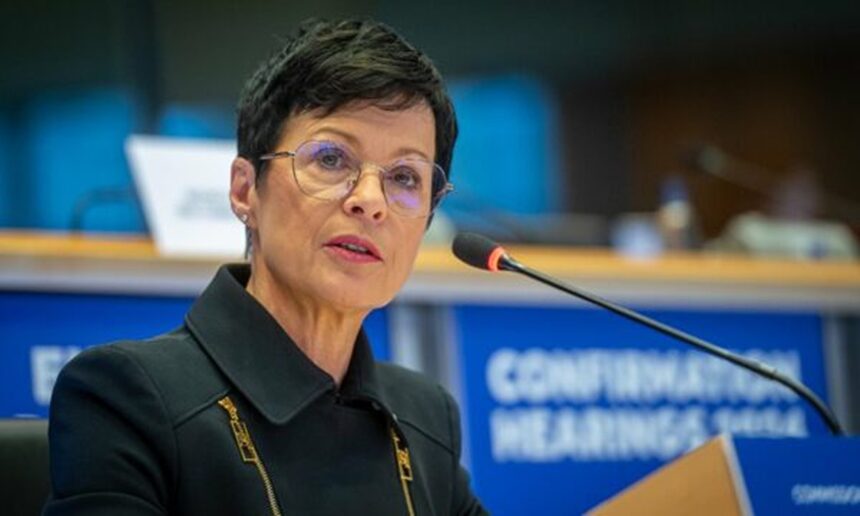
European Commissioner for Enlargement Marta Kos has said that, following the state-honored funeral of convicted war criminal Ratko Mladić in Belgrade, the European Union should seriously assess whether Serbia remains a genuine candidate for EU membership.
In an interview with Germany’s Frankfurter Allgemeine Zeitung (FAZ), Kos said Serbia had reached a turning point and that the EU needed to determine whether the country’s authorities and society remained genuinely committed to the European path.
“Serbia is now at a turning point. The accession process also requires coming to terms with the past and achieving genuine reconciliation. It is also about the rule of law and a country’s strategic orientation. We have to examine to what extent Serbia is still sincere about its European path,” Kos told FAZ.
She said she would first discuss the issue with European Commission President Ursula von der Leyen. According to Kos, the EU’s assessment of its readiness for future members is expected to be completed by the end of September and could then serve as a basis for discussions among EU member states in October.
Kos said she was prepared to do everything possible to keep Serbia on its European path, but stressed that the outcome also depends on Serbia itself.
“It is also in the hands of the Serbs — not only politicians, but also the population,” she said, referring in part to elections expected to take place in Serbia.
“How can someone convicted as a war criminal be celebrated?”
Explaining her decision to cancel a planned visit to Belgrade during Mladić’s funeral, Kos strongly criticized the way the former Bosnian Serb military commander was treated.
“How can someone who has been convicted as a war criminal be celebrated?” she told FAZ.
Kos said she could not travel to Belgrade at a time when, in her view, large numbers of people — not only politicians — were glorifying Mladić.
“I could never look the mothers of Srebrenica in the eye again,” she said.
She described confronting the past as one of the most difficult issues facing the Western Balkans, noting that 31 years have passed since the war in Bosnia and Herzegovina.
According to Kos, political elites have a responsibility to heal the wounds of the past rather than reopen them.
“It is not only about those who were killed. It is also about those who survived, who were raped and who lost family members,” she said.
Kos pointed to Germany as an example of a country that, in her view, learned important lessons after the Second World War. She also referred to an upcoming visit by Germany’s minister for Europe to Kragujevac, connected to crimes committed by German forces during the Second World War.
The European commissioner stressed that people responsible for causing immense suffering must not be glorified.
A gradual path toward EU membership
Kos also discussed the future of EU enlargement, saying geopolitical changes have forced the bloc to move away from an “all or nothing” approach, under which a country can benefit from integration only after fulfilling all membership conditions.
Instead, she said, the EU wants to pursue gradual integration of candidate countries into strategic sectors such as energy, transport and critical raw materials.
In this context, Kos pointed to Moldova and Ukraine, saying the EU is helping both countries become fully independent of Russian energy by the end of 2027.
She also commented on German Chancellor Friedrich Merz’s proposal for an associated membership model for Ukraine, arguing that the idea of gradual integration should be available to all candidate countries, particularly those that need more time to meet the requirements.
“It is quite clear that Ukraine will need more time than Montenegro,” Kos said, adding that the final decision will ultimately be made by EU member states.
EU must learn from internal blockages
Kos also warned that the EU must learn lessons from Hungary’s ability to block European consensus and develop safeguards that would ensure new members continue to respect the bloc’s rules and values over the long term.
She said a document examining the concrete impact of enlargement on the EU is also expected to be published at the end of September.
Kos warned that important elections expected across Europe next year could influence future enlargement decisions, particularly if eurosceptic parties gain further strength.
She concluded that a stronger Europe also means better protection of citizens’ interests and that enlargement should be seen not only as a process of bringing new countries into the EU, but also as an opportunity for the Union to reflect on and strengthen itself.