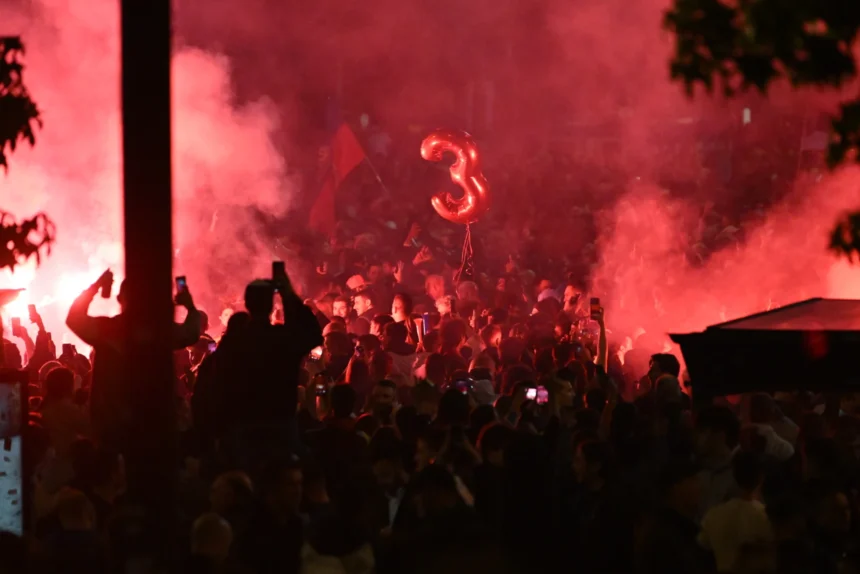
Serbia faces a complex political transition following a major electoral defeat for the ruling Serbian Progressive Party (SNS), with questions emerging over whether the change in power can proceed peacefully and institutionally or whether the outgoing political establishment will attempt to obstruct the new leadership.
In an analysis published by Radar on October 29, journalist Vera Didanović examines the challenges facing the student-backed electoral list, the prospects for rebuilding democratic institutions and the possibility that Aleksandar Vučić’s political movement could eventually return to power.
The immediate question is whether Serbia can restore the functioning of its institutions without resistance from outgoing officials and networks of influence, and whether the political shift will extend beyond the parliamentary level to the presidency and local governments.
Civic mobilization and the scale of the defeat
One of the first visible signs of change came at Belgrade’s Pionirski Park, a site that had become a symbol of the outgoing government’s political presence. The day after the election, citizens responding to a call from the environmental organization Eko Straža joined public utility workers in cleaning the park, which had been occupied by pro-government groups and widely referred to as “Ćacilend.”
The episode illustrated both the potential for civic engagement and the practical difficulties of restoring public institutions to their intended roles. According to the report, the municipal cleaning service initially declined to participate, citing a lack of responsibility, before eventually taking part following intervention by Stefan Simić, a political figure campaigning for mayor.
The circumstances surrounding the service’s eventual involvement remained unclear, raising questions about whether the decision reflected public-service obligations or an effort to accommodate a potential incoming administration.
According to figures cited in the article, voter turnout reached 68.85 percent, based on data from Serbia’s Republican Electoral Commission with approximately 97 percent of polling results processed at the time. The report noted that turnout had been higher only in the first multiparty elections in 1990 and the federal elections of September 2000.
The article also argued that the official voter register may not accurately reflect the number of eligible voters actually living in Serbia, meaning the effective turnout could be higher than the official figure.
The electoral result itself marked a major setback for the SNS. The student-backed list reportedly secured more than 2.2 million votes, or 53.4 percent, while the ruling party received slightly fewer than 1.7 million votes, equivalent to 39.6 percent.
The result represented a decline of 8.4 percentage points for the SNS compared with the 2023 elections, according to the figures cited by Radar.
The student-backed list’s support extended beyond major urban centers. It reportedly won in 26 of 29 cities and also made gains in rural areas that had traditionally been strongholds of the ruling party.
The report highlighted results in Kosjerić, Mionica and Sevojno, where the student-backed list defeated the SNS. European Western Balkans editor Aleksandar Ivković described these outcomes as examples of voters delivering what he called “small acts of revenge” following earlier controversies surrounding elections and alleged intimidation.
Will the SNS collapse or obstruct the transition?
The future of the ruling party remains uncertain. One interpretation suggests that the SNS could enter a period of rapid disintegration as officials and public-sector managers reassess their political loyalties.
The report cited several developments that could point in this direction, including the absence of some public-enterprise directors from work, changes in public broadcaster RTS coverage, an apology from broadcaster RTV and reports that some SNS members in Čačak had returned their party membership cards.
Another interpretation emphasizes Vučić’s public insistence that his political movement will continue its struggle and seek a return to power. Pro-government media have continued to highlight potential disagreements within the student-backed list, whose members have diverse ideological positions and no extensive experience governing together.
The formation of a new parliament may also take time. Electoral complaints could require repeat voting at certain polling stations, including in Kanjiža and Ljig. Once the final election report is submitted, the deadline for convening the parliament’s inaugural session is 30 days, followed by a 90-day period to form a government.
These procedural steps mean the transition will not happen immediately, leaving the outgoing administration and its officials in place during an important interim period.
Managing public expectations
Dušan Spasojević, a professor at the Faculty of Political Sciences in Belgrade, said the incoming leadership’s first challenge would be managing public expectations.
Many voters, he argued, may expect rapid improvements in living standards, the immediate prosecution of those accused of wrongdoing and public accountability for officials associated with the previous government. Such processes, however, are often slow, legally complex and uncertain in their outcomes.
Public impatience was already evident after the election. Despite calls from the student-backed list for restraint, attacks were reported at the offices of television stations Informer and Pink, two broadcasters frequently associated with pro-government coverage.
Spasojević stressed that the new leadership should prioritize restoring democracy, particularly media freedom, an independent prosecution service and university autonomy.
He also warned that the student-backed movement’s internal decision-making structures remain unclear and that its lack of governing experience could present significant challenges.
Issues that divide Serbian society, including relations with Russia and the status of Kosovo, could further complicate efforts to establish a stable governing coalition. Spasojević suggested that the new government should initially concentrate on institutional reform and avoid allowing contentious questions to dominate its early agenda.
The European Union’s role
Mateo Bonomi, head of the Europe program at the Italian Institute for International Affairs, argued that the European Union should support Serbia’s political transition without attempting to direct it.
In his analysis, the EU should focus on strengthening the judiciary, media pluralism, electoral integrity and the security sector, where informal networks of influence have long been a concern.
Bonomi also cautioned against imposing immediate geopolitical demands concerning Russia, China or Kosovo on the incoming government. Such pressure, he argued, could reinforce Vučić’s narrative that the student movement is acting in the interests of Western governments rather than Serbian society.
He suggested that the political transition could also challenge previous ideas of offering Serbia closer economic integration with the EU without a clear path toward full membership.
If Serbia succeeds in restoring the rule of law and democratic institutions, Bonomi argued, it would become increasingly difficult for the EU to offer anything short of a credible accession perspective.
Could Vučić return to power?
A return by the SNS remains possible, but Spasojević said it would depend on the new leadership making a series of serious mistakes and demonstrating an inability to govern effectively.
He cautioned against assuming that the SNS would necessarily return in its current form, describing it as a party built around the exercise of power rather than one with the organizational and ideological foundations of Hungary’s Fidesz or Montenegro’s Democratic Party of Socialists.
The report suggested that political competition could shift toward presidential and local elections, potentially reshaping Serbia’s political landscape beyond the parliamentary level.
A victory by the student-backed movement in a future presidential election could extend the change in power, while local elections—particularly in Belgrade—could become another major arena of political contestation.
Spasojević also anticipated a broader reorganization of political forces, as established opposition parties and new political actors seek closer ties with the student movement. The movement itself may eventually reveal which of its members intend to pursue formal political careers.
Changes in local administrations could also occur before new local elections, particularly in municipalities where the ruling party depends on coalition partners to maintain its majority.
A transition with uncertain outcomes
Serbia’s political transition presents both an opportunity for institutional reform and a series of practical challenges. The student-backed list must navigate internal differences, limited governing experience and high public expectations while dealing with institutions staffed by officials appointed under the outgoing administration.
At the same time, the SNS retains political, financial and media resources that could influence the transition and shape future electoral competition.
Whether the change produces lasting institutional reform will depend not only on the election result but also on how the new leadership handles the judiciary, media freedom, public administration and relations with the European Union.
The coming months will therefore be critical in determining whether Serbia’s political shift leads to a broader restructuring of its institutions or becomes another episode in a cycle of political confrontation.