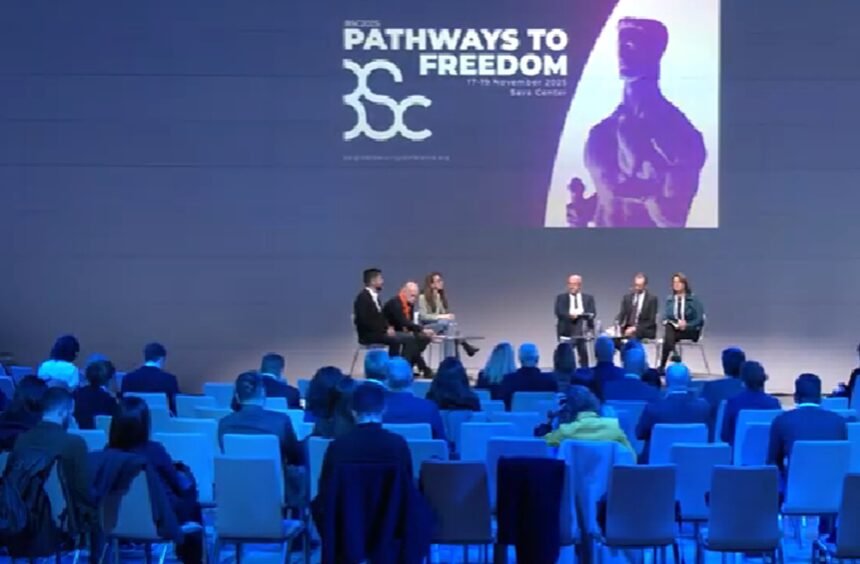
Hybrid attacks including airstrikes on critical infrastructure, cyberattacks, and social-media manipulation are undermining institutions, polarizing societies, and creating fertile ground for new escalations, officials from EU member states warned at the Security Conference held in Belgrade on Tuesday.
Belgrade, November 18 – Eastern and Southeastern Europe are facing mounting pressure from Russia’s hybrid warfare, participants at the conference said.
Representatives from several European countries emphasized that Russian hybrid aggression is reshaping how states in the region perceive security and democratic resilience. According to EU politicians, drone and missile attacks, sophisticated disinformation campaigns, and election interference have pushed the region into a tense climate where “the situation feels on the verge of war.”
They warned that these threats do not occur in isolation. Instead, they intersect with internal vulnerabilities and political divisions within European countries, increasing the risk to the continent’s stability. Hybrid operations are increasingly seen as tools to destabilize governments, undermine Euro-Atlantic integration, and fuel authoritarian tendencies.
The conference underscored the urgent need for the West—EU, NATO, and transatlantic partners—to develop a unified strategy against these threats.
Germany: Europe Still Has No Mechanism to Fight Russia’s Hybrid Aggression
Thomas Röwekamp, a member of the German Bundestag and Chairman of the Defense Committee, warned that Europe has yet to establish a coordinated mechanism to confront Russian hybrid attacks.
“The main problem is the lack of unity against such threats. We are victims of Russia’s daily attacks—in many forms: drones, ports, data infrastructure. We are not at war, but we are somewhere between war and peace. We need a joint vision to face Russia’s threat,” he said.
Röwekamp added that Germany still must make major national decisions and that current capacities are insufficient to counter hybrid aggression.
“We need more European and NATO-based solutions, and we must pool our capacities in order to respond,” he stressed.
France: Hybrid Threats Require Hybrid Defense
Frédéric Petit, a member of the French National Assembly, cautioned that Russia uses propaganda-driven justifications to interfere in the region, while European states must focus on strengthening democratic defense.
“We are facing hybrid warfare, so we need hybrid defense. What young people in Serbia are doing today is a form of defense—they are resisting with different tools, and it should be an example to all,” Petit said.
He emphasized that the coordinated Western support given to Ukraine must also apply to non-military hybrid threats.
Moldova: Hybrid Attacks Hit Citizens Directly
Mihaela Siritanu, a public policy expert from Moldova, described Russia’s interventions as multi-layered and simultaneous.
“Every time we move closer to the EU, problems appear that affect people’s daily lives—power cuts, economic crises—to increase public frustration. That is Russia’s influence,” she noted.
Siritanu warned of increasing online manipulation and covert vote-buying operations.
“Moldova has joined sanctions against Russia, yet they still spend millions of euros to influence elections and buy activists,” she added.
Bulgaria: Russian Influence Reaches Deep Into EU Member States
Former Bulgarian Prime Minister Kiril Petkov provided a concrete example of Russia’s reach within an EU member state.
“Corrupt politicians pretending to be pro-European, interference in the judiciary, security services, and even the church—all fueled by Russia,” Petkov said.
He recalled that during his term, multiple Russian agents were arrested and expelled, yet local oligarchs linked to Moscow continue to control media outlets and political parties.
Italy: First High-Level Meeting on Hybrid Threats
Enrico Borghi, President of the Institute of European Democrats, highlighted that for the first time, Italy’s High Council of Defense convened specifically to discuss hybrid threats.
“Despite a politically divided landscape, the Italian Senate recently reached consensus on addressing hybrid warfare, supported by both majority and opposition forces,” Borghi said.
He stressed that advancing technological capabilities is essential in responding to these evolving threats.