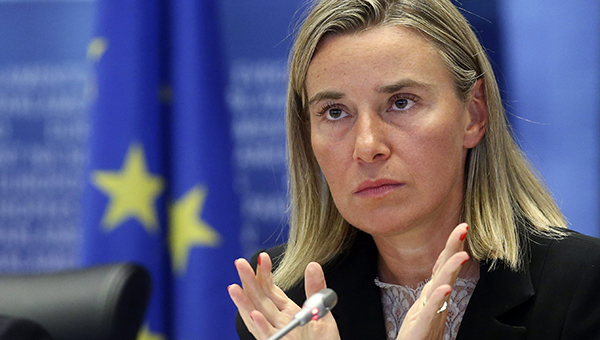
For years she had left behind the frontline battles of EU politics for what seemed like the calmer academic life in the “towers of Bruges.” Now, Federica Mogherini is back in the headlines — and not for good reasons.
During the past five years, the former EU High Representative had crafted an image as “the quiet rector of the College of Europe”, overseeing aspiring diplomats with the poise of a well-connected director whose contact book was as thick as any academic volume.
But as first reported by Euractiv, Belgian police carried out searches on Tuesday in Bruges and at Mogherini’s private residence as part of a criminal investigation into alleged misuse of EU funds related to the EU Diplomatic Academy — the institution she has led since its creation in 2022.
Mogherini, 52, was detained and questioned, along with senior European Commission official Stefano Sannino and a staff member of the College of Europe, over suspected procurement fraud, corruption, and conflict of interest.
Police searched college buildings, the EEAS, and several private homes, marking a dramatic departure from the carefully managed public image Mogherini has upheld since stepping away from frontline politics.
A Sudden Fall After a Carefully Curated Persona
Since 2020, Mogherini had expanded the College by opening a new campus in Tirana, Albania, alongside its existing Bruges and Natolin (Poland) campuses.
She led the institution through the pandemic and took disciplinary action against a senior male professor dismissed for sexually harassing a female student.
Mogherini built a reputation as a visible and approachable leader, often spotted speaking with students or joining them in the dining hall — a sharp contrast to her more reserved academic predecessors.
A Career Built on Timing — and Criticism
Her political ascent began in the Italian left, rising from youth ranks to Member of Parliament and then Italy’s Foreign Minister in 2014.
After only eight months, she made a sudden leap to Brussels, assuming one of the EU’s four top positions as High Representative for Foreign Affairs under Commission President Jean-Claude Juncker.
Her tenure, however, drew mixed reviews.
While her allies once branded her as “young, Italian, competent,” critics later accused her of having “disappointed expectations” and having minimal geopolitical influence.
She struggled to shape EU policy on Russia and Ukraine, was sidelined in discussions on Syria and the wider Middle East, and faced skepticism from Eastern EU states that saw her as too soft on Moscow.
A Controversial Move Into Academia
In 2020, despite not holding a master’s degree and lacking academic experience, she was appointed Rector of the College of Europe, an elite institution training future EU officials.
The decision was controversial — raising questions about transparency, qualifications, and influence.
Students and staff described her as a charismatic political figure rather than a traditional academic, someone who brought star power to the college.
Mounting Problems and the Qatargate Shadow
Her name re-emerged during the Qatargate corruption scandal, as she sat on the honorary board of the NGO Fight Impunity, founded by the scandal’s key suspect, former MEP Pier Antonio Panzeri.
While Mogherini denied any knowledge of wrongdoing, the association added to the scrutiny surrounding her.
She pushed the college into new partnerships and global engagements, and had even explored opening a new campus in Morocco before ultimately choosing Albania.
The “Crown Jewel” That Triggered Her Collapse
Her reputation collapsed on Tuesday with her arrest over the alleged fraudulent creation of the EU Diplomatic Academy, a prestigious project meant to be a cornerstone of her leadership.
What was once a symbol of European elite formation has suddenly become the backdrop of a political thriller, Euractiv notes.
Following nearly a full day of silence, the College — founded in 1949 — finally issued a short statement acknowledging the EPPO searches in Bruges, making no mention of Mogherini’s arrest, and leaving students confused.
“The College takes all necessary measures to ensure continuity of its activities,” the statement read.
The message was unmistakable: with or without Mogherini, the College must move on.