Hungary announced on Wednesday that it will launch legal action against the European Union’s provisional agreement to gradually phase out imports of Russian natural gas, a key step in reducing the bloc’s dependency on Russian energy.
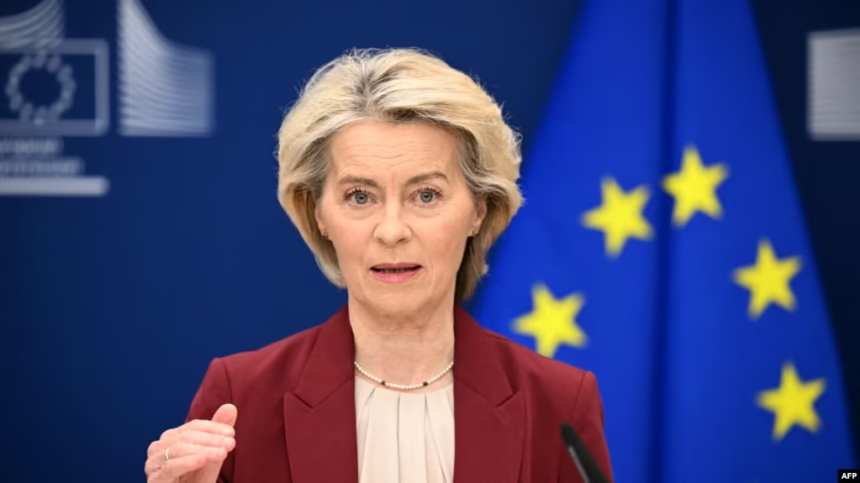
European Commission President Ursula von der Leyen stated that the EU is entering “a new era” with the decision to end reliance on Russian fossil fuels. The measure adopted on Wednesday includes a ban on importing liquefied natural gas (LNG) by the end of 2026, while pipeline gas imports will be phased out by autumn 2027.
“This is the beginning of a new era: an era of complete energy independence for Europe from Russia,” von der Leyen said.
She highlighted that the EU has already drastically reduced Russian fossil fuel imports, cutting Moscow’s revenues used to finance its war against Ukraine.
At the start of the war, Europe was paying Russia €12 billion per month for fossil fuels; this figure has now dropped to €1.5 billion per month.
“It is still too much. Our goal is to bring it to zero,” she added.
The new regulation is legally binding, prompting Hungary—highly dependent on Russian gas and lacking access to the sea—to announce that it will challenge the decision before the EU Court of Justice.
Hungarian Foreign Minister Péter Szijjártó called the measure unacceptable:
“Accepting and implementing this Brussels directive is impossible for Hungary,” he said, adding that Budapest will file a legal challenge as soon as the REPowerEU plan is formally adopted.
Szijjártó argued that the decision violates the EU’s founding treaties and described it as a sanction against Russia rather than a trade measure.
Prime Minister Viktor Orbán, who has repeatedly criticized the EU’s stance toward Russia, said that Russian energy remains “vital” for Hungary.
Slovakia, another country heavily dependent on Russian supplies, also expressed concern and is considering how to respond to the new measures.
The EU’s REPowerEU strategy, launched after Russia’s full-scale invasion of Ukraine in February 2022, aims to eliminate the bloc’s reliance on Russian energy and prevent Moscow from using gas as a geopolitical weapon.
The United States has also increased pressure on Russian energy exports. In October, the U.S. Treasury imposed sanctions on Rosneft and Lukoil, while the EU followed with sanctions targeting Rosneft and Gazpromneft.
President Donald Trump, however, granted Hungary an exemption from U.S. sanctions on Russian energy purchases, according to Orbán.
European Commissioner for Energy Dan Jørgensen declared:
“We did it: Europe is permanently closing the tap on Russian gas. We have chosen energy security and independence for Europe. No more blackmail. No more manipulation. We stand firmly with Ukraine.”
The Kremlin responded by warning that the EU’s decision will accelerate the decline of Europe’s economic potential and reduce its competitiveness, adding that European consumers will now rely on gas that is more expensive than Russian supplies.
The provisional agreement must still be approved by the European Parliament and the EU member states before it becomes final.