The Independent Journalists’ Association of Serbia (NUNS) has published its 2025 annual retrospective, warning that pressure on journalists in Serbia has evolved into a systemic problem, marked by a sharp rise in threats, attacks, and institutional failures.
Sharp Increase in Attacks and Threats
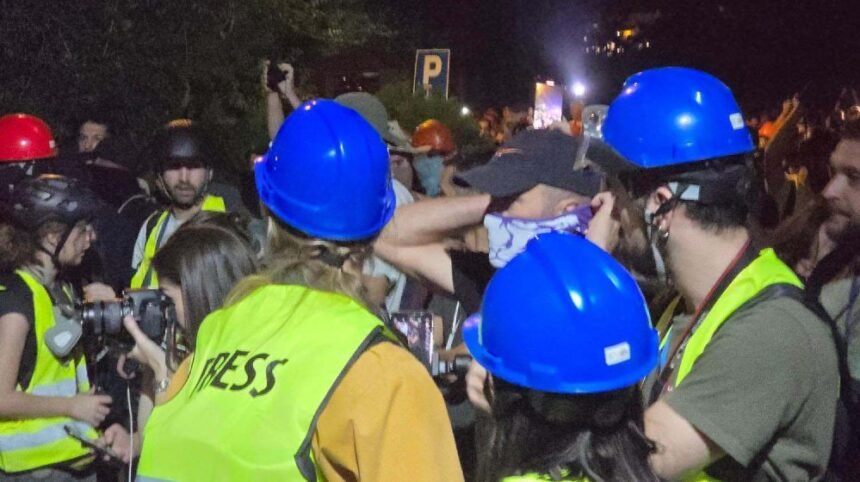
According to NUNS, 371 cases of threats to journalists’ safety were recorded in 2025, more than double the 168 cases reported in 2024. These included:
- 113 physical attacks
- 165 threats, both online and offline
International monitoring platforms reflect the same alarming trend. The Mapping Media Freedom initiative registered 203 incidents, placing Serbia at the top of Europe in terms of risk level for journalists.
NUNS further noted that cases from Serbia account for 15.9% of all alerts submitted to the Council of Europe Platform, covering 46 member states.
“These figures are not mere statistics – they represent a map of a society in which critical journalism is increasingly treated as a hostile act,” NUNS stated.
Political Rhetoric Fuels Hostility
The association warned that the climate is further inflamed by verbal attacks and delegitimisation campaigns originating from the highest levels of power.
Monitoring by the Slavko Ćuruvija Foundation shows that since August 2025, the number of aggressive public statements targeting journalists and media outlets has never dropped below 137 per month.
Journalists have been publicly labeled “traitors,” “foreign mercenaries,” and even “terrorists,” a narrative that criminalises journalism and normalises violence against media workers.
NUNS highlighted that in 2025, such rhetoric was especially prominent among public officials and office-holders, including Nebojša Bakarec, Boris Bratina, Aleksandar Vučić, Ana Brnabić, and Vladimir Đukanović.
Police Increasingly Seen as a Source of Risk
One of the most troubling developments in 2025, according to NUNS, is that the police have increasingly shifted from protectors to sources of risk for journalists.
Prosecutorial data shows:
- In 2024, there were 64 cases of threats to journalists, with police failing to act on prosecutors’ orders in 34 cases
- In 2025 (up to November), prosecutors recorded 117 cases, with police failing to act in 50 cases — the highest number since records began in 2016
Additionally, between March and December 2025, NUNS documented 77 cases in which police either passively observed attacks on journalists or actively used force against clearly identified media workers.
“This represents a dangerous shift in paradigm – from inaction to direct action to the detriment of journalists,” the statement warned.
Economic and Legal Pressure on Journalists
NUNS emphasized that pressure on journalists is not limited to physical and verbal attacks, but also includes labor, legal, and existential pressure.
The media sector remains characterised by:
- Precarious employment
- Limited labour rights
- High vulnerability of freelance and non-permanently employed journalists
During 2025, at least 20 cases were reported involving dismissals or disciplinary measures against journalists who refused to participate in political manipulation of editorial policies, particularly in media outlets owned by Telekom Serbia and public broadcasters.
International Assessments Mirror Domestic Reality
NUNS stressed that Serbia’s international rankings fully reflect the domestic situation:
- Reporters Without Borders (RSF) ranked Serbia 96th out of 180 on the 2025 World Press Freedom Index
- Freedom House classified Serbia as “Partly Free” with a score of 56/100
- For the first time since measurements began, Serbia was also rated “Partly Free” in internet freedom, scoring 67/100
Notably, the European Union, in its 2025 annual progress report, recorded backsliding in freedom of expression for the first time.
“This is a clear signal that the crisis can no longer be dismissed as an internal issue or a temporary political fluctuation,” NUNS concluded.