It is a question President Donald Trump has been privately asking his national security team for months: Why isn’t the Iranian people overthrowing their leaders?
It was an outcome Trump appeared relatively confident would happen at the beginning of the war, after Israeli Prime Minister Benjamin Netanyahu convinced him that street protests would erupt in Tehran following an intense wave of strikes.
Other U.S. officials were less convinced. After reviewing intelligence assessments indicating that such an uprising was unlikely, the issue became the subject of intense debate before the first strikes were launched, according to people familiar with the matter.
Nevertheless, Trump began the conflict in late February by calling on the Iranian people to take control of their government.
“This may be your only chance for generations,” he told Iranians in a video released on the night the war began.
The idea quickly faded as a more urgent priority took over: negotiating with the Iranian regime to reopen the Strait of Hormuz.
By June, Trump insisted that he had “never been interested in regime change” in Iran, claiming he was negotiating with “very rational people” and arguing that U.S. attempts to overthrow foreign governments “never work.”
Despite those comments, Trump continued to question why his calls for the Iranian government to be overthrown were not being heeded, according to people familiar with the matter.
Now, with traffic through the Strait of Hormuz still below pre-war levels and diplomacy with Iran at a standstill, Trump has returned to the very concept with which he began the war six months ago.
“When will the Iranian people rise up and fight?” he asked on social media Tuesday.
A Familiar Pattern in an Ongoing War
The renewed shift toward regime-change rhetoric marks another familiar turn in a war that has repeatedly fallen back into the same cycle of escalation.
A month-long period of relative calm was broken this week after the United States and Iran exchanged strikes for three consecutive days, returning to the pattern of escalation that had persisted for weeks earlier this summer.
Trump, who has repeatedly threatened to destroy Iranian civilian infrastructure, said Wednesday that he was prepared to order an even more destructive round of attacks if necessary.
“It was a very violent attack last night, and we are ready to launch another attack whenever we want,” Trump said, adding that he did not believe the renewed fighting would last long.
According to officials, there are currently no serious efforts underway to restart diplomacy after Trump ordered his envoys to halt talks with Iran last month.
Instead, Trump has said he is satisfied with the current state of the conflict and does not appear eager to reach a permanent end to the fighting.
“I like our position now much better, with almost total control of the Strait of Hormuz and their economy totally collapsing,” he wrote on social media this week.
Many of Trump’s allies would prefer to see the conflict fade from the political spotlight over the next two months as voters begin casting ballots that will determine the balance of power on Capitol Hill.
Although Trump has downplayed the impact of the midterm elections on his Iran decisions, senior advisers and Republican lawmakers have warned that a renewed conflict could create problems on Election Day.
“I don’t know how much they can take,” Trump said Wednesday of Iran. “But, you know, whatever it is, it doesn’t matter. I’m not affected by elections.”
A Strategic Shift — With Pressure Designed to Fuel Domestic Anger
The desire for a less visible conflict has coincided with a shift in the administration’s strategy toward squeezing Tehran’s financial resources, including threats of sanctions against some of Iran’s largest trading partners.
The U.S. Treasury Department has not yet imposed the harshest sanctions it has threatened.
But part of the Trump team’s calculation in cutting off Iran’s financial lifeline—and worsening economic conditions inside the country—has been to fuel anger among Iranians who have become increasingly frustrated with their leaders.
Economic pressure is already being felt in Iran. Inflation has risen, food prices are increasing every week and the Iranian rial has fallen sharply in value.
Iranian officials privately acknowledge that ordinary Iranians will bear much of the burden of new sanctions.
“We apologize for these problems, as we find ourselves in a comprehensive economic, military and security war,” Iranian President Masoud Pezeshkian said, according to Iranian state media, shortly before the U.S. Treasury announced new measures last week.
Still, some U.S. officials say there is little intelligence indicating that Iranian protesters are likely to return to the streets in an effort to overthrow the leadership, even as the country’s economic situation deteriorates.
U.S. intelligence assessments conducted before the war concluded that a joint U.S.-Israeli operation was unlikely to lead to regime change. Months into the conflict, officials say the Iranian government has not lost its grip on power.
Decades of punishing Western sanctions have also done little to weaken the regime, despite the hopes of successive U.S. administrations.
Instead, protests have repeatedly been met with violent crackdowns, including earlier this year when the Iranian government carried out one of the most severe repression campaigns in the history of the Islamic Republic.
Analysts say Iran’s leadership is well aware of Trump’s strategy of tightening economic pressure.
“The Iranian leadership does not look at this kind of economic pressure campaign in isolation, but as part of a broader U.S. campaign that will at some point include an element of domestic unrest and ultimately lead either to regime change or improved relations between Iran and the United States,” said Hamidreza Azizi, a senior Iran analyst at the International Crisis Group.
Trump was evasive this week when asked whether the United States, potentially through the CIA, would arm Iranian opposition groups seeking to overthrow the regime.
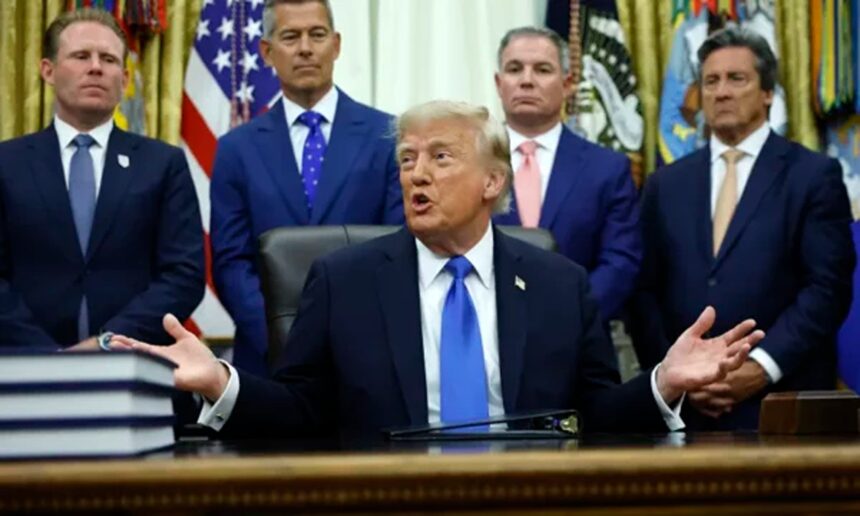
“I’d like to tell you that, but it’s not appropriate to say that right now,” Trump said in the Oval Office on Wednesday.
Even after questioning why Iranians had not risen up, Trump acknowledged that he understood the answer.
“I understand their plight. They are being shot at right now,” he said.