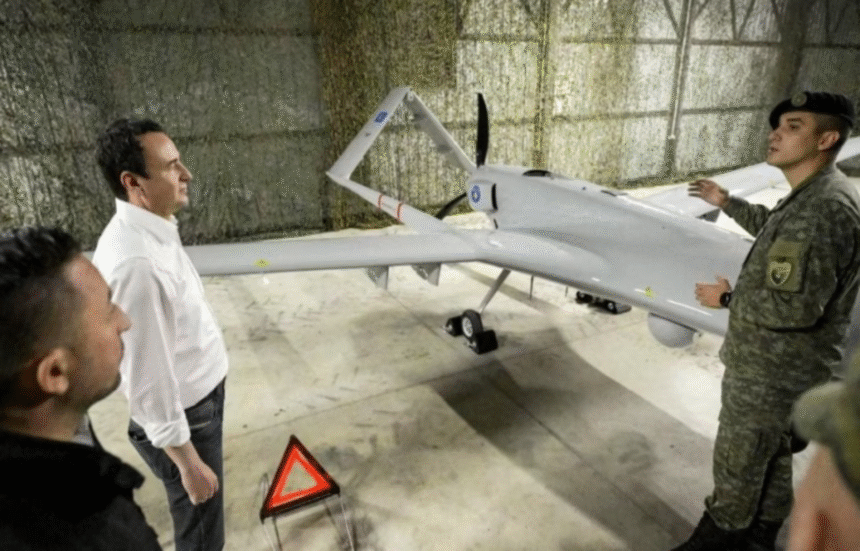
In a region where security is fragile, every arms purchase carries more than technical capability — it also sends political messages. That was the case with Kosovo’s recent acquisition of thousands of Turkish drones, which provoked a furious reaction in Serbia.
President Aleksandar Vučić said he was “horrified by the behavior of the Turkish state” and accused it of “dreaming of reviving the Ottoman Empire.”
Despite attempts, Radio Free Europe was unable to obtain a response from Ankara. For defense experts, however, the anger is linked to the direct battlefield effect of the drones.
“Essentially, they raise the cost of any military operation against Kosovo. From field experience, we see that drones have the ability to inflict [on enemy forces] very large expenses,” Çağlar Kürç, a defense industry expert at Abdullah Gül University in Ankara, told Radio Free Europe’s Expose program.
Kosovo presented the purchase as a step to strengthen its defensive capabilities, while NATO warned that any aerial activity must be coordinated with its mission in Kosovo, KFOR.
KFOR monitors the country’s low airspace, which authorities in Kosovo say has recently been violated by drones suspected to be from Serbia.
The two countries have been escalating rhetoric day by day, exchanging accusations of provocations and breaches of regional security.
Kosovo President Vjosa Osmani criticized Vučić’s reaction to Turkey and his rapprochement with Russia, China, and Iran, stressing that Kosovo will continue to strengthen its defensive capabilities.
“We will continue to deepen ties with NATO allies, modernizing our defense capabilities according to NATO standards, ensuring peace and stability for our people and actively contributing to collective security,” Osmani wrote on X.
Kosovo’s defensive capabilities remain mostly undisclosed because much information is classified. Still, public reports this month indicate Kosovo bought thousands of Skydagger kamikaze drones from Turkey, and two years earlier it received a fleet of Bayraktar drones from the same country — systems noted for their role in several of the decade’s major conflicts.
Kürç explains that these Turkish drones are capable of a range of missions: destroying air-defense systems, striking behind enemy lines, targeting logistics chains, and gathering intelligence.
“The Bayraktar TB2, for example, is cheaper compared to American drones. It provides unobstructed surveillance, is easy to deploy, and has a direct battlefield impact during conventional warfare,” he said.
Sitki Egeli, a military-studies analyst and professor at İzmir University, says drones give Kosovo a new defensive dimension and serve as a deterrent against potential threats.
He emphasizes that these systems have revolutionized surveillance, targeting, and strike execution, and their impact is already irreversible — much as artillery once changed warfare.
“When people realize how drones change the rules of the game, everyone will adopt them. If not now, then in three, five, or ten years. It’s only a matter of time before drones become an integral part of all militaries. I remember when 40 or 50 countries had drone capabilities, but after Russia’s invasion of Ukraine, their number has increased — it may have doubled or tripled,” Egeli said.
According to United Nations-cited reports quoted by the BBC and The New York Times, 118 states now possess military drones — along with 65 non-state actors.
The use of expendable remote-controlled explosive craft is not new: during World War II, the Germans used radio-guided explosive boats to attack fleets off Normandy.
In subsequent decades, drones served mainly for reconnaissance, until after the September 11 attacks when they were armed and became essential battlefield tools.
John Arquilla, a defense professor at the U.S. Naval Postgraduate School, agrees that drones have fundamentally changed how wars are fought. He cites the U.S. campaign in Afghanistan and the conflict in Ukraine, where Turkish drones have had a visible battlefield impact.
“A drone functions as a force multiplier. Ukrainians, for example, are far fewer in number than Russian forces, but drones help them even the battlefield and — especially when in defensive tactical positions — prevent many Russian attacks. So for small countries, enhancing defense with drones is probably a very, very good idea,” Arquilla told Radio Free Europe’s Expose.
Kosovo has a security force of just over 4,000 personnel, currently in the process of transitioning into an army. Last year Kosovo allocated $162 million for defense, compared with $2.2 billion for Serbia. In the region, only Montenegro spent less than Kosovo, with $143 million, according to the Stockholm International Peace Research Institute.
Beyond Ukraine, Egeli notes that Turkish drones have played decisive roles in conflicts in Libya and Syria, as well as in the Azerbaijan‑Armenia fighting over Nagorno‑Karabakh.
“But the world fully understood and appreciated the significance of this change only during the Russia‑Ukraine war. In my opinion, this happened because the scale of that conflict was much greater, and international public interest was more focused on it than previous conflicts,” Egeli said.
Not everything is without controversy. Drones make the use of force cheaper, and when personnel are not put at risk, the threshold to strike becomes lower — increasing the risk of escalation, Arquilla says.
“I think it was extremely provocative when Ukraine struck Russian bomber aircraft hundreds of miles from the front line. If drones begin being used like that for strikes in depth, the risk of further escalation is considerable,” he assessed.
For example, Arquilla points out that the administration of former U.S. President Barack Obama used drone strikes roughly five times more often than the administration of his predecessor, George W. Bush. He adds that many of these systems are relatively easy to operate and do not require long pilot training.
“I think one of the most attractive aspects of drones is their ease of use. You don’t have to be an airplane pilot to operate them. In the U.S., we’ve seen that some of the best drone pilots are young people who like video games. Their reflexes are fast, and that creates a large pool of potential operators. That’s also one reason drones are expected to spread more and more,” Arquilla says.
He nonetheless does not expect drones to fully replace traditional airpower. He foresees a future combining human pilots, remotely piloted aircraft, and fully autonomous drones.
Relying solely on drones, he warns, would be dangerous because they can be vulnerable to electronic interference or other countermeasures.
Last month, Kosovo also received some U.S.-made drones with a range of up to 60 kilometers. Its inventory mainly includes weapons from the U.S., Turkey, and Germany.
Defense Ministry officials earlier told Radio Free Europe that “all arms purchased by Kosovo in the last four years meet NATO standards” — the alliance Kosovo aspires to join.
They also announced plans to continue procuring arms from the U.S., in cooperation with Albania and Croatia.
Vučić reacted angrily at the time — calling it an arms race and vowing that his country would defend itself against any possible aggression.
This whole situation also reflects broader regional developments, where NATO and the European Union are building a “drone wall” to protect member states from aerial incursions.
As Professor Arquilla notes, drones are becoming a permanent part of modern warfare.
The example of Ukraine, he says, has inspired countries like Taiwan to build drone forces as a means to detect and deter any potential invading fleet. /REL