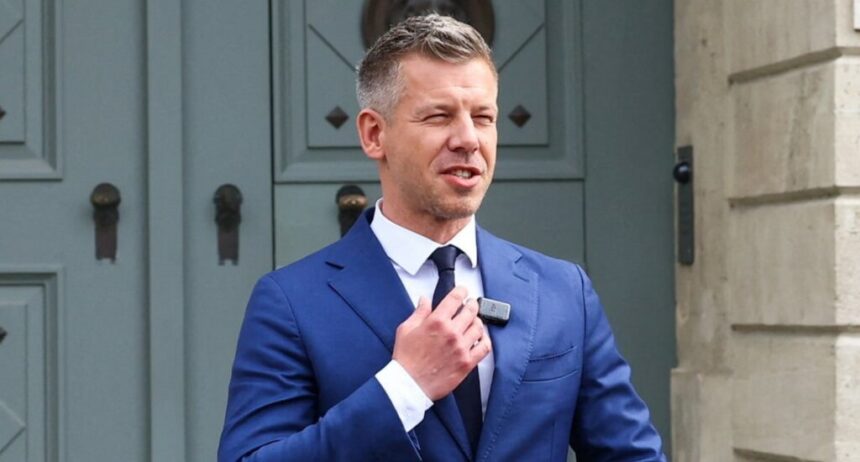
Budapest, April 15, 2026 – Hungary’s prime minister-elect Péter Magyar has announced plans to suspend the news services of state media, describing them as a “propaganda machine” that will be reformed once his government takes office in mid-May.
Magyar, who won Sunday’s election in a decisive victory ending 16 years of rule by Viktor Orbán, outlined his intentions in two interviews with public radio and television on Wednesday. The appearances marked his first engagement with state broadcasters in 18 months, contrasting sharply with Orbán’s frequent use of public media during his tenure.
During the interviews, Magyar accused state-run outlets of spreading fear and misinformation, drawing comparisons to propaganda systems in authoritarian regimes. He said Hungary’s public media had deviated from its role as an independent broadcaster and instead functioned as an extension of government messaging.
“Every Hungarian deserves public media that tells the truth,” Magyar said, adding that his government would introduce new press legislation and establish a new media authority aimed at restoring public broadcasting standards.
He further claimed that he had been largely excluded from state media coverage during the election campaign, a claim rejected by public media authorities, who said multiple invitations had been extended to him and his party.
Magyar also reiterated criticism of Hungary’s media landscape, which international watchdogs such as Reporters Without Borders have repeatedly described as heavily concentrated, with around 80% of outlets linked to allies of Orbán’s Fidesz party.
Following the interviews, Magyar wrote on social media that Hungary had “just witnessed the final days of a propaganda machine,” adding that state media would be suspended until it could be restructured into a genuinely public service broadcaster.
The incoming prime minister also renewed calls for the resignation of President Tamás Sulyok, arguing that he no longer represents national unity or guarantees constitutional oversight. Sulyok has reportedly agreed to review Magyar’s concerns.
The political transition marks a significant shift in Hungary’s governance model, which critics have long described as a “illiberal democracy” characterized by strong executive influence over institutions, the judiciary, and media.
International reactions to the election were cautious. U.S. President Donald Trump described Magyar as someone who would “do a good job,” while maintaining a more reserved tone compared to his previously strong support for Orbán.
Trump and his political circle have previously viewed Orbán as a key ideological ally, particularly regarding state authority and nationalist governance. Despite Orbán’s defeat, U.S. officials indicated they would work with the new Hungarian government.