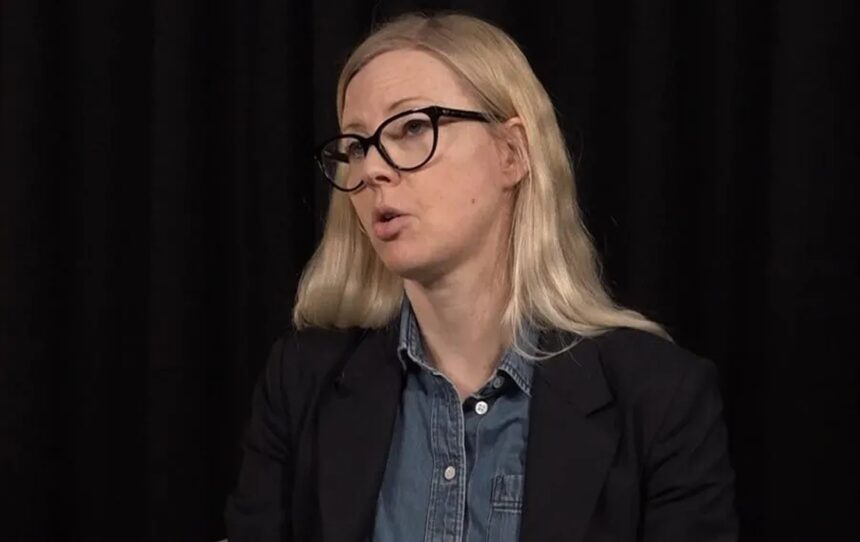
Finnish journalist Jessikka Aro assesses that Russian information warfare poses a real threat to global security, including Kosovo.
For more than ten years, she has faced continuous threats, including death threats, as a result of her work exposing Russian propaganda networks. The situation became so severe that she was forced to temporarily leave Finland during 2017–2018 in order to find safety and peace.
Despite the pressure, Aro managed to write three books, including Putin’s Trolls.
She warns that Russian propaganda and disinformation have become part of the mainstream flow of information in some countries, including Serbia, affecting the wider Kosovo region as well.
According to her, Russia aims to increase internal tensions and influence domestic politics in regional countries through networks linked to it.
“The threats came from all my technical devices, day and night…” Aro told KosovaPress.
The situation became so serious that she was forced to temporarily leave Finland during 2017–2018 to ensure her physical safety.
One of her most difficult experiences, she says, was facing in court in Helsinki the individuals who had harassed her.
She warns that these methods include coordinated attacks on social media, hate speech, intimidation, and attempts to silence critical voices.
“I have received several warnings and direct threats of physical danger. I have received death threats, both indirect and direct, from the very beginning. For more than ten years I have experienced continuous threats…” she recounts.
Despite constant pressure, she continued her work, documenting how disinformation networks and “troll factories” operate—a term used for fake online accounts that deliberately spread disinformation, provoke, and attack individuals in an organized manner.
In the interview, Aro emphasizes that Russian propaganda is no longer limited within a single country, but operates in a coordinated international way.
“Russian disinformation and propaganda, as well as information warfare messaging, are widespread and even part of mainstream media in some parts of Serbia. In Serbia, this Russian influence is very strong and is extending into the Kosovo region as well. Many of the disinformation messages sent by Russian security services and the ‘troll factories’ they control are international. Thus, many false narratives about Ukraine and Russia’s war against Ukraine are the same here as in other parts of Europe. For example, Russia tries to claim it wants peace in Ukraine, while Russian ‘trolls’ attempt to say that Russia is not waging any war in Ukraine. Such materials are entirely international, and Russia tries to push these narratives into mainstream media both here and across Europe,” Aro says.
“These messages are not local—they are global and organized by Russian security services and ‘troll factories’,” she adds, highlighting how deeply Russian propaganda has penetrated Serbia.
“Serbian propaganda often aligns with Russian propaganda and uses the same methods… Definitely, yes [it can be harmful to Kosovo]. For the Kremlin, propaganda is part of warfare, and the information space is seen as a battlefield. Therefore, it is very dangerous, especially in Serbia. I have investigated the situation there, and it seemed, for example, that the Russian embassy had a very strong influence within the country and was also influencing domestic politics and business. Also, some pro-Kremlin Serbian activists, who have been in direct contact, for example, with Sergey Lavrov, are very active and include individuals with violent pasts who have participated in political operations in the region. So it appeared to me that Russia is fueling internal tensions and strongly influencing domestic politics in Serbia,” she says.
The Finnish journalist believes that since 2022, Russian propaganda has become even more aggressive, shifting from fake profiles to direct messaging from Russian leadership.
According to her, the goal is clear—to radicalize different groups and influence political developments in various countries, including those in the region.
“Russian information warfare constitutes a serious security threat. For example, by radicalizing real people, inciting violence, taking the form of hate speech and misogyny, and encouraging different types of violence. It can also be used as a political weapon, for example by building support for marginal or extremist political organizations so they grow rapidly, as well as recruiting individuals to even participate in war on the Russian side, as we have seen in Finland,” she adds.
Aro suggests several concrete measures, such as blocking platforms used for propaganda and banning media outlets that serve as tools of information warfare.
However, she emphasizes that the strongest defense remains public awareness.
“Informing citizens about how propaganda works and why it is dangerous is the best protection we have,” the Finnish journalist concludes.
She also points to Ukraine as an example, noting that since 2014 it has blocked social media platforms like VK (VKontakte), which are widely used in Russian information warfare.
“They blocked it, and I think that is a very good idea, because Russians use VKontakte to fuel information warfare even in Western countries. Another good idea is banning Russian information warfare channels like RT, formerly known as Russia Today, as has been done in the Baltic states and Ukraine. However, a very effective countermeasure is increasing public awareness and informing audiences about Russian propaganda messages and why they are dangerous,” she concludes.