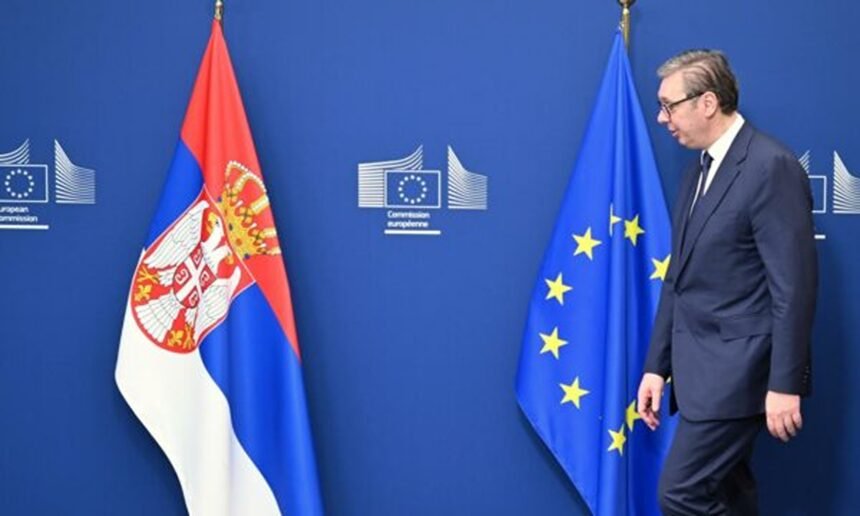
A newly released comprehensive survey examining public perceptions across the Western Balkans has highlighted a striking geopolitical divide, revealing that Serbia stands as a stark anomaly in the region regarding its distrust of the European Union and the United States.
The data, compiled and published on Wednesday, June 24, 2026, by the EU-funded project “WeBalkans,” was gathered through extensive face-to-face interviews with over 6,000 citizens across six regional territories between February and April 2026. While support for EU integration remains overwhelmingly high among its neighbors, the Serbian public is looking directly toward Moscow and Beijing for global alignment.
The EU Perception Gap: Serbia vs. The Western Balkans
The data shows that while more than 60% of citizens in almost all Western Balkan countries view the EU positively, sentiment in Serbia has completely soured.
Only 28% of Serbian citizens hold a positive view of the EU, compared to a staggering 82% in Albania and over 60% in Kosovo, Montenegro, and North Macedonia. Even in Bosnia and Herzegovina, where complex internal politics often stall integration, 53% of the population views the bloc favorably.
Public Image of the European Union (2026 Survey Data):
========================================================================
Country                 Positive Image (%)    Neutral (%)    Negative (%)
========================================================================
Albania                 ||||||||||||||||| 82%   [  N/A  ]      [  N/A  ]
Kosovo                  ||||||||||||| 60%+      [  N/A  ]      [  N/A  ]
Montenegro              ||||||||||||| 60%+      [  N/A  ]      [  N/A  ]
North Macedonia         ||||||||||||| 60%+      [  N/A  ]      [  N/A  ]
Bosnia & Herzegovina    ||||||||||| 53%         [  N/A  ]      [  N/A  ]
Serbia                  ||||| 28%               38%            32%
========================================================================
This negative sentiment translates directly into a lack of institutional trust and an active opposition to accession. When asked about potential EU membership, 40% of Serbian respondents stated they either somewhat or strongly oppose joining the EU, compared to just 31% who support the path to integration. Another 27% remain entirely indifferent.
Institutional Trust: The Transatlantic vs. Eurasian Divide
The survey exposed deep structural fault lines across the region when breaking down public trust in global superpowers, dividing the Western Balkans into clear pro-Western and pro-Eurasian camps.
The Pro-Western Group (Albania & Kosovo)
Trust in the United States and the EU is exceptionally high in Albania (92% trust the EU, over 80% trust the US) and Kosovo (83% trust the EU, over 80% trust the US). Conversely, public trust in Russia and China in these two territories sits at under 10%.
The Swing States (North Macedonia, Montenegro & BiH)
North Macedonia maintains solid pro-Western baselines (79% trust the EU, 62% trust the US), though 47.5% express trust in China. Montenegro shows a highly unique footprint: while 73% trust the EU, nearly 65% express trust in China and 47% trust Russia, indicating a distinct openness to multi-vectored economic and political alliances.
The Euro-Skeptic Exception (Serbia)
Serbia represents the complete inversion of its regional neighbors. Trust in Western institutions has cratered, while eastern powers enjoy comfortable majorities:
- Trust in Russia: 58%
- Trust in China: 54.5%
- Trust in the European Union: 40%
- Trust in the United States: 16%
Methodology Note: The “WeBalkans” regional tracking project utilized a standardized, representative sample size of 1,000 individuals per country aged 15 and older. The field work utilized face-to-face interviewing to minimize digital bias, capturing a raw look at a region heavily split between Brussels’ regulatory sphere and Eastern strategic investment.