Russia promotes division, Serbia operationalises it, and the European Union funds a system it is trying to dismantle.
The visit of Aleksandr Grushko to Banja Luka on 21 April was, on its surface, a routine bilateral engagement: a Russian deputy foreign minister meeting an entity government, issuing joint statements on the Dayton framework and criticizing Western involvement in Bosnia and Herzegovina. Yet, just days earlier in Beijing, Russian Foreign Minister Sergey Lavrov articulated the same strategic line in broader terms, speaking of the need for “unifying infrastructure” in the Balkans in opposition to what he described as Brussels’ attempt to turn Serbia into a buffer zone.
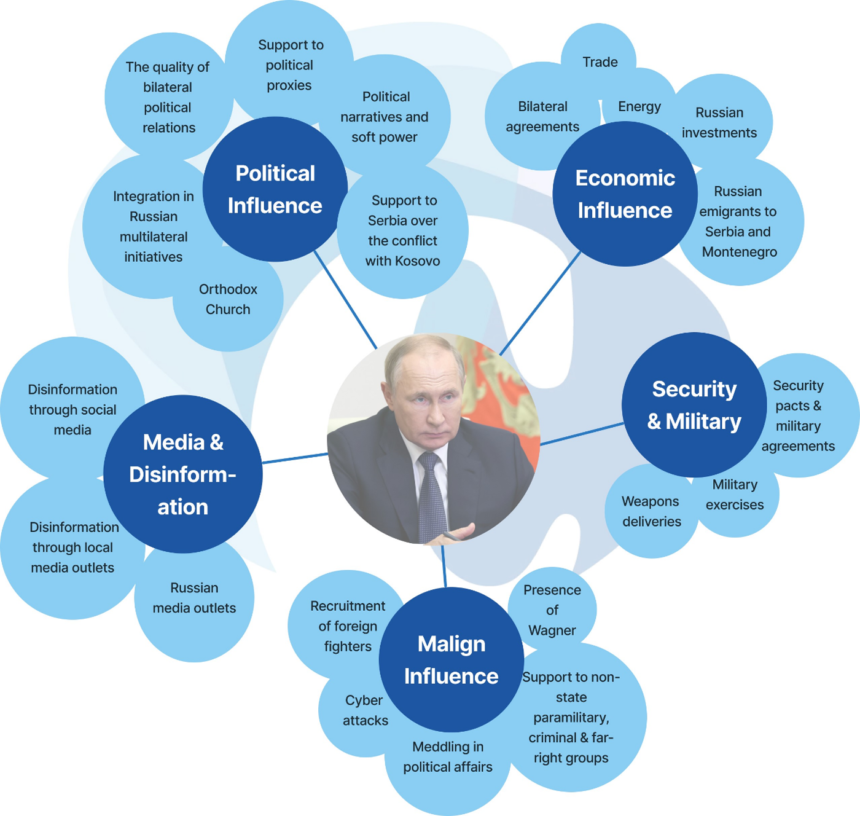
Taken together, these statements do not represent separate diplomatic signals but rather a single, coordinated narrative. Read alongside years of parallel developments across Bosnia and Kosovo, they reflect an emerging Russian strategic approach to the Western Balkans one that is less about outright geopolitical victory and more about sustaining fragmentation as a durable condition.
At the core of this approach is not the failure of European Union enlargement, but the preservation of ethnic segmentation as a structural reality. Fragmented political systems, by design, limit institutional convergence with the EU single market, thereby maintaining external leverage for actors such as Russia. In Bosnia and Herzegovina, this logic is embodied in the functioning of Republika Srpska as a semi-autonomous entity that often resists state-level fiscal and legal integration, while in Kosovo it is reflected in competing interpretations of governance and authority in Serb-majority areas.
From this perspective, Lavrov’s reference to “unifying infrastructure” is not contradictory but rhetorical repositioning. The proposed “unity” exists outside EU regulatory frameworks, and therefore inherently preserves the conditions of disintegration required for external influence.
Scholars of post-Yugoslav governance have long described Bosnia’s power-sharing system as consociationalism a model intended to stabilize peace but which has increasingly entrenched institutional vetoes that limit state functionality. A similar dynamic, though structurally different, has been observed in Kosovo through the long-standing dispute over the Association of Serb-Majority Municipalities.
Agreed in principle under the 2013 Brussels Agreement, the Association remains contested in interpretation. Pristina views it as a strictly limited coordination mechanism bound by Kosovo’s constitutional order and a 2015 Constitutional Court ruling restricting executive authority. Belgrade, by contrast, interprets it as a substantive self-governing body with legislative, fiscal, and external competencies.
The divergence between these interpretations reflects a broader strategic gap: whether Kosovo evolves as a unitary state aligned with Euro-Atlantic institutions or as a layered system of ethnic autonomy. Moscow’s position consistently aligns with Belgrade’s interpretation.
On the ground, governance in northern Kosovo has long reflected a dual structure. Until recent institutional closures in 2024 and 2025, Serbian-funded institutions operated in parallel with Kosovo’s administrative system. Reports from international organizations have documented overlapping jurisdictions in education, healthcare, taxation, and social services, creating a system in which residents effectively navigated two administrative orders simultaneously.
This parallel structure also formed the basis of political control. Srpska Lista, established in 2013, has consistently dominated Serb representation in Kosovo’s institutions. Its electoral success has been widely attributed to structural advantages, including financial and institutional backing from Belgrade. Public-sector salaries, social transfers, and political coordination mechanisms have reinforced a system of dependency that significantly limits political pluralism within Serb communities in Kosovo.
From 2024 onward, Kosovo authorities undertook coordinated actions to dismantle these parallel institutions, including the closure of banking branches, postal services, and administrative offices operating under Serbian jurisdiction. By early 2025, the government declared the parallel institutional framework effectively terminated. The European Union, while critical of the unilateral pace of implementation, did not dispute the illegality of the structures under Kosovo law.
In parallel, the EU launched its Growth Plan for the Western Balkans in 2023, aimed at accelerating economic convergence through integration into the single market. The plan, backed by approximately €6 billion in grants and loans, is conditional on reform agendas submitted by individual states. Serbia, as the largest recipient, has been allocated approximately €1.58 billion under the current framework.
However, the structural tension lies in the fact that EU financial assistance is directed toward institutional modernization in a state that simultaneously maintains political, economic, and institutional linkages with parallel governance structures in Kosovo and strong alignment with Republika Srpska in Bosnia and Herzegovina.
This creates a policy contradiction at the heart of EU enlargement strategy: the Union is financing convergence while tolerating, and at times indirectly accommodating, conditions that perpetuate fragmentation—the very condition identified in its own strategic documents as the main obstacle to integration.
In Bosnia and Herzegovina, Russian diplomatic activity continues to emphasize support for Republika Srpska and criticism of central state institutions, including the Office of the High Representative. In Kosovo, Belgrade’s interpretation of the Brussels dialogue continues to shape political expectations among Kosovo Serbs, particularly regarding the scope of the Association of Serb-Majority Municipalities.
Meanwhile, EU financial instruments continue to support Serbia’s reform agenda, including governance, economic restructuring, and public administration reforms. Yet these frameworks do not directly address the parallel governance structures and political mechanisms that underpin regional fragmentation.
The result is a regional architecture in which political influence is distributed across multiple levels. Russia provides strategic narrative framing and diplomatic backing; Serbia operationalizes influence through administrative and institutional linkages; and the European Union, through its financial instruments, underwrites modernization processes that do not fully resolve the underlying structural fragmentation.
In this sense, Aleksandr Grushko’s visit to Banja Luka was not an isolated diplomatic event, but part of a broader system of coordination. The financial resources sustaining this system, however, are increasingly European.
The central question is therefore not whether Russia has a coherent strategy in the Western Balkans it clearly does but whether the European Union has fully internalized the extent to which its own funding mechanisms may be sustaining the institutional conditions that allow that strategy to persist.