Germany has entered a new phase in its military commitment to NATO’s eastern flank by formally advancing the deployment of a permanent Bundeswehr combat brigade in Lithuania, a move driven by growing concerns over a potential Russian threat.
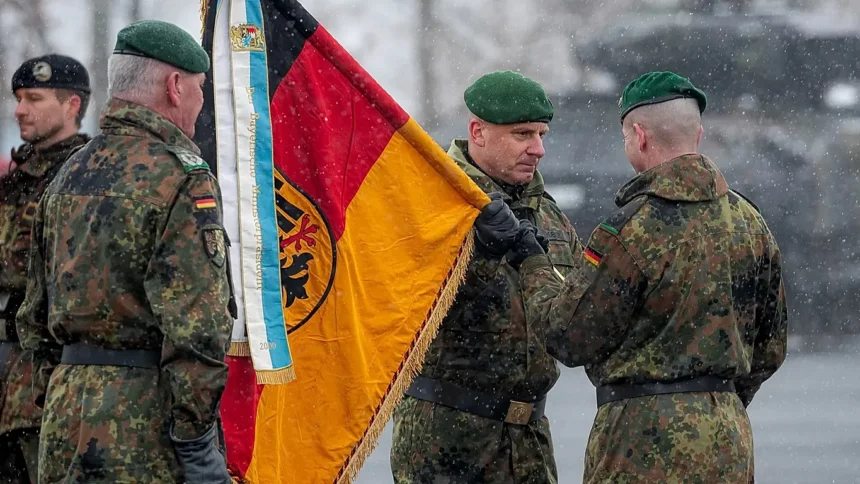
On 29 January, two combat battalions were placed under the command of Armoured Brigade 45 “Lithuania”, marking a significant step in Germany’s gradual force build-up in the Baltic state. According to senior Bundeswehr officials, Germany is preparing for the possibility of a Russian attack within the next two years.
Preparing for a Worst-Case Scenario
In an interview with The Times, Gerald Funke, head of the Bundeswehr’s newly created Support Command, outlined a potential worst-case scenario involving a large-scale Russian attack on NATO territory in the Baltic states.
Because of its brigade stationed in Lithuania, Germany would be immediately drawn into any such conflict, followed by the rapid deployment of tens of thousands of NATO troops to the eastern flank. These forces would be routed through German ports and transport corridors, even under conditions of potential hybrid or cyber attacks.
Under this scenario, Germany would serve as NATO’s central logistical hub, as defined in the Operational Plan Germany (OPLAN DEU) — a classified military blueprint integrating national defence, alliance obligations, and civilian coordination.
“Protection of Vilnius Is Protection of Berlin”
Lithuanian Defence Minister Robertas Kaunas has also warned that a Russian attack, while not inevitable, cannot be ruled out, noting that limited military actions designed to test NATO’s resolve are more likely.
This strategic reality was underscored by a statement from the German chancellor unveiled in Vilnius last year:
“Lithuania’s security is also our security. The protection of Vilnius is the protection of Berlin.”
The message reflects Germany’s belief that deterrence in Lithuania is inseparable from its own national security.
A Historic Deployment
In 2023, Germany made a historic decision to permanently station a Bundeswehr combat brigade outside its national territory for the first time. The 45th Armoured Brigade, known as the “Lithuania Brigade,” represents a long-term military commitment rather than a symbolic gesture.
Chancellor Friedrich Merz reaffirmed this position during talks with Lithuanian Prime Minister Inga Ruginienė, describing the deployment as a joint investment in European security.
“This brigade is not a political symbol, but a military contribution to deterrence and defence,” Merz stated.
Force Structure and Deployment
Most of the brigade will be based in Rūdninkai, approximately 30 kilometres from the Belarusian border, while the German-led NATO Battlegroup Lithuania — currently composed of troops from eight allied countries — will be integrated into the brigade’s command structure.
By 2027, around 4,800 German soldiers and 200 civilian staff are expected to be permanently stationed in Lithuania. As of now, approximately 500 personnel are already deployed.
On 29 January, the 203rd Armoured Battalion and the 122nd Armoured Infantry Battalion were formally subordinated to the brigade, bringing total personnel in-country to around 1,800 troops.
German Defence Minister Boris Pistorius confirmed that 2026 will be a year of intensive training, adding that infrastructure development remains on schedule, including the construction of Rūdninkai Military Town, which will accommodate up to 3,000 soldiers by the end of 2027.
Assessing the Russian Threat
General Funke’s warning aligns with NATO’s Joint Threat Assessment, which indicates that Russia could rebuild sufficient military capability by 2028–2029, potentially fielding up to 1.5 million troops.
Germany’s Inspector General Carsten Breuer has emphasized that capability does not equal intent, but stressed the need to prepare for all contingencies.
To accelerate defence readiness, Germany plans to increase military spending to nearly €153 billion by 2029, reinforcing what officials describe as “war readiness” across NATO’s eastern flank.