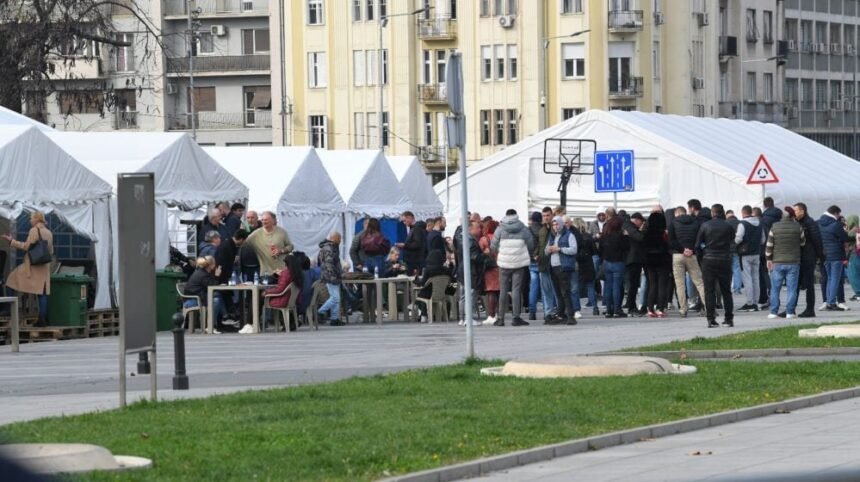
The Lawyers’ Committee for Human Rights (YUCOM) has called on Serbia’s Ministry of Interior (MUP) to immediately halt ongoing public gatherings of government supporters in Pionirski Park and in front of the Serbian Parliament, describing them as a long-term abuse of the right to peaceful assembly.
In a statement released today, YUCOM urged the MUP to act “in accordance with the Law on Public Assembly,” which allows for the termination of gatherings once conditions for restrictions are met.
Illegal Occupation of Public Space
YUCOM recalled that since March 6, 2025, participants of the so-called “student gatherings” had demanded the right to continue their studies, and the police were informed that the protest would last “until the demands are fulfilled.”
However, the organization pointed out that the police failed to reject such an open-ended application, which by law should have been dismissed.
“Instead, the MUP treated this gathering as legal, legitimate, and even provided it with special protection,” YUCOM said.
Demands Already Met, but Gatherings Continue
YUCOM emphasized that with the start of the new academic year on November 1, 2025, the protesters’ demands had been met, as classes had resumed across all universities.
“By continuing to protect this assembly, the MUP is now enabling a clear abuse of the right to free assembly, which seriously endangers public safety, freedom of movement, and the peaceful enjoyment of property,” the organization stated.
Rising Tensions and Public Disturbance
The prolonged presence of pro-government groups in front of key institutions — the Parliament, the Presidency, and the City Assembly — has, according to YUCOM, turned into a de facto months-long occupation of public space and traffic routes.
“Citizens’ frustration has reached alarming levels, leading to increasingly frequent outbursts of violence between opposing groups and individuals,” YUCOM warned, stressing that all legal grounds for ending the gatherings have been met.
A Test for the Rule of Law
Human rights advocates view this situation as a serious test of Serbia’s institutions and the independence of the police from political influence.
“Allowing this kind of manipulation of public assembly rights undermines the rule of law and fuels further social divisions,” YUCOM concluded.