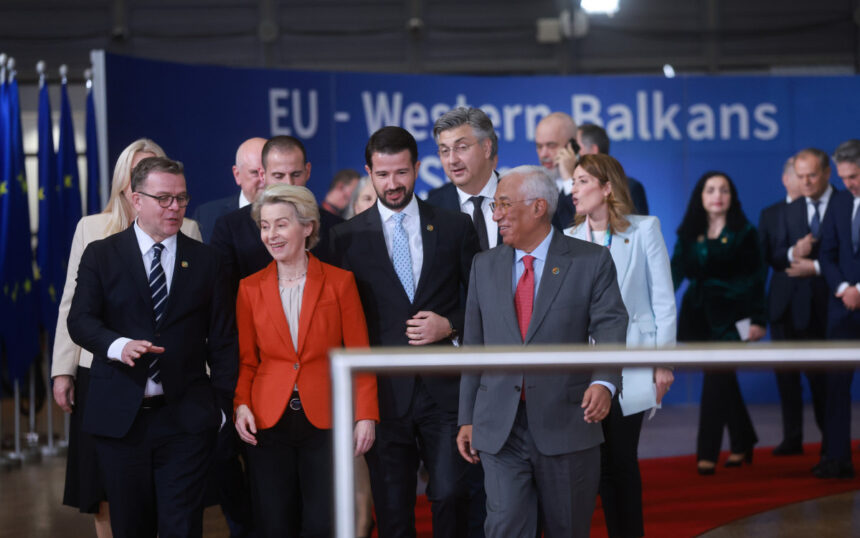
The war in Ukraine has reshaped the European geopolitical landscape and served as a catalyst for reconsidering the European Union’s (EU) enlargement model. Long-standing Western Balkan candidates, alongside new contenders like Ukraine, Moldova, and Georgia, are now being assessed in a broader strategic context, prompting EU leaders to label enlargement as both a “priority” and a “geopolitical necessity.”
As a result, discussions on more flexible membership models have gained traction, allowing candidate countries to integrate gradually into EU structures without waiting for full membership. The most commonly proposed approaches include phased, partial, and “reverse” membership.
The phased membership model envisions gradual integration of candidate states into EU institutions and programs before full accession, aiming to accelerate and facilitate enlargement while maintaining legal compliance and oversight. Miloš Pavković, Strategic Director at the Center for European Policy (CEP), explained that the concept, developed in 2021, bridges the gap between current member states and candidates while tying financial support to reforms.
The “reverse” membership model also emphasizes gradual integration but in a different order: candidates obtain membership first, with full rights and obligations phased in over time. This approach has been discussed in the context of Ukraine, which seeks rapid EU membership with initially limited rights.
Partial membership, meanwhile, focuses on economic integration without granting full voting rights, veto power, or representation in the European Commission. Leaders such as Albanian Prime Minister Edi Rama and Serbian President Aleksandar Vučić have expressed openness to this approach, proposing access to the EU Single Market and Schengen Zone as a first step.
While these flexible models have sparked interest, full implementation requires consensus among EU member states and alignment with candidate countries. Legal and institutional challenges remain, particularly regarding veto rights and full participation in EU governance. According to Pavković, the phased membership model remains the most realistic and legally feasible path forward.
Alternative accession scenarios, such as targeted integration in key sectors like energy or the Eurozone SEPA system, are also under consideration, with some Western Balkan countries already participating. These approaches aim to balance speed, reform incentives, and practical inclusion in EU projects, providing a potential path for countries that have fallen behind in the enlargement process.