As a child, Peter Magyar admired Viktor Orban, then a fiery anti-communist, and would pin his photograph on his bedroom wall following Hungary’s first democratic elections in 1990. Decades later, Magyar now seeks to end Orban’s 16-year tenure as prime minister, Reuters reports.
Magyar, only nine when communism fell, recalls decorating his Budapest home with images of key political figures. Orban, then a young lawyer, became a hero of Hungary’s pro-democracy movement in 1989 when he publicly called for the withdrawal of Soviet troops.
“There was a wave of energy around the regime change that swept me up as a child,” Magyar recalled last year on the podcast Fokuszcsoport.
Today, most opinion polls indicate that Magyar’s pro-European, center-right party, Tisza, is challenging Orban’s nationalist Fidesz party in the April 12 parliamentary elections. Magyar—whose surname literally means “Hungarian”—first gained widespread attention two years ago after his ex-wife, Orban’s former Justice Minister Judit Varga, resigned from all political roles following a public scandal related to sexual abuse cases.
Magyar quickly distanced himself from Fidesz, accusing the party of corruption and propaganda, expressing disappointment with Orban’s leadership. Just four months after reemerging publicly in an interview on the YouTube channel Partizan, Magyar’s new party won 30% in the June 2024 European elections, finishing second to Fidesz and overshadowing the rest of the opposition.
High Stakes for Hungary and Europe
Next month’s elections carry significant implications for Hungary and Europe’s broader populist right. Since 2010, Orban has promoted what he calls a “non-liberal democracy,” limiting media freedom, constraining NGOs, and weakening judicial independence. He maintains close ties with Russian President Vladimir Putin and former U.S. President Donald Trump, while frequently clashing with the European Union, which has suspended billions in funds over democratic standards concerns.
In contrast, Magyar has pledged to restore Hungary’s Western orientation, end reliance on Russian energy by 2035, and pursue “pragmatic relations” with Moscow. He has also promised to unblock EU funds to revive Hungary’s stalled economy, carefully balancing reform goals to avoid alienating conservative voters. Unlike Orban, he does not reject Ukraine’s eventual EU membership but opposes rapid accession and, like Fidesz, opposes EU-mandated migrant quotas, maintaining the border fence built under Orban. Analysts suggest that Tisza’s rise could ease tensions between Budapest and the EU, especially after Orban vetoed a €90 billion aid package for Kyiv.
“Orban has lost confidence in the current form and direction of European integration, pursuing a veto-based and obstructionist policy,” said Botond Feledy, a geopolitical analyst at Red Snow Consulting. “Tisza does not oppose integration in principle and will pursue it pragmatically.”
Campaigning from Orban’s Playbook
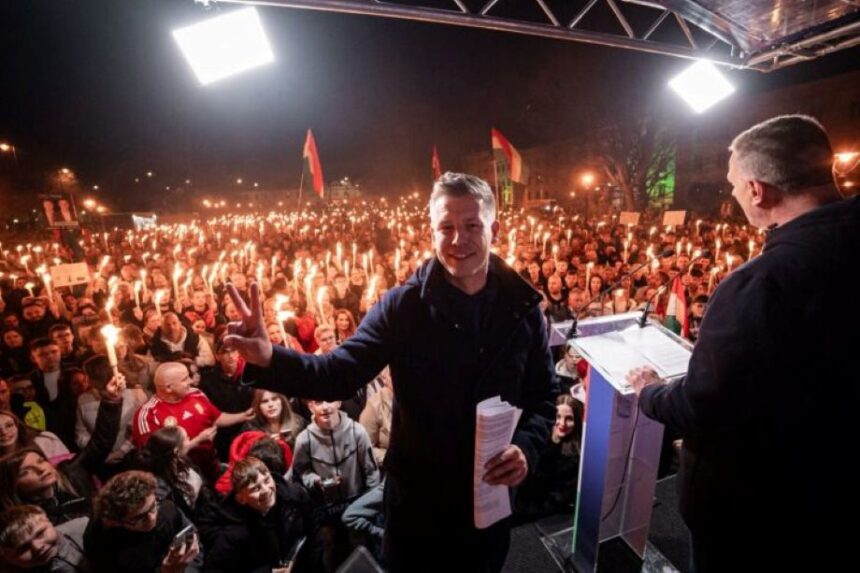
Magyar has adapted lessons from Orban’s political playbook, running a simple campaign that resonates in rural Fidesz strongholds. His rallies prominently feature national flags and patriotic messaging. Continuous messaging and savvy use of social media have fueled his rapid rise, according to Gabor Toka, senior research associate at the Open Society Archives.
Born in 1981 to a family of lawyers, Magyar studied law, married Judit Varga in 2006, and joined Hungary’s diplomatic corps while Varga pursued a career in Brussels. After returning to Hungary, he worked at a state bank and later led a student loan agency. Magyar and Varga divorced in 2023 and have three sons. Magyar describes himself as religious, enjoys cooking, and plays football with friends and his children.
Asked in December how politics has changed him, Magyar responded to media claims of hot-headedness: “Now I count to ten.”