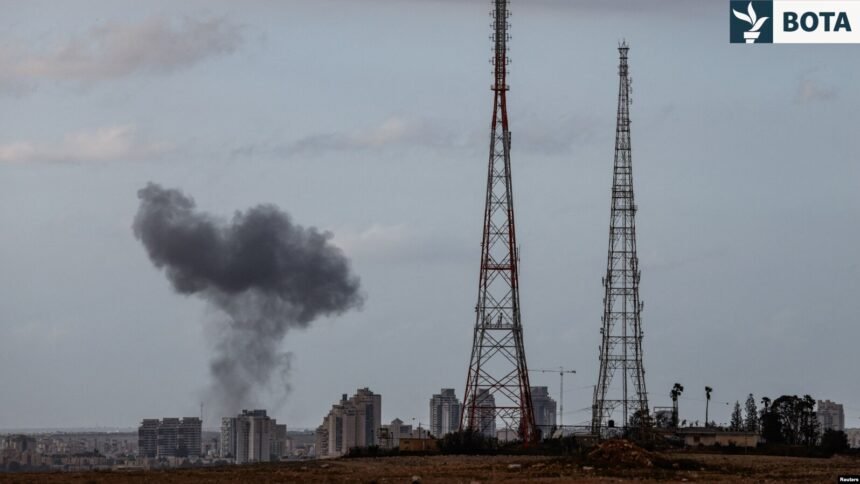
Since the first day of the conflict, Iran launched hundreds of ballistic missiles in massive barrages, initially attempting to overwhelm U.S. and Israeli air defenses. Many of these early missiles were intercepted.
Since February 28, Tehran has reduced the number of short- and long-range missile launches to several dozen per day. However, military analysts tracking open-source data report that the accuracy of these strikes has increased significantly.
Experts attribute this shift partly to the degradation of Iran’s military capabilities by the United States and Israel, as well as Tehran’s deliberate effort to conserve its remaining arsenal and target higher-value objectives.
“U.S. and Israeli strikes have caused substantial damage to Iran’s missile infrastructure,” said Kelly Grieco, senior researcher at the Stimson Center in Washington. “This physical weakening explains much of the decline in launch frequency. At the same time, Iran has deliberately shifted strategy toward smaller, more precise barrages aimed at specific, high-value targets.”
These targets include key U.S. military installations and radar systems in the Middle East, critical oil and gas infrastructure of U.S. allies in the Persian Gulf, and industrial and energy sites in Israel. By launching fewer missiles, Iran appears to be achieving its strategic objectives—expanding the battlefield, disrupting the global economy, and imposing direct costs on the U.S. and its allies.
Missile Arsenal Under Pressure
One of the primary goals of the one-month conflict has been to eliminate Iran’s large ballistic missile arsenal. The U.S. and Israel have heavily targeted ground-based launchers, missile stockpiles, and underground depots.
U.S. President Donald Trump stated on March 26 that Iran has “very few missiles left,” while other officials claimed Tehran’s ballistic capabilities had been nearly destroyed. Israeli and U.S. officials assert that over 10,000 Iranian targets have been struck since the air campaign began. Washington reports a 90% reduction in Iranian missile launches since the conflict’s start, presenting this as evidence of near-total neutralization of Iran’s missile program. Israel claims that at least 70% of Iran’s launchers and missile reserves have been destroyed.
Despite these losses, sirens warning of air attacks remain a daily occurrence across the Middle East. Analysts report that Iran continues to launch 20–30 ballistic missiles per day, along with dozens of lethal drones. This indicates that Iran retains access to missile launchers and stockpiles, despite heavy bombardment, and is increasingly relying on mobile launch systems.
High-Value Targets and Strategic Selection
Despite a weakened arsenal, analysts note that Iran’s strike effectiveness has steadily increased during the conflict. Advanced missile interceptors deployed by the U.S. and allied Arab states have forced Israel to limit the use of some of its most powerful defensive systems, leaving it more vulnerable to Iranian attacks.
Significant attacks include a March 27 strike on Prince Sultan Air Base in Saudi Arabia, injuring at least 12 U.S. personnel and severely damaging two KC-135 refueling aircraft. On March 21, Iranian missiles struck Arad and Dimona in southern Israel for the first time, near a major nuclear research site and reactor, causing dozens of injuries.
“By focusing missiles and drones on major infrastructure such as refineries, airports, and energy facilities, even a single strike near a high-value target can cause significant damage,” said Grieco. She added that Iran appears to be learning from successive waves of attacks, refining trajectories and timing to maximize penetration chances.
Experts expect Iran’s accuracy and target hit rate to remain stable or gradually improve unless a ceasefire or major shift occurs in the conflict.