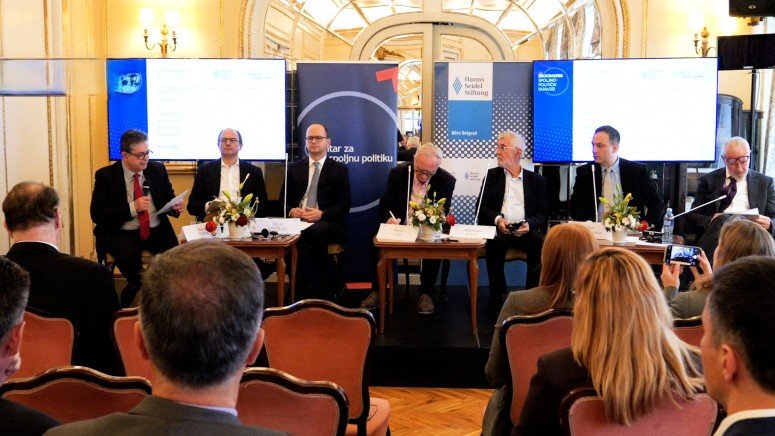
At the Belgrade Foreign Policy Dialogues conference, experts discussed the state of bilateral relations between Serbia and Albania, describing them as characterized by “fragile normalization” over the past decade. While the two countries are not required to be allies, there is potential to identify shared interests, participants noted during the panel titled “How to Successfully Avoid the ‘Elephant in the Room’.”
Ditmir Bušati, from Harvard University’s Center for International Relations and former Albanian Minister of Foreign Affairs, stated that Albania and Serbia have already navigated the “elephant in the room”—the Kosovo issue—but expressed concern that both countries have not yet made substantial progress toward modern political maturity. He emphasized that neither side should hold the other “hostage” politically and that identifying common interests is crucial.
Regarding relations between Tirana and Pristina, Bušati noted that they remain below desired levels. He also expressed the view that EU accession for Montenegro and Albania could catalyze democratic impulses in Serbia, Bosnia and Herzegovina, and North Macedonia.
Remzi Lani, Executive Director of the Albanian Media Center, described the past decade of Albania-Serbia relations as a period of “fragile normalization.” On a political level, the situation remains largely status quo. Lani noted that while media often amplify political narratives, economic ties are moving in a positive direction, citing that 100,000 Serbians visited Albania in the past year as a sign of growing engagement.
The panel also addressed the “Mini Schengen” initiative, later developed into the Open Balkan project, which Albania and Serbia actively engaged in at one point. Igor Novaković, Senior Associate at the Center for International and Security Affairs in Belgrade, highlighted that despite criticism, the initiative helped legitimize regional integration by establishing connections between Albania, Serbia, and North Macedonia.
Nenad Đurđević, advisor to the President of the Serbian Chamber of Commerce, noted that Open Balkan demonstrated what could be achieved when political will exists. He shared trade data showing a 73% increase in trade between Albania and Serbia from 2012 to 2024, with trade reaching €355 million in 2025.
The conference was jointly organized by the Belgrade Center for Foreign Policy and the Hans Seidel Foundation for Southeast Europe.