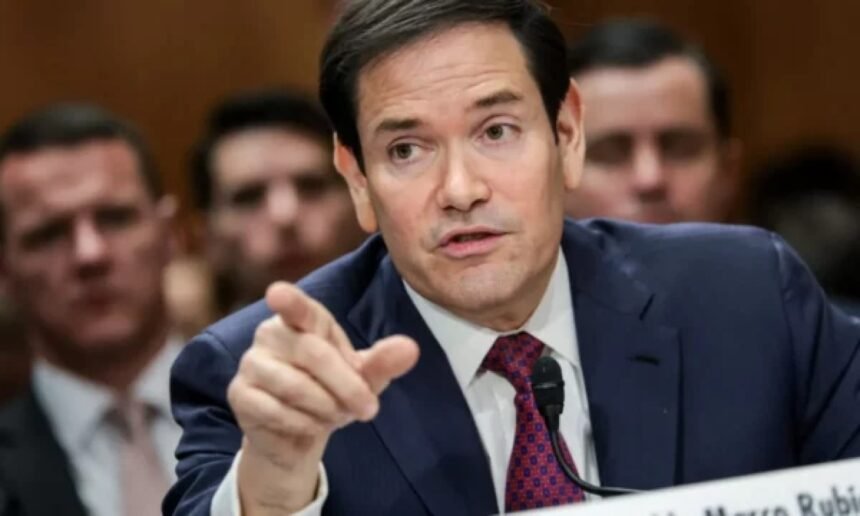
U.S. Secretary of State Marco Rubio said the “finish line” in the conflict with Iran is now in sight. Once the hostilities conclude, the United States will “reassess” its relationship with NATO, after some European nations declined to support the conflict.
In an interview with Fox News, Rubio said that “discussions are ongoing” to bring the war to an end, with the possibility of “a direct meeting at some point.”
“We can see the finish line. It’s not today, it’s not tomorrow, but it is coming,” he added without elaborating further.
Recent developments have increased the likelihood of a resolution to the conflict that began on February 28. Iranian President Masud Pezeshkian stated on March 31 that his country has the “necessary will” to end the conflict with the U.S. and Israel, provided conditions such as security guarantees are met.
The United States reportedly presented a 15-point plan last week, including dismantling Iran’s nuclear facilities, limiting its missile capabilities, and ending support for regional allied forces. President Donald Trump stated on March 31 that the fighting could end within “two to three weeks,” further raising hopes for a resolution.
“Messages are being exchanged, discussions are ongoing. There’s a possibility for a direct meeting at some point,” Rubio said.
Looking beyond the end of the conflict, Rubio added that the Trump administration will “unfortunately” need to “reassess the value of NATO and the alliance for our country.” He and other U.S. officials have previously questioned the alliance’s utility if America cannot freely use allied bases to defend its interests.
“If we reach a point where NATO means… that we can no longer use those bases to protect U.S. interests, then NATO becomes a one-way street,” Rubio said.
Several European allies have refused direct involvement in the conflict, which has seen daily U.S. and Israeli strikes against Iran. Tehran has retaliated with missiles and drones targeting sites in the Middle East.
Iran has also effectively blocked the Strait of Hormuz, a key waterway used for transporting roughly 20% of the world’s oil and gas, and has struck several ships despite air strikes that have damaged Tehran’s military infrastructure.
Recent media reports indicate that Spain and Italy—both NATO members—denied permission for U.S. military aircraft to use their bases for operations in Iran.
President Trump criticized France and the U.K., the closest U.S. allies, on March 31 for not supporting Washington, telling the world: “Go get your own oil” and “Learn to fight for yourselves.”
Trump also said he is seriously considering withdrawing the U.S. from NATO, calling the Western military alliance a “paper tiger” in an interview with The Telegraph. “NATO never impressed me. I always knew it was a paper tiger, and [Russian President Vladimir] Putin knows it too,” he said.
Responding to Trump’s remarks, British Prime Minister Keir Starmer stressed that the U.K. would act in its national interest. “Regardless of the pressure on me and others, regardless of the noise, I will act in the national interest of Britain in all decisions I make,” Starmer said during a press conference in London on April 1.
“And that is why I have been absolutely clear: this is not our war, and we will not be involved,” he added.