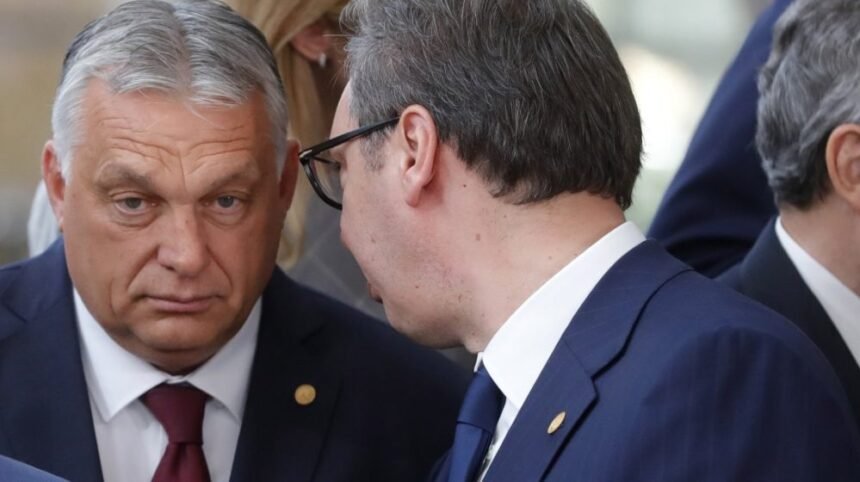
As the Hungarian parliamentary elections approach on April 12, attention in Belgrade has turned to the outcome in Budapest, which is seen by some in the Serbian political elite as almost as significant as Serbia’s own electoral results. Prime Minister Viktor Orbán, widely regarded as an autocratic leader similar to Serbian President Aleksandar Vučić, is fighting to remain in power.
Orbán, known for his pro-Russian stance and Euroscepticism, has cultivated close personal and political ties with Vučić. The Serbian Progressive Party (SNS) has publicly expressed strong support for Orbán’s reelection, highlighting the two leaders’ alignment on several key issues.
Recent incidents, such as the alleged discovery of explosives near a gas pipeline connecting Serbia and Hungary, have been interpreted by critics as politically motivated moves aimed at bolstering Orbán ahead of the vote, possibly with tacit support from Belgrade.
Strategic Implications for Vučić
Analysts note that regardless of Orbán’s victory or defeat, Vučić’s domestic standing has already weakened both in Serbia and in the European Union. While a reelected Orbán would provide Vučić with a reliable ally in the EU, it would not significantly alter Serbia’s internal or foreign policy challenges.
Marko Miletić, editor of the portal Mašina, emphasizes that the SNS regime is facing a long-term decline in popularity and the rise of new political actors capable of challenging its dominance. He notes that Orbán and Vučić mutually support each other to maintain power, but the Hungarian prime minister’s opposition to EU policies can complicate Serbia’s diplomatic position, regardless of the election outcome.
Orbán as a Key Partner
Political analyst Boris Varga highlights that an Orbán victory would allow Vučić to maintain a European partner aligned with his political style and international interests, including support for Russian influence and expanding Chinese infrastructure projects in Southeast Europe. According to Varga, Orbán’s support reinforces Vučić’s authoritarian model, providing both a shield and a role model for his governance.
However, Varga warns that scandals or crises in Hungary, such as controversies over gas infrastructure or relations with Ukraine, could expose Vučić to international scrutiny, even with Orbán as an ally.
Election Outcome Scenarios
Igor Novaković, director of research at the Center for International and Security Affairs (ISAC Fund), stresses that the implications for Serbia depend on the manner of Orbán’s victory. A contested or divisive win could deepen polarization in Hungary and spill over into Serbia, affecting domestic stability.
Bojan Pajtić, law professor at Novi Sad University, points out that Orbán is currently the only European politician providing Vučić with tangible support. A loss for Orbán would weaken Vučić’s position internationally and force the SNS into cooperation with more extreme political groups in Europe, potentially constraining Serbia’s diplomatic maneuverability.
In conclusion, while Orbán’s reelection would sustain a valuable ally for Vučić, it would not fundamentally solve the broader political and economic pressures facing Serbia, and a Hungarian opposition victory could introduce new challenges both domestically and internationally.