The president of the ruling party in Republika Srpska, Milorad Dodik, assessed the military cooperation between Croatia, Albania and Kosovo as a threat to the entity and the Serbian people, following the rhetoric of official Belgrade.
Analysts for Radio Free Europe assess these allegations as political tactics, not a security assessment.
Following the rhetoric of official Belgrade, Milorad Dodik, the president of the ruling party in Republika Srpska (RS), declared military cooperation between Croatia, Albania and Kosovo a threat to that entity and the Serbian people.
However, analysts for Radio Free Europe (RSE) assess Dodik’s claims as political tactics, rather than serious security assessments.
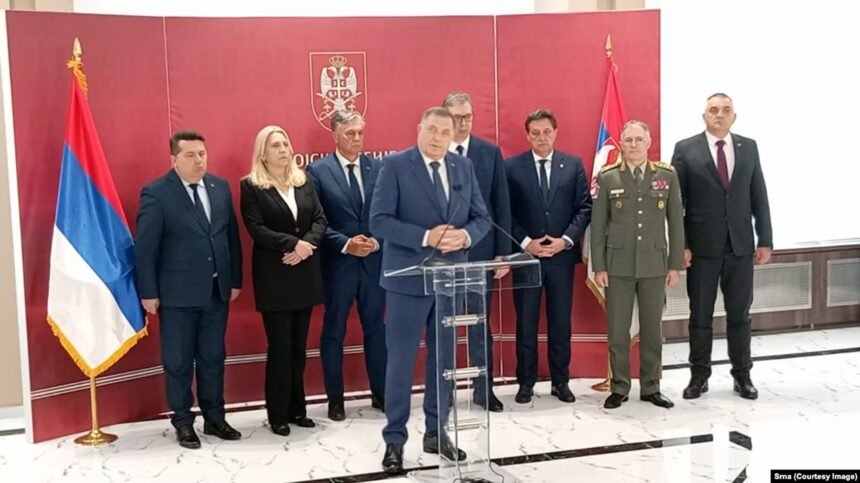
During his stay in Belgrade on April 15, Dodik spoke about the recently signed Declaration on Cooperation in the Field of Defense and Security between Croatia, Albania, and Kosovo, claiming that it represents an alleged threat to RS.
Dodik’s statement was preceded by similar reactions from government representatives in Serbia, who claimed that it was a provocation and a threat to regional stability.
Croatia, Albania and Kosovo signed the Declaration in mid-March which strengthens cooperation and highlights the importance of joint responses to security challenges, hybrid threats and other risks.
The Ministers of Defense signed the Declaration on Military Cooperation between Kosovo, Albania and Croatia in Tirana, on March 18, 2025.
Denis Hadžović from the Center for Security Studies in Sarajevo tells Radio Free Europe (RSE) that Bosnia and Herzegovina has a clearly defined security and defense system, in which there is no room for entity-based interpretations of threats.
Hadžović stressed that any military or security threat to the entity would automatically be considered a threat to the state of BiH, emphasizing that there is no realistic scenario in which the Republika Srpska could be separately threatened, outside the security framework of the state as a whole.
“Within the functioning of the BiH system, such an act would represent an attack on the integrity of the state, and all resources, institutions and the entire security system would be put in place to protect the interests of all BiH citizens,” Hadžović said.
Scoring political points
Apart from being the head of the ruling party in RS, Dodik currently holds no office in the entity or state government. This did not prevent him from addressing a meeting of RS and Serbian officials in Belgrade, on behalf of the entities, with the leadership of the Ministry of Defense and the Serbian Army.
Speaking about the cooperation between Croatia, Albania and Kosovo, which he called a military alliance, he said that the RS was “monitoring the situation.” Without further argument, he stated that the goal was “to endanger Serbs,” emphasizing that BiH entity as a separate security entity, apart from the state of BiH.
However, the constitutional and legal framework of BiH does not recognize such a perspective. Since the defense reform of 2005, defense and security policy creation have been the responsibility of state-level institutions.
RFE/RL’s interlocutors claim that Dodik’s claims fall within the realm of political rhetoric that ignores the constitutional order of BiH, but that they do not represent a realistic assessment of the threats.
Political analyst Žarko Puhovski further relativizes the story of RS’s vulnerability, pointing out to RFE/RL that Dodik “has long stopped caring about the state’s powers,” but instead sends messages in line with his own interests.
Puhovski also questions the actual vulnerability of the RS entity in the regional context.
A shared narrative of vulnerability
Hadžović assesses that regional agreements are used more as a political lever than as a real security challenge, and emphasizes that the cooperation between Zagreb, Tirana and Pristina “has no major implications for Serbia.”
However, as he says, it is used in political discourse to create a sense of threat to Serbian interests, which is rhetoric that has been appearing in statements by Serbian President Aleksandar Vučić for a long time.
In this context, he points out, Dodik’s insistence on this topic in Belgrade can be viewed, which indicates an attempt at mutual political reinforcement of narratives.
“This alliance is being used as a political move, in order to give more space to the narrative about the threat to Serbian interests, or rather the common threat, which is then tried to be reflected in BiH,” he says.
Why does Dodik mention the ‘Croatian component’?
Speaking in Belgrade, Dodik also mentioned that the “alliance” is disruptive in the entire region, and said that “the Croatian component, and certainly the Bosniak component, will be turned towards such orientations.”
Puhovski believes that Dodik’s rhetoric is partly a consequence of damaged political relations with Zagreb and the “Croatian component” within BiH.
“It seems that the long-standing cooperation with the Croatian Democratic Union (HDZ) of BiH has entered a serious crisis, if not completely disappeared. Previously, one of Dodik’s people was a Croatian representative in the BiH Presidency, which forced the Croatian component in BiH to cooperate with Dodik, and then the Croatian government,” says Puhovski.
As he adds, it is obvious that these relationships are changing, which is why Dodik is now looking for new narratives and enemies.
“It is obvious that Dodik no longer wants to cooperate with the Croatian government, or vice versa – that the Croatian authorities no longer want to cooperate with him, so he decided to make this move. And then, just in case, he brought Albania and Kosovo into the story,” says Puhovski.
Apart from the political milieu of the RS, there have been no official reactions from BiH state institutions that would label the cooperation between Croatia, Albania and Kosovo as a security threat.
Armin Kržalić, a professor at the Faculty of Criminalistics, Criminology and Security Studies in Sarajevo, believes that Dodik’s statements are part of everyday political discourse through which party representatives try to score political points.
“The Armed Forces of BiH are Bosniak, Serb and Croat, and any activity in the region cannot call that into question. Dodik probably wants to say with this that there is a problem with the Armed Forces as a single force, so that they are being distributed or that another armed force that he dreamed of is being created,” he said.
Milorad Dodik has been using claims about the alleged threat to the RS for years, most often in the context of relations with state institutions and international actors.
During the political crisis of 2021 and 2022, he announced his withdrawal from the Armed Forces of BiH and spoke about the formation of the RS army, explaining that this was necessary for the “protection” of the entity.
The unified Armed Forces of BiH were formed in early 2006, following the reform of the BiH defense sector and the transfer of defense responsibilities from the entity to the state level.
The Armed Forces of BiH today also include three national regiments that follow the traditions of the Army of the Republic of Bosnia and Herzegovina, the Croatian Defense Council (HVO), and the Army of the Republika Srpska.
Kržalić also believes that there is no real threat to either Serbia or Bosnia and Herzegovina in the existing security arrangements. He believes that strengthening regional cooperation should be a priority if there is a real concern for security.
“However, political interests go in a different direction, everyone looks after their own interests and, if they are not part of certain agreements, immediately presents them as a threat to the security of citizens. The problem is that there is still distrust between states, so cooperation is often mistakenly presented as destabilization,” he says.
The Croatian government previously told RFE/RL that the joint declaration of the three countries does not aim to establish any military alliance, emphasizing that it is not necessary, apart from NATO membership.
Croatia and Albania are members of NATO, unlike Kosovo, whose independence is not recognized by BiH, nor by neighboring Serbia, due to opposition from politicians from RS.
Despite opposition from RS representatives, who advocate military neutrality modeled after Serbia, BiH cooperates with NATO, and last year took a significant step towards membership by adopting the Individually Tailored Partnership Program (ITPP).