
Military cooperation between states is a norm in the modern security architecture, but in the Balkans it continues to be viewed as a problem—at least by Serbia when it involves Kosovo and two NATO allies, Albania and Croatia.
The narrative goes as far as a perception of threat, which does not necessarily reflect the real security situation on the ground.
The starting point of this entire dynamic was a declaration on cooperation in the field of defense and security between Pristina, Tirana, and Zagreb, signed more than a year ago.
The signatories presented it as a commitment to strengthening cooperation, defending territories, and contributing to international peace and security, emphasizing that it is not directed against anyone.
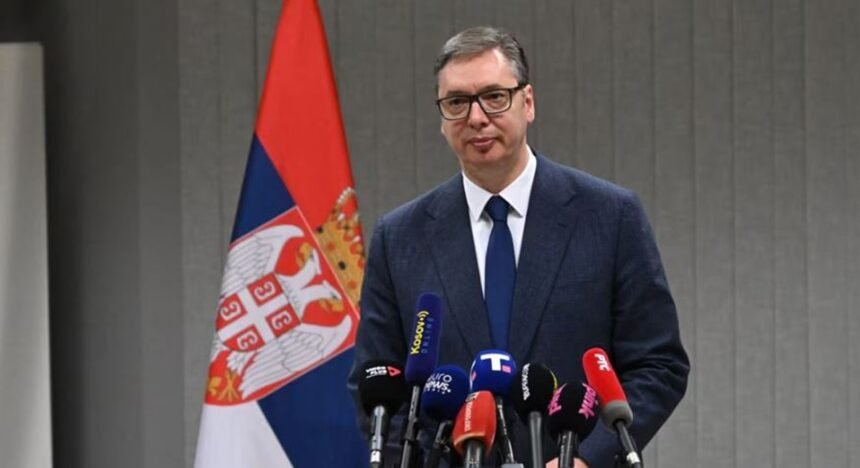
However, Serbia interpreted it as an open provocation that threatens its territorial integrity and the security of its citizens—to the point that Aleksandar Vučić declared last month that these countries are preparing for an attack.
“Out of nowhere, a military alliance appears between Pristina, Tirana, and Zagreb. Not military-technical cooperation, not military-economic cooperation, but a military alliance. And, of course, I am worried for every citizen of this country,” Vučić said for Radio Television of Serbia.
To reinforce this narrative, he announced last week new investments in the military and a further increase in defense capacities, emphasizing that Serbia must be prepared for any development in a “complex” security situation caused by the activities of Pristina, Tirana, and Zagreb.
“In the coming days, we will sign very important contracts for the procurement of weapons and military equipment. We expect important visits and new contracts with other countries, with the aim of placing large orders for our army,” Vučić wrote on Facebook.
In a region where the memory of the conflicts of the 1990s still shapes how security is interpreted, even developments that are essentially cooperative often take on political meanings.
Radio Free Europe/Radio Liberty asked NATO for comment regarding the declaration on defense cooperation between Kosovo, Albania, and Croatia and the reactions it has triggered in Serbia. An alliance official said it is a trilateral agreement between those countries and institutions in Kosovo, of which NATO is aware but is not a party.
According to him, NATO membership “does not prevent” allied countries from developing additional cooperation in the field of defense.
Serbia presents itself as militarily neutral, has the largest defense budget in the region, and cooperates in parallel with NATO, Russia, and China.
So why does an agreement between three countries that have neither territorial claims nor declared threats against it provoke such strong reactions in Belgrade? For security experts, the answer lies more in political interpretation than in a real threat.
Aleksandar Radić says that part of Serbian society views regional developments through the prism of external threats—making it easier for Vučić to create the image of a country “under siege” and to mobilize support through security rhetoric.
In the context of anti-government protests that have lasted for more than a year, Radić assesses that claims of external danger also serve to shift attention away from internal crises.
“When analyzing the mindset of people who support Vučić, it is noticeable that they are inclined to believe that external factors negatively affect Serbia. They think that foreign intelligence services are disrupting order and acting against Serbian interests. In this context, the agreement between Zagreb, Tirana, and Pristina serves Vučić as a useful tool to strengthen the narrative that he ‘is protecting Serbia’ and ‘is strengthening the army,’ because it is necessary,” the Serbian analyst told RFE/RL’s Exposé program.
In this blurring of public opinion, the fact is overlooked that Serbia itself has a defense cooperation agreement with Croatia. It was signed in 2010 by the then ministers of defense, Dragan Šutanovac and Branko Vukelić, and remains in force.
Andrej Plenković recently spoke about it while criticizing Vučić’s narrative as clearly constructed for domestic political purposes.
“When you look at the content, the agreement that exists between Croatia and Serbia is similar, and even more comprehensive in some aspects than the one Croatia has with Kosovo and Albania,” Plenković told journalists.
Marinko Ogorec says it is regrettable that Vučić interprets in such a way a cooperation that aims to strengthen regional security and stability through education, training, and joint exercises.
According to him, such rhetoric risks fueling unnecessary tensions and could lead to an arms race.
“In political theory, this is called a ‘security dilemma.’ If you see your neighbor arming heavily, naturally you begin to respond in the same way. This leads to an arms race. We are seeing that Serbia is, in reality, arming itself and purchasing weapons systems beyond reasonable needs,” says Ogorec.
Serbia has in its arsenal weapons from both the West as well as Russia and China. Last month it was revealed that it had also purchased supersonic ballistic missiles CM-400 from China, with significant destructive power.
For security expert in Albania, Xhavit Shala, this highlights the asymmetry of armament in the region.
“Serbia recently acquired the latest Chinese hypersonic missiles. What did Kosovo receive? Kosovo received anti-tank missiles from the United States. Those are defensive, whereas hypersonic missiles are not—they are for attack, to threaten others. With ranges that cover the territories of other countries—including NATO members,” Shala said.
He assesses that Vučić’s rhetoric about threats against Serbia has become a “daily refrain,” aimed primarily at a polarized domestic audience, but also as a political message to the West.
“By presenting this as a dangerous alliance for Serbia, he tries to justify the continuation of relations with Russia and China, as well as the purchase of weapons from them. So, allegedly as a consequence of the threat, we are forced to act this way,” says Shala.
Security expert in Kosovo, Burim Ramadani, agrees that Vučić’s arguments about threats from neighbors are unfounded, or as he calls them, camouflage for other political and geostrategic purposes.
“Clearly, Serbia’s propaganda has a purpose behind it, and that has to do with strengthening ties with Russia and China, which also have an interest in the Western Balkans being destabilized, its states being under threat and pressure, and NATO being in a more sensitive position,” Ramadani says.
Serbia, since 2006, has been part of NATO’s “Partnership for Peace” program and has planned joint exercises with the Alliance next month.
A NATO official confirmed to RFE/RL that they respect Serbia’s military neutrality, emphasizing the need for trust and commitment to regional stability.
“To move forward, the NATO-Serbia partnership must be a two-way street, based on trust and mutual respect, as well as a genuine commitment to regional stability. We continue to call on Serbia to engage with NATO and its neighbors in a responsible and constructive manner,” the NATO official said.
Also, the United States ambassador to NATO, Matthew Whitaker, during a visit to Serbia this week, called on Belgrade to deepen cooperation with the United States and NATO in the field of security.
In an article for the Serbian newspaper Politika, Whitaker said that “the purchase of defense technology that is not operationally compatible with European or American systems complicates future cooperation and creates unnecessary obstacles.”
Shala, on the other hand, assesses that the White House’s proposal to appoint a military figure as U.S. ambassador to Albania shows that the United States takes security issues in the Balkans seriously and sees the region as an important part of its strategic interests.
For Radić, now is the time for Serbia to define its position—“military neutrality is neither internationally recognized nor functional.”
“In Serbia, we must position ourselves toward NATO in a different way—either become a full member or redefine neutrality and move forward. Not create the impression that everyone around us is an enemy. Unfortunately, this leads Serbia into a situation similar to 1999, when everyone was against it.”
“At that time, NATO bombed Serbia, and the airspace of all countries surrounding Serbia was used for NATO operations. That should have been a historical message—that a country should not create an environment entirely without allies. Unfortunately, history, in a way, is repeating itself,” says Radić.
Serbia already appears to have limited control over the dynamics shaping the region.
According to Ogorec, Croatia and Albania as NATO members, and Kosovo as a country aspiring to join, are aligning their military capacities with Alliance standards—a process he describes as costly but entirely natural for member states.
If this is interpreted in Serbia as an arms race or a threat, then it is a matter of perception of reality, rather than reality itself, Ogorec concludes.