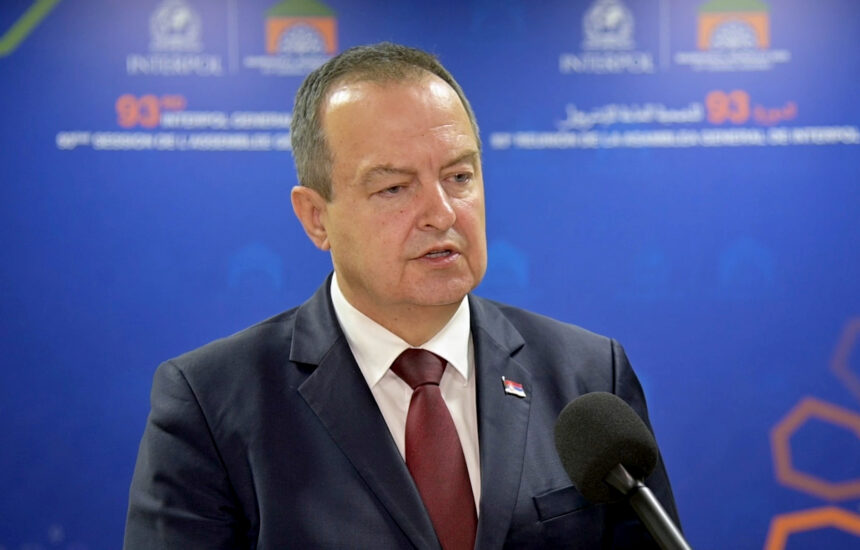
The Deputy Prime Minister and Minister of Internal Affairs of Serbia, Ivica Dačić, issued an aggressive public warning on Tuesday night, stating that the Republic of Serbia will aggressively prosecute and sanction any individual who contributed to the detention of five Kosovo-Serb officials in Graçanica.
Dačić’s fierce response follows a high-stakes law enforcement operation executed by the Basic Prosecution of Prishtina, which resulted in the arrest of five Serbian citizens in the central Kosovo enclave. The individuals are being held under official suspicion of violating Article 210 of the Kosovo Criminal Code, which covers the “Violation of the Free Will of Voters” ahead of the fast-approaching June 7 snap parliamentary elections.
Belgrade Brands Operation an “Anti-Serb Act”
According to official releases from the Serbian Ministry of Internal Affairs (MUP), the state intends to use its full legal and judicial weight to retaliate against those cooperating with Prishtina’s anti-coercion probe.
“All individuals who, through their actions, contributed to the detention of the five Serbs—directors of health and educational institutions of the Republic of Serbia from the central part of Kosovo and Metohije—will be aggressively prosecuted and sanctioned in strict accordance with the laws of the Republic of Serbia,” Dačić stated in a formal bulletin.
The interior minister explicitly categorized the judicial sweep as an “unlawful, unfounded, and deeply anti-Serb act,” asserting that Belgrade is entirely resolute in ensuring that anyone responsible for aiding the operation is “treated with the absolute utmost severity under Serbian law.”
   [THE ESCALATING LEGAL STANDOFF]
   • Prishtina's Mandate: Arrests executed under Article 210 (Voter Coercion).
   • Belgrade's Counter-Threat: Criminal prosecution under Serbian law for any informants or collaborators.
   • Target Demographics: Heads of the remaining parallel Serbian health and education sectors.
Inter-Party Warfare Triggered the Sweep
The political firestorm was initially lit by Nenad Rašić, a minister within the technical mandate of the Kosovo government and leader of the progressive Party for Freedom, Justice, and Survival (PDS). Rašić formally complained that Lista Srpska—the dominant, Belgrade-backed political force in the enclaves—was conducting a brutal economic purge by summarily firing public sector employees who refused to pledge absolute fealty to them.
Both Lista Srpska and the head of Serbia’s Office for Kosovo, Petar Petković, immediately moved to control the narrative, confirming that the five detainees are prominent administrative directors managing local hospitals, clinics, and school districts funded by Belgrade.
Petković heavily blasted the operation, characterizing it as a calculated, thuggish campaign orchestrated by Prime Minister Albin Kurti to systematically terrorize and break the spirit of the Serbian electorate before they can cast their ballots on June 7.
With Dačić now threatening cross-border criminal sanctions against Kosovo investigators, local politicians, and civilian whistleblowers, monitors warn that the upcoming election has devolved into a volatile security crisis between Prishtina’s security apparatus and Belgrade’s state defense mechanisms.