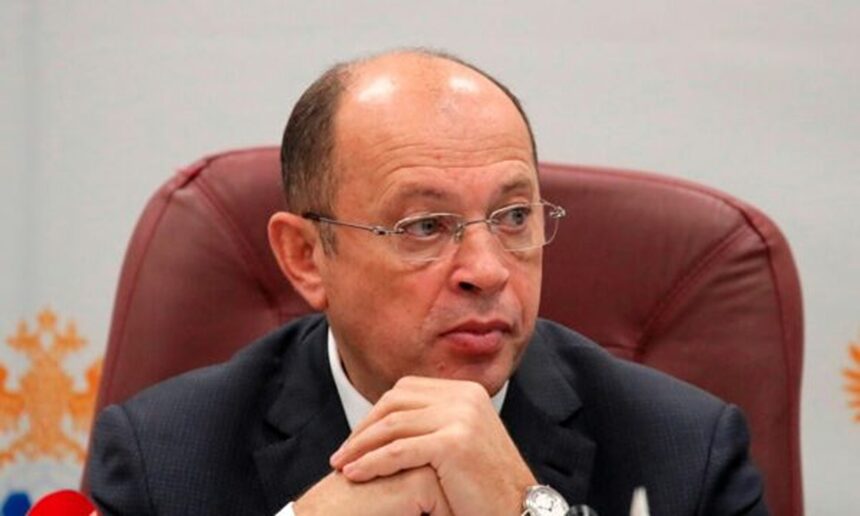
Russian football official and former intelligence officer Sergei Pryadkin has obtained Serbian citizenship through an accelerated procedure, according to an analysis of official Serbian government documents by the Balkan Service of Radio Free Europe.
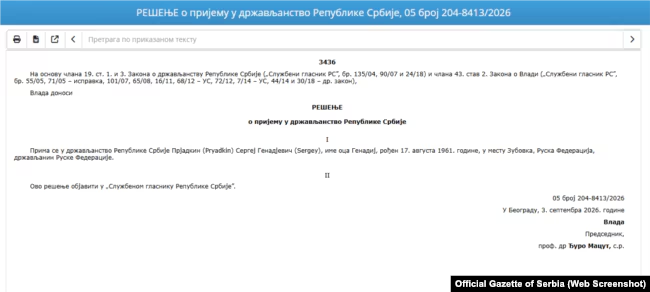
The Serbian government approved Pryadkin’s citizenship on September 3, bypassing the country’s regular naturalization procedures. The decision, signed by Serbian Prime Minister Đuro Macut, was published the following day in Serbia’s Official Gazette.
The decision cites a legal provision allowing a foreign national to obtain Serbian citizenship through an expedited procedure when doing so is considered to be in the “interest” of the state.
However, Serbian authorities did not provide an explanation for why Pryadkin’s citizenship was considered to be in Serbia’s interest.
Media reports have highlighted Pryadkin’s close ties to prominent figures in Serbian football, particularly Zvezdan Terzić, general director of Red Star Belgrade and godfather of Serbian President Aleksandar Vučić.
Serbian football clubs have continued to maintain what they describe as “brotherly relations” with Russian clubs and the Russian national team despite international sanctions imposed following Russia’s full-scale invasion of Ukraine.
The Serbian government did not respond to Radio Free Europe’s questions about why Pryadkin was granted citizenship or how his naturalization serves Serbia’s interests.
Radio Free Europe also attempted to contact Pryadkin through UEFA and the Russian Football Union, but received no response before publication.
Who is Sergei Pryadkin?
Pryadkin has long been considered one of the leading figures in Russian football.
He headed the Russian Premier League for 14 years, stepping down in 2021. He has also served as a vice president of the Russian Football Union.
His career in Russian football has been accompanied by journalistic investigations raising allegations of corruption and conflicts of interest related to player transfers. Russia’s main football governing body has denied those allegations.
Pryadkin later became involved with UEFA. According to Russian state news agency TASS, in June 2025 he said he was serving his second term as an adviser at UEFA and was officially expected to remain in the position until 2027.
The Russian Football Union identified Pryadkin in 2025 as an adviser to the UEFA president. He has said that his work within European football included efforts to facilitate the return of Russian teams to international competition.
Russian clubs and the national team have been suspended from UEFA and FIFA competitions since 2022. However, the sanctions do not apply to individuals working within international football organizations.
UEFA confirmed to Radio Free Europe that its sanctions do not apply to Russian officials working within the organization.
Pryadkin’s name does not appear in UEFA’s current list of officials and bodies, although UEFA did not clarify whether he currently has another form of involvement with the organization.
In 2019, Pryadkin was awarded the Order of Honour by Russian President Vladimir Putin for his work as a senior football official.
Before entering football, however, Pryadkin had a career in intelligence.
His official biography, previously published on the Russian Football Union’s website, states that he studied at a KGB institution, referring to the Soviet Union’s secret police, and later served in Russian intelligence structures during the 1990s.
“Best friend” of Red Star executive Zvezdan Terzić
According to media reports, Pryadkin has visited Belgrade regularly in recent years and has been hosted by Zvezdan Terzić, one of the most influential figures in Serbian football.
In a 2023 interview with the Serbian weekly NIN, Terzić described Pryadkin as a “former KGB general” and his “best friend.”
A video from 2024 also went viral on social media showing Terzić and Pryadkin singing the Russian folk song “Katyusha” together at a private celebration in Belgrade following Red Star’s UEFA Champions League victory.
Terzić did not respond to Radio Free Europe’s questions about whether he played any role in Pryadkin obtaining Serbian citizenship.
Serbia maintains close football ties with Russia
Although Russian teams have been excluded from European competitions since 2022, Serbian clubs have continued their cooperation with Russian counterparts.
The country’s most successful clubs, Red Star Belgrade and Partizan, have played several friendly matches against leading Russian teams, maintaining what they describe as “brotherly relations.”
In 2024, the Serbian national team became the first European national side to play a friendly match against Russia in Moscow after the sanctions were imposed. The game was promoted as a “brotherly duel” and was approved by UEFA.
Serbia’s football ties with Russia mirror the broader policy of the Serbian authorities, who have so far rejected repeated calls from Brussels to align with the EU’s common foreign and security policy, including sanctions against Moscow.
A previous Radio Free Europe analysis published in June found that, since the beginning of 2026, the Serbian government had granted citizenship through accelerated procedures to four times as many Russian citizens as to all other foreign nationals combined.
Among those granted citizenship were at least three Russian nationals under international sanctions.
The analysis also found that since the beginning of Russia’s war against Ukraine, more than 300 Russian citizens have obtained Serbian citizenship through government decisions.
The actual number is likely higher, as Serbian citizenship can also be granted by the Interior Ministry through regular procedures when applicants meet the required conditions.
Serbia’s Interior Ministry did not respond to Radio Free Europe’s questions about how many Russian citizens have obtained Serbian citizenship since 2022.
The case of Sergei Pryadkin has therefore renewed scrutiny of Serbia’s accelerated naturalization practices and its continued political, economic and institutional ties with Russia, despite Belgrade’s declared ambition to join the European Union.