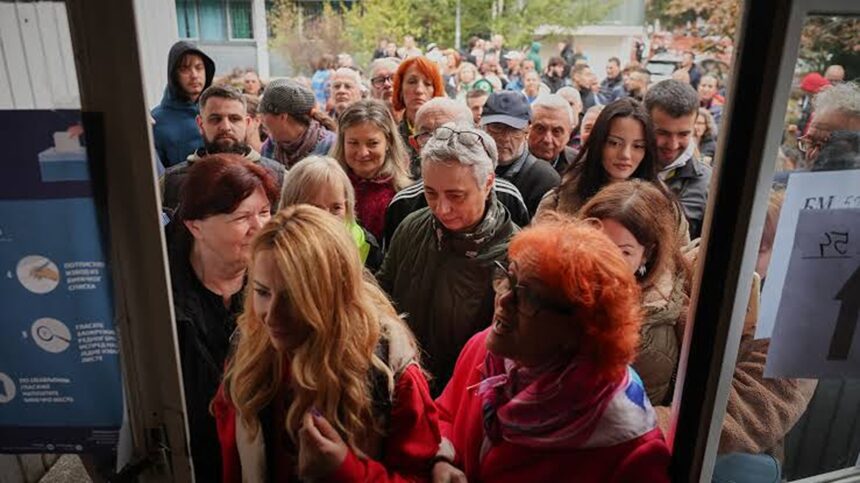
High voter turnout was recorded in Serbia’s early parliamentary elections by midday, while reports of irregularities emerged at polling stations across the country.
According to the Republic Electoral Commission (RIK), 34.55% of eligible voters had cast their ballots by 12:00 p.m. Long queues were reported outside polling stations.
This represented a higher turnout than in the 2023 elections, when 21.33% of voters had cast their ballots by the same time.
Meanwhile, election observation mission CRTA reported that 41.1% of registered voters had voted by 1:00 p.m. At the same time during the 2023 elections, turnout stood at 26.6%.
Voter participation was also higher than in previous elections during the early morning hours.
CRTA said earlier that turnout was already “outside historical trends.” Rasha Nedeljkov of the organisation reported irregularities, stating that procedural violations had been recorded at 14% of polling stations by midday.
Reported irregularities included the photographing of ballots, problems involving electoral ink and ultraviolet lamps, and other procedural issues.
In these elections, Serbia’s third parliamentary vote in five years, a student movement that emerged from a civic initiative is seeking to end the 14-year rule of Aleksandar Vučić and the Serbian Progressive Party (SNS).
According to CRTA, polling stations across Serbia opened largely on schedule. Meanwhile, the Center for Free Elections and Democracy (CeSID) reported more than 70 irregularities by 9:00 a.m.
The organisation documented cases of ballot photographing, mobile phone use, voting outside polling booths and family voting. One report alleged that a voter had cast a ballot on behalf of another person.
Serbian police intervened in a neighbourhood in Novi Sad where citizens had gathered. Some people said they had seen individuals carrying money and envelopes. CRTA also reported that six men and one woman obstructed an election observer outside a polling station and verbally abused her.
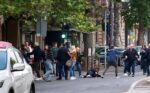
In Pančevo, local media reported that a group of masked individuals attacked several young people outside a polling station.
According to a video published by Pancevo.city, masked individuals armed with iron bars attacked the young people, with one victim seen bleeding from the face.
Other incidents included clashes between polling station board members, temporary suspensions of voting, threats and incidents involving voters, as well as problems with election materials and voter verification.
“Particularly concerning is the obstruction of access for election observers. At several polling stations, observers have been denied access, forcing us to contact the responsible authorities and intervene so that they can carry out their duties,” CeSID said.
Polling stations opened at 7:00 a.m. and were scheduled to remain open until 8:00 p.m. A total of 6,450,523 citizens were eligible to vote. Voting was taking place at 8,392 polling stations, including 93 abroad.
Vučić resigned from the presidency at the end of September. As he cannot run for a third presidential term, he is now seeking to become prime minister, a position he held from 2014 until his election as president in 2017.
However, the election campaign has been accompanied by growing concerns about possible electoral manipulation.
The elections are being closely monitored by the European Union, which has criticised Serbia over democratic backsliding under Vučić’s leadership.
An Uncertain Outcome
Amid deep political divisions and social tensions, Vučić’s Serbian Progressive Party (SNS) is seeking to retain power following two years of mass protests against the government and corruption across the country.
For the first time in many years, however, the party faces a significant challenger: the Student List, a movement that emerged from these protests.
“These are the first elections in more than a decade whose outcome is genuinely very uncertain,” Vladimir Bilčik, former European Parliament rapporteur for Serbia, told Radio Free Europe/Radio Liberty (RFE/RL).
Available opinion polls suggest that Serbia’s electorate is largely divided between those supporting a broad coalition built around the ruling party and those backing the student movement.
The students have no formal leader, and their electoral list consists of non-partisan figures, most of whom are university professors.
On November 1, 2024, the collapse of a reconstructed canopy at the city’s railway station killed 16 people. Suspicions of corruption surrounding work on one of the government’s flagship projects, involving Chinese companies, triggered protests across the country.
The government denied the allegations, while protesters faced police violence and arrests. One of the most serious incidents occurred on March 15, 2025, when authorities were alleged to have illegally used a sonic weapon against peaceful demonstrators.
Vučić Faces the Student List
More than 6.4 million eligible voters are choosing among 2,418 candidates competing for 250 seats in parliament. The race is expected to centre primarily on Vučić’s party and the Student List.
At stake are the continuation of Vučić’s policies, including close ties with Russia and China, and the student movement’s pledge to fight corruption.
Several US lawmakers have warned that Moscow could play an active role in the elections, while the European Parliament has raised concerns about Russian influence operations in Serbia.
“Russia is making its best resources, tactics and methods available to monitor, suppress and obstruct the citizens of Serbia, as well as the powerful student movement that wants to restore the rule of law in the country,” Republican Congressman Joe Wilson told RFE/RL.
Alongside maintaining close ties with Russia, Serbia’s main gas supplier, Vučić has sought to strengthen relations with China, a major investor in the country, while preserving Serbia’s long-standing ambition to join the European Union. He has also sought to improve relations with the United States and Israel.
During the campaign, Vučić pledged to continue this foreign policy course, including refusing to impose sanctions on Russia over its invasion of Ukraine, despite calls from the EU.
The student movement, meanwhile, has placed foreign policy lower on its agenda. Nevertheless, it has opposed sanctions against Russia and reiterated its support for Belgrade’s official position against recognising Kosovo’s independence.
“This shows that even the students are unable to escape the trap of Serbia’s nationalist politics, which is built around the Kosovo myth,” Žarko Korać, a professor from Belgrade, told RFE/RL.
Concerns Over Electoral Manipulation
The election campaign has been marked by growing concerns about possible manipulation during Sunday’s vote.
RFE/RL’s Balkan Service found that approximately 500,000 people had been registered to vote without a complete address.
RFE/RL also found that hundreds of voters had been registered at public facilities, including social welfare centres, and at homes that could not accommodate such large numbers of residents. The authorities have rejected these allegations.
Investigations have also highlighted an increase, ahead of the vote, in the number of people eligible to vote in Serbian elections in Bosnia and Herzegovina and Kosovo.
Ethnic Serbs in both territories are considered an important source of support for Vučić’s party.
Serbia’s previous elections, held in 2023, were followed by widespread protests after international observers reported irregularities, including the transportation of voters by bus from neighbouring Bosnia and Herzegovina and voter intimidation.
A bipartisan group of US senators called on Serbian authorities to ensure a level playing field for all election participants, citing “troubling signs” ahead of the October 25 vote.
A statement published on October 21 by the Senate Foreign Relations Committee referred to reports of illegal surveillance targeting opposition members and efforts to discredit and obstruct election observation missions.
An independent forensic analysis by domestic and international experts confirmed nearly 20 cases involving the use of illegal surveillance software since the beginning of 2026.
The opposition and student movement have accused the authorities of conducting the surveillance, while government officials deny spying on their opponents.
The OSCE Office for Democratic Institutions and Human Rights (ODIHR) deployed 14 experts and 30 long-term observers for the elections in Serbia, with another 300 short-term observers scheduled to join them on election day.
Change of Government, Continuity on Kosovo
The contest between Vučić’s SNS and the Student List is expected to be close, although opinion polls have produced differing results.
Faktor Plus puts Vučić’s list ahead with 48.6%, compared with 37.1% for the students. By contrast, the Serbian political analysis and polling organisation NSPM gives the student movement the lead, with 44.4% against 41.7%.
For Kosovo, however, a change of government in Belgrade would not necessarily mean a change in Serbia’s position on Kosovo’s statehood. As the student movement’s foreign policy positions indicate, opposition to Kosovo’s independence remains a common position shared by both political blocs.
In May, the student movement formalised this position in a memorandum describing Kosovo as an “inalienable and integral part” of Serbia.
According to Marko Savković, an associate of the Belgrade-based Centre for International and Security Affairs, opposition to Kosovo’s statehood did not begin with Vučić and is unlikely to end with him. He argues that political space for a fundamentally different approach to Kosovo’s status remains very limited.
“When it comes to rejecting Kosovo’s statehood as a concept, this is certainly state policy, and some degree of continuity can be expected regardless of who holds power in Serbia. Political options that accept the de facto situation, because Kosovo is de facto a state, are few and remain on the margins of the political spectrum,” Savković said.