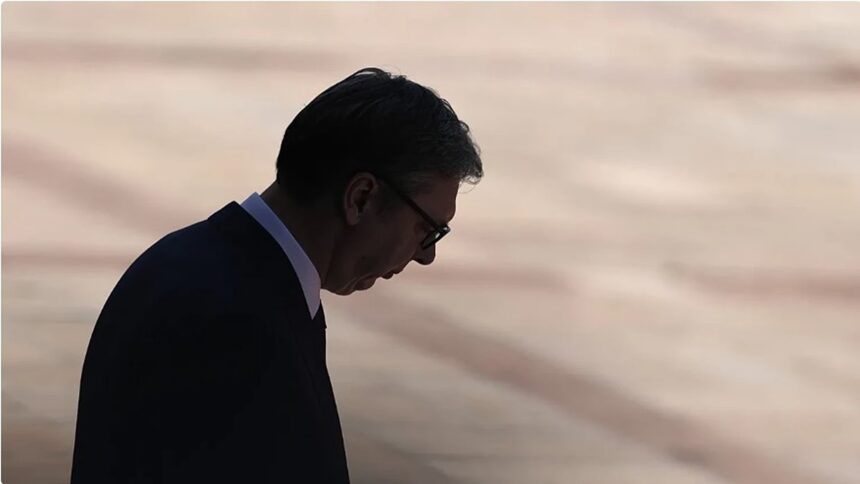
As a young man and war volunteer, Serbia’s current president, Aleksandar Vučić, served in Sarajevo in support of a criminal policy—one whose consequences are still felt today, writes German journalist Michael Martens in the prestigious German newspaper Frankfurter Allgemeine Zeitung.
“Even cemeteries die.” This is what the former Yugoslav Nobel Prize-winning author Ivo Andrić once wrote in his 1954 essay, In the Jewish Cemetery of Sarajevo. Of the once 12,000 Jews who had lived in the Bosnian capital, only a handful remained at that time. Most had not survived the occupation by German troops and their Croatian allies between 1941 and 1945; they were murdered in Auschwitz, Bergen-Belsen, or the Croatian-run Jasenovac concentration camp.
Andrić had Jewish friends and was familiar with the history of Bosnia’s Jewish community: “When the Jews were expelled from Spain at the end of the 15th century, they sought refuge in various countries where there was no systematic persecution of Jews and where they were, at the very least, tolerated. One of those countries was the Ottoman Empire. In the 16th century, the expelled Spanish Jews—the Sephardim—also appeared in the major commercial centers of the Balkans, including Sarajevo.”
In Bosnia, “surrounded by the prejudices and superstitions of their fellow citizens of other faiths,” they spoke at home the Spanish language they had brought from their homeland, from which Ladino, or Judeo-Spanish, later developed. “It was a small community, hermetically closed by the force of circumstances and customs, where there was wealth earned through immense effort, guarded with constant anxiety and continually under threat, and even more widespread, profound poverty,” wrote Andrić, who himself had experienced severe poverty as a child after being born in Sarajevo in 1892 to a single mother.
Yet it was only the Second World War that completely destroyed the city’s Jewish community, wiping out entire families or reducing them so drastically that their centuries-old presence became more visible in the Jewish cemetery than among the living. “A world that no longer exists,” Andrić observed in 1954, drawing from this a broader appeal: if humanity is to deserve the name “humanity,” it must organize itself “against all international crimes, so that strong barriers may be erected and real punishment imposed on all murderers of people and nations.”
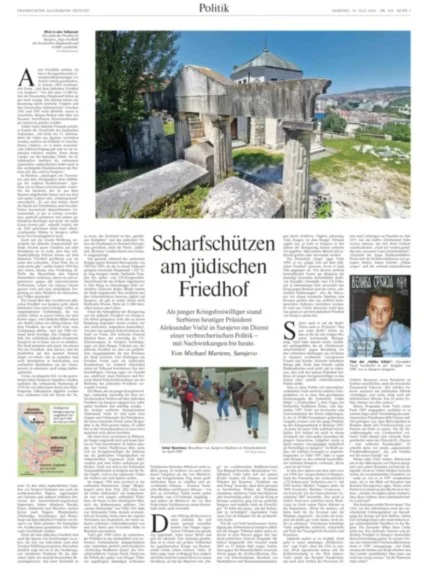
Anyone who walks today through Sarajevo’s devastated Jewish cemetery, through knee-high grass and overgrown bushes, past the embedded gravestones that rise from the ground like crooked teeth from a jaw, sees scenes similar to those witnessed by Andrić seventy years ago. In the cemetery where the first burial took place around 1630, no one has been buried since 1966. The grounds are slowly disappearing into ruins. Sarajevo’s remaining Jewish community is too small to maintain it. The city itself barely takes any responsibility for it. In the upper, oldest section of the cemetery, the inscriptions on most of the gravestones have already disappeared; only on some can words in Hebrew and Arabic script from the Ottoman era still be recognized, along with a few inscriptions in Ladino.
Further below, in the newer section, where Sarajevo’s Jews were buried after Ottoman rule was replaced in 1878 by four decades of Habsburg occupation, the list of names becomes broader. Alongside Sarajevo’s old Sephardic families came Ashkenazi families from Galicia and other eastern provinces of the Austro-Hungarian Empire. Next to the Albaharis, Baruhs, Fincis, Calderons, and Maestros, the Jewish cemetery of Sarajevo also became the resting place of Singers, Mondshajns, Glückseligs, Sternbergs, and Rosenbergs, until both the Sephardic and Ashkenazi communities were ultimately consumed by the Holocaust.
But the Jewish cemetery also bears the traces of the destruction that occurred only decades after the Second World War. This is particularly evident in a monument erected after the war for the Jewish victims of the terror of the German-Croatian occupation. A stone plaque states that the monument is dedicated to the “fallen fighters” and Jewish victims of fascism in Bosnia and Herzegovina, but the words “victims” and “Bosnia” have been torn away by a grenade.
This happened during the Serbian war against Bosnia and Herzegovina from 1992 to 1995, when Bosnia’s capital, located in a valley, was kept under siege for 1,425 days. The Serbian forces of General Ratko Mladić—who was later sentenced to life imprisonment by the UN tribunal in The Hague for crimes committed during the wars in the former Yugoslavia—had surrounded the city. Their artillery and snipers fired on Sarajevo every day; often there was neither electricity nor running water. More than 11,000 people were killed.
One of the scenes of the siege was precisely Sarajevo’s Jewish cemetery. The highest parts of this area on the hillside were controlled by Serbian attackers. From there, snipers targeted the city. British General Michael Rose, who for a time commanded UN protection forces in Sarajevo, testified before the Hague Tribunal that the Jewish cemetery had consistently been a dangerous launching point for shelling the city. A city hospital in the Marienhof neighborhood below in the valley was also fired upon from positions in the cemetery. A surgeon working there testified in court that patients and medical staff had repeatedly been wounded by snipers firing from the direction of the Jewish cemetery.
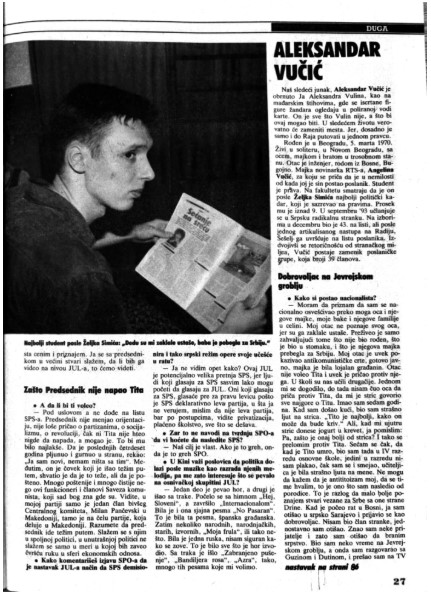
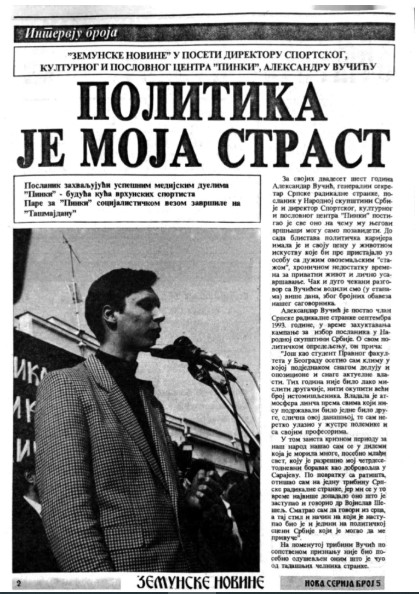
A man who, as a young war volunteer, had been present for at least some time during these criminal actions at Sarajevo’s Jewish cemetery would later become famous and powerful—the current president of Serbia, Aleksandar Vučić. It was not his opponents or critics who brought this unpleasant detail of his biography into the public sphere; he himself spoke proudly about it in interviews during the 1990s.
The interviews were published in newspapers that have since ceased publication and have left only a few traces online. Some of Vučić’s boasts about his time as a war volunteer never made the transition from the printed past into the electronic present and have remained relatively unknown. However, anyone who searches through the archives of the National Library of Serbia in Belgrade, deep within its paper collections, can find many traces.
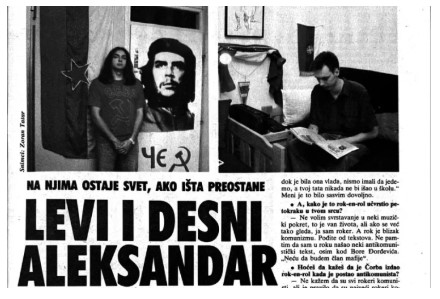
In August 1994, for example, the Serbian illustrated magazine Duga (“Rainbow”) published a double portrait titled “Aleksandar Left and Right,” featuring two young Serbian politicians who today are among the country’s most powerful figures. “Aleksandar Right” was Vučić. “The Left” was Aleksandar Vulin, then formally a socialist, today one of the president’s closest associates, a former head of Serbia’s intelligence service, known for his particularly close ties with Russia.
By 1994, Vučić was already considered a rising politician within the “Serbian Radical Party” of Vojislav Šešelj, a party believed to have been created or at least partially infiltrated by the Serbian state security service. For Šešelj, the policies of Serbia’s then-president Slobodan Milošević—also later indicted in The Hague—were not radical enough. He demanded an even more extreme course to create a Greater Serbian state through war and to expel the “undesirable” ethnic groups from it: Croats, Bosnian Muslims, and Kosovo Albanians. Šešelj was later also indicted by the UN tribunal—and unlike Milošević, who died of a heart attack before the end of his trial, he was convicted.
In 1994, all of this still appeared to be a future that few could have imagined. The Hague Tribunal had only recently been established, had limited resources, and was regarded as weak. Almost no one believed it would ever be able to bring the main figures responsible for the crimes of the Yugoslav wars to justice. Vučić, aged 24, had studied law in Belgrade and was still living with his parents in an apartment building when the Duga journalist visited him in the socialist-era neighborhood of New Belgrade. He lived in modest conditions. Vučić shared a room with his brother, Andrej; the journalist noted “war trophies” hanging on the wall, without describing them in detail. Vučić himself willingly explained where these trophies came from: “When the war in Bosnia began, I went to Serbian Sarajevo and registered as a volunteer.” He said he had done so “to defend Serbdom.”
How this “defense of Serbdom” unfolded in practice in Sarajevo was documented by the Hague Tribunal, among other cases, during the trial of Bosnian Serb Army General Dragomir Milošević. He was sentenced in 2007 to 33 years in prison for crimes against humanity: terror against civilians, the use of snipers, and artillery attacks on markets and gatherings of people. Every day, for years. Numerous witnesses told the court that during the siege of Sarajevo there was no safe place. People could be killed or wounded anywhere and at any time.
Vučić told Duga in 1994 that he had spent “some time at the Jewish Cemetery” before going to Pale. It was from this small town under Serbian control that Radovan Karadžić—also sentenced to life imprisonment by the Hague Tribunal—directed the war against Bosnia and the “ethnic cleansings”: massacres in which Bosnian Muslims and Croats were killed or expelled from areas claimed by Serbs. The interview does not make clear exactly what Vučić did at Sarajevo’s Jewish Cemetery.
Did he also fire on the city? Did he kill civilians? What was his role? What is certain is that there is no credible evidence for the claim circulating in recent months that Vučić allegedly served at the time as a guide for wealthy foreigners who, as “weekend snipers,” were paid to kill women and children in Sarajevo from Serbian positions. However, to understand that Serbia’s current president, as a young man and war volunteer, placed himself in the service of an extremely criminal policy, these extreme allegations are not necessary.
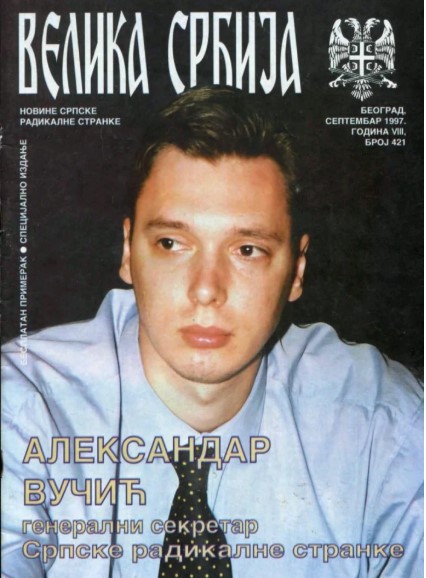
Vučić himself declared on other occasions that he fully supported this policy, for example in a special issue of Velika Srbija (“Greater Serbia”)—the publication of the Serbian Radical Party—in September 1997. At that time, Vučić had risen to the position of the party’s secretary-general. In the issue, printed in 50,000 copies, the young politician recalled the outbreak of the Bosnian war in 1992: “During that truly difficult period of crisis for our people, I found myself facing a dilemma that troubled many people, especially the younger generation. The dilemma was resolved through my forty-day stay as a volunteer in Sarajevo.” It is unclear what dilemma he was referring to. Overall, he said in 1997, he had spent eight months in areas of Bosnia under Serbian control, including “two months at the front.”
Three years after the 1994 interview, many things had happened in Bosnia. After the capture of the UN-protected area of Srebrenica on July 11, 1995, Mladić’s troops had executed more than 7,000 Bosnian Muslims — an act of genocide, as determined by the International Court of Justice in 2007. This does not play a role in Vučić’s statements. In the spirit of his party, he tells the journalist: “If you think I was committed to the Croats or the Muslims — I was not, and I have no intention whatsoever of being ashamed of that.” Instead, Vučić reiterates Serbian claims over parts of Bosnia and Croatia.
At the same time, he preaches patience. There is still “a powerful world policeman,” Vučić says, without openly naming the United States. But one day the balance of power in the world must change. Vučić gives the example of France, which, after losing Alsace and Lorraine to Prussia in 1871, had waited nearly half a century to take back those provinces. “We too will be patient, in order to reclaim our land,” the young radical promises. When the balance of power changes, Serbia should “show its teeth” and annex to Serbia the territories under Serbian control in Bosnia and Croatia, including the Croatian Danube city of Vukovar: “We will defend Vukovar first through political means, and if necessary, also through military means. It is our land, just like all the others.”
Vučić had already announced this program at the end of 1995, when, much to his frustration, the bloodshed in Bosnia was finally brought to an end through the Dayton Agreement, under the mediation of U.S. President Bill Clinton. In the December issue of the magazine “Greater Serbia,” he published an angry text titled “Dayton — a Serbian catastrophe.” There, he described the agreement as a “so-called peace agreement” that was “peace only for our enemies.”
oday, Vučić’s rhetoric has changed. He has rhetorically accepted the Dayton Agreement and respects the territorial integrity of Bosnia. However, in the media controlled by him, an openly revanchist tone continues to prevail — exactly as he had promised in 1997, when, referring to Croatia and Bosnia and Herzegovina, he said: when his party comes to power in Serbia, “we will remind them every day that those territories are our ancient lands.”
What do these words mean today? The United States, which three decades ago was the decisive factor in stopping the wars in the Balkans, has withdrawn or even supports hard-line nationalists in the region. The Europeans have failed to fill the vacuum. The Serbian veteran from the Jewish cemetery in Sarajevo is watching these developments closely. In his attack on the peace agreement in Bosnia in 1995, he had predicted: “In the end, the Serbs will raise their heads and take back their lands. We only need a little more patience.” Is the end of this waiting period now approaching?