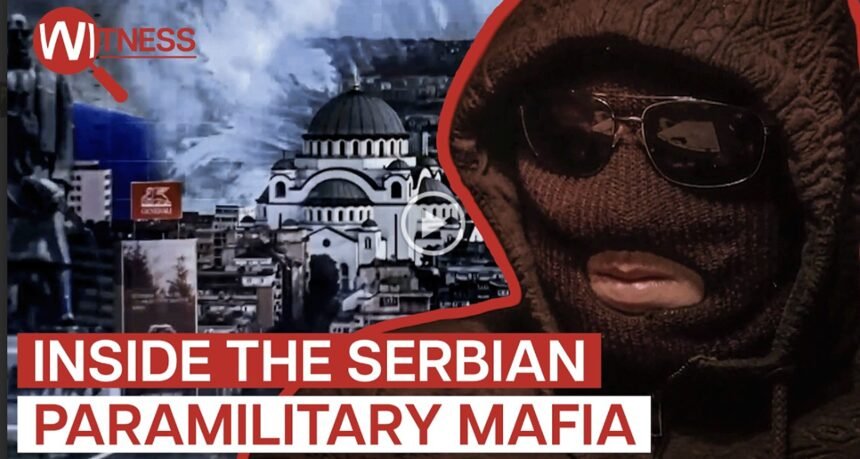
This investigative documentary follows journalist Jérôme Pira as he traces what he describes as one of Europe’s most persistent and deeply embedded criminal systems: an arms and organized crime network stretching from the Balkans into Western Europe. The film does not present isolated criminal cases, but rather a structured ecosystem in which war, politics, football hooliganism, and state institutions are portrayed as overlapping forces.
At the center of this narrative stands Serbia and, more specifically, the legacy of Željko Ražnatović, known as Arkan, whose name continues to surface in discussions of post-Yugoslav criminality, wartime violence, and political power.
The documentary’s tone is unapologetically accusatory. It suggests not only that Serbia served as a key hub for arms trafficking, but that the criminal structures born in the 1990s were never fully dismantled only transformed, absorbed, and protected.
A War Economy That Never Ended
The film argues that the Yugoslav wars did not simply end in the 1990s they created a permanent economic and criminal infrastructure.
According to the investigation, massive quantities of weapons remained in circulation after the conflict, forming the backbone of a long-term black market. These weapons, allegedly sourced cheaply in the Balkans, are described as being funneled through a chain of intermediaries across Europe, eventually reaching criminal networks in France, Italy, and Germany.
What is presented is not a fragmented trade, but a system organized, profitable, and resilient. The documentary repeatedly implies that such a system could not function at this scale without tolerance, protection, or at minimum institutional blindness.
Arkan: Criminal, Commander, and Symbol of Impunity
No figure dominates the film more than Arkan.
He is presented not as a peripheral actor, but as a central symbol of the era: a man who allegedly moved effortlessly between organized crime in Western Europe, paramilitary command during the Yugoslav wars, and later public legitimacy in Serbia.
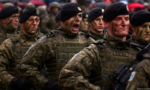
The documentary portrays Arkan as the leader of the Serbian Volunteer Guard (“Tigers”), a unit described as both militarized and ideologically driven, composed partly of football hooligans and individuals drawn from criminal environments.
The film’s implication is direct: that war did not suspend criminality it elevated it.
Arkan is shown as a figure who allegedly benefited from a system in which violence became politically useful, and criminal capability became a form of currency. His rise is framed as impossible without structural protection and selective state tolerance during the collapse of Yugoslavia.
The Passport System: A Parallel Infrastructure
Perhaps the most controversial claim made in the documentary concerns the issuance of official documents to individuals operating within these covert networks.
Boža Spasić states that during his time in the system, more than 600 passports were issued to criminals. These documents, according to his testimony, were part of a broader operational strategy that allowed selected individuals to move freely across borders under false or protected identities.
The film presents this as a critical mechanism: a parallel infrastructure of mobility that enabled suspected operatives, contract criminals, and intelligence assets to travel between Yugoslavia and Western Europe without detection.
This system, as described, was not limited to isolated cases but appears in the documentary as a structured and repeated practice, embedded within state security operations.
Football Stadiums as Criminal Infrastructure
One of the most striking accusations in the documentary is the role of football supporter groups in Serbia as extensions of organized crime.
Belgrade’s ultra groups are portrayed not as informal fan communities, but as disciplined networks allegedly involved in drug trafficking, burglary operations across Europe, and coordinated violence.
The film suggests that stadiums functioned as recruitment grounds, meeting points, and territorial headquarters for criminal groups. Rivalries between clubs are described as extending far beyond sport, reflecting deeper networks of influence, loyalty, and control.
In this framing, football becomes less a cultural phenomenon and more an operational cover for organized crime.
The State Question: Protection or Complicity?
Perhaps the most serious allegation raised by the documentary is the claimed historical overlap between organized crime and elements of state structures.
Former officials and insiders interviewed in the film suggest that during the 1990s, individuals such as Arkan were not merely uncontrolled criminal actors, but were at times utilized for specific operations linked to intelligence or security objectives.
The documentary does not present these claims as proven fact, but it frames them as part of a broader pattern: the idea that the boundaries between state violence and criminal violence became deliberately blurred during the Yugoslav wars.
This is where the film becomes most accusatory—implying that the system did not fail to control organized crime, but in some instances may have enabled or repurposed it.
Sanctions, Collapse, and the Expansion of Criminal Power
The 1990s sanctions imposed on Serbia are presented as a catalyst for the expansion of black markets. The documentary argues that economic isolation created ideal conditions for illicit trade to flourish, particularly in arms, fuel, cigarettes, and narcotics.
Within this environment, criminal groups allegedly became more powerful than legitimate institutions in certain spheres of economic life. The film suggests that war profits and sanctions-era smuggling laid the foundation for post-war wealth accumulation by individuals connected to these networks.
The implication is stark: criminal capital did not disappear after the war it was laundered into the post-war economy.
Arkan’s Death and the Silence Around Power
Arkan’s assassination in 2000 is treated not as an isolated crime, but as a turning point in a struggle for control over criminal and political influence in Serbia.
The documentary presents multiple competing theories criminal rivalry, political betrayal, and security involvement but emphasizes a key idea: that someone within the system had both motive and capacity to eliminate him.
The lack of a definitive judicial resolution is presented as part of a broader pattern of unresolved accountability in Serbia’s post-conflict transition.
A System That Adapted, Not Disappeared
One of the documentary’s strongest claims is that the structures formed during the wars did not vanish with peace. Instead, they allegedly adapted shifting from battlefield operations to economic, political, and criminal influence.
Former fighters, hooligans, and security-linked actors are described as having transitioned into business, construction, and political circles. The film suggests that this evolution allowed wartime networks to survive under a civilian facade.
Legacy and Unanswered Questions
The documentary ultimately leaves viewers with unresolved questions about accountability and institutional continuity. It argues that the legacy of the Yugoslav wars is not confined to history, but continues to shape criminal and political networks in the present.
The testimony of Boža Spasić, particularly regarding the issuance of hundreds of passports and the recruitment of criminals for covert operations, stands as one of the most striking elements of the narrative. Whether viewed as insider revelation or contested memory, it contributes to a broader picture of a period in which the lines between state authority and organized crime were, at the very least, dangerously porous.
In the absence of full judicial clarity, the documentary positions itself firmly in investigative territory—mapping connections, reconstructing testimonies, and exposing what it claims to be the hidden architecture of power behind one of Europe’s most turbulent regions.
“Inside Serbia’s Arkan’s Tigers Mafia: The War Criminal Gangsters” constructs a deliberately confrontational narrative: that the legacy of war in the Balkans cannot be separated from contemporary organized crime, and that Serbia through figures like Arkan remains central to that unresolved history.
While many of the documentary’s claims rely on testimony, interpretation, and investigative reconstruction rather than judicial confirmation, its argument is unambiguous in tone. It presents a system in which crime and power were not merely connected, but mutually reinforcing.
The result is a portrait of a post-war order where the past has not been fully buried reorganized.