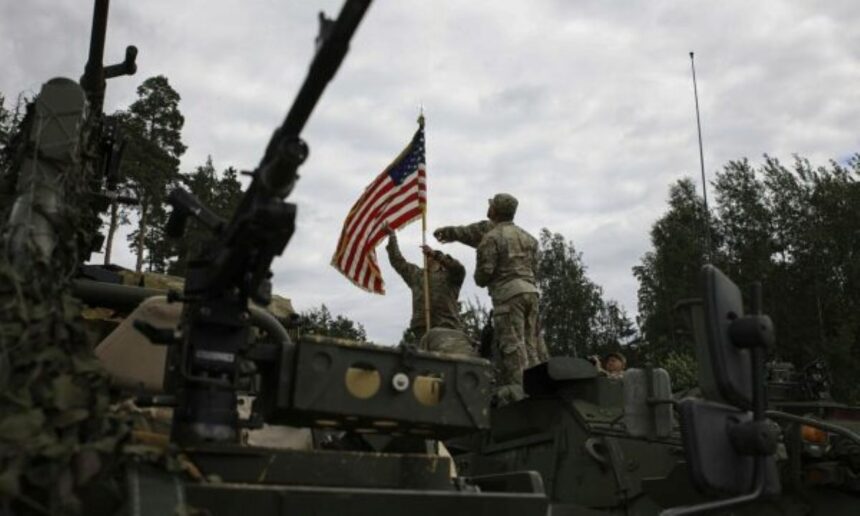
NATO’s Supreme Allied Commander Europe (SACEUR), U.S. Air Force General Alexus “Alex” Grynkewich, stated on Tuesday that he does not anticipate any immediate or additional drawdowns of American troops from the European continent, outside of the 5,000-person freeze recently ordered by President Donald Trump.
Speaking to reporters at NATO headquarters in Brussels, Gen. Grynkewich sought to calm growing transatlantic anxieties regarding the reliability of Washington’s conventional military umbrella.
“It will be 5,000 troops coming out of Europe,” Grynkewich stated during a meeting of the alliance’s top defense policy chiefs. “That is all that I am expecting in the near term.”
The Reality of the “Drawdown”: Canceled Deployments, Not a Retreat
While initial leaks of Trump’s executive order sparked fears of a wholesale retreat, the Pentagon has since clarified that the reduction will be executed by canceling scheduled rotations rather than pulling out personnel already dug into existing bases:
- Poland Deployment Halted: Roughly 4,000 soldiers belonging to the U.S. Army’s 2nd Armored Brigade Combat Team (1st Cavalry Division) will no longer be dispatched to Poland as planned.
- Germany Long-Range Block: A specialized deployment to Germany consisting of about 1,000 personnel trained in firing high-tech, long-range rocket systems has been officially frozen.
Despite these adjustments, the overall American footprint in Europe remains immense, with approximately 75,000 to 80,000 U.S. troops continuously stationed across the continent. Grynkewich emphasized that he has been in direct contact with military chiefs along the frontline—including Estonia, Latvia, Lithuania, and Poland—to reorganize existing assets and ensure deterrence against Russia remains ironclad.
   [THE BEDSHEET OF U.S. TROOPS IN EUROPE]
   Current Total Footprint: ~80,000 Troops Stationed in Europe
   -----------------------------------------------------------
   [ -4,000 ] Canceled Armored Brigade Deployment to Poland
   [ -1,000 ] Canceled Long-Range Rocket Deployment to Germany
   ===========================================================
   Adjusted Active Force: ~75,000 Troops Remaining In-Theater
Spat with Germany’s Friedrich Merz Over the Iran War
The sudden troop reduction follows an intense, highly publicized diplomatic fallout between President Donald Trump and German Chancellor Friedrich Merz.
Tensions boiled over after Merz publicly criticized Washington’s current military strategy in the Middle East, asserting that the United States was being “humiliated” by the leadership in Tehran. Trump, furious over the Chancellor’s public remarks and Germany’s perceived lack of support for the ongoing war with Iran, retaliated by abruptly freezing the scheduled troop augmentations to Germany and Poland without consulting alliance officials beforehand.
Long-Term Outlook: A Multi-Year Pivot to European Self-Reliance
While the immediate “hiccup” has been managed, Gen. Grynkewich left no room for doubt that the structural architecture of NATO is undergoing a permanent shift.
As the Trump administration prepares to pitch a downsized U.S. crisis commitment at the upcoming NATO Summit in Ankara, Turkey, this July, the top commander warned that Europe must accelerate its defense industrial manufacturing.
“Over the long term, we absolutely should expect additional redeployments as Europe continues to build capability and capacity and steps up to provide more of the conventional defense of Europe,” Grynkewich concluded. “It’s going to be an ongoing process for several years… but we are going to stay well-synchronized with our allies.”