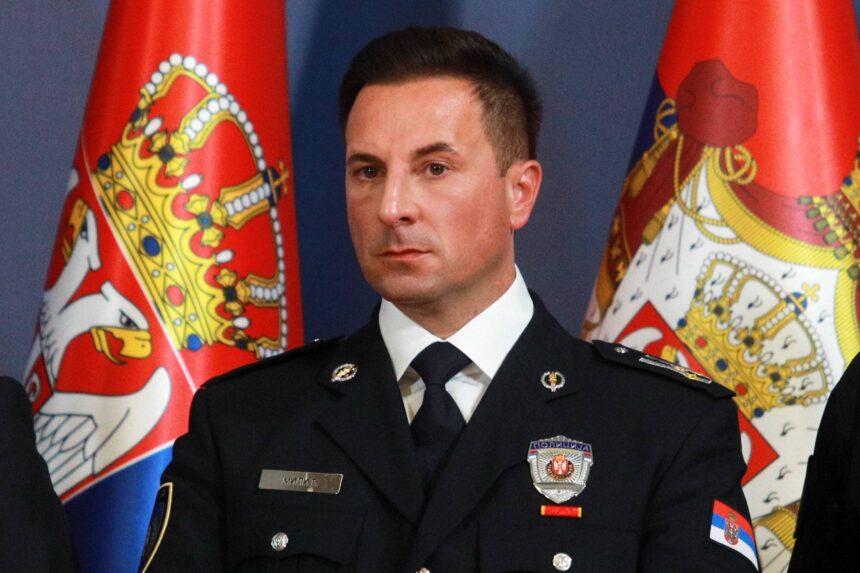
The widening fallout from the arrest of Belgrade Police Chief Veselin Milić has drawn fierce condemnation from opposition lawmakers, who are calling the crisis a systemic meltdown that proves organized crime has thoroughly pierced the upper echelons of Serbia’s government.
Appearing on N1 Television, Members of Parliament Stefan Janjić (of the SRCE party) and Aleksandar Ivanović (of the People’s Movement of Serbia – NPS), both lawyers by trade, characterized the situation in the country as deeply disordered.
“After 14 years of this regime, we don’t need lawyers anymore—we need psychiatrists, because we are living in a completely abnormal system,” Ivanović stated bluntly.
From the Generalštab to Total State Collapse
Ivanović recalled that just months ago, in February, opposition parties united to demand a parliamentary vote of no confidence against the government. At the time, the catalyst was the highly controversial “Generalštab” real estate deal involving Minister Nikola Selaković—an issue that then felt like a once-in-a-generation European scandal.
Today, Ivanović argues, that issue has been completely overshadowed by a mafia-style cover-up executed by the police force itself.
   [THE ESCALATION OF SYSTEMIC CORRUPTION]
   2016: Savamala Demolitions (State steps aside for illicit actors)
     │
   Feb 2026: Generalštab Real Estate Scandal (Controversial state asset handovers)
     │
   May 2026: The Senjak Cover-Up (Police Chief arrests over an ongoing murder case)
The lawmaker traced the genesis of this crisis back to the notorious 2016 Savamala demolitions, when masked men destroyed private property while police ignored emergency calls. “That was the exact moment the mafia mastered the state,” Ivanović noted. “The state capitulated, and the syndicate took over the entire system.”
A Culture of Silence: “Dačić Must Resign”
The interview focused heavily on the absolute silence of Ministry of Internal Affairs (MUP) leadership. Minister Ivica Dačić has noticeably avoided making public statements since the dramatic arrest took place.
Stefan Janjić pointed out that this vanishing act is a hallmark of Dačić’s political playbook whenever a crisis threatens his survival. Both lawmakers agreed that under normal democratic norms, the entire government cabinet would have collapsed by now.
- Systemic Accountability: The opposition is demanding the immediate resignations of both Minister Ivica Dačić and Police Director Dragan Vasiljević.
- Historical Precedent: Janjić emphasized that Serbia has never witnessed a corruption crisis of this magnitude. “Never before has a law enforcement official of this caliber been directly implicated in concealing a brutal murder. This is, without a doubt, the biggest scandal in the history of the police in this country.”
The Shield of Executive Immunity
The legal probe has continued to widen, with investigators recently questioning Nemanja Đuran, the former deputy chief of the Criminal Police Directorate (UKP), over telephone logs tied to the night of Aleksandar Nešković’s disappearance.
Despite the growing mountain of evidence, President Aleksandar Vučić has publicly rushed to Milić’s defense, utilizing a strict “innocent until proven guilty” talking point.
Opposition figures view this executive defense as a familiar tactic used to shield loyalists, drawing direct parallels to how the regime previously protected figures like Tomislav Momirović and Goran Vesić during past national infrastructure scandals.
With the political atmosphere in Belgrade rapidly deteriorating, neither lawmaker expressed optimism that the current institutions could deliver an impartial verdict. “We are no longer operating in a gray zone; we are fully in the black zone,” Ivanović concluded. “Ahead of the next elections, absolutely anything is possible.”