Russia and the United States should build a “Putin–Trump” railway tunnel under the Bering Strait to connect the two countries, unlock joint exploration of natural resources, and “symbolize unity,” according to one of Russian President Vladimir Putin’s closest associates.
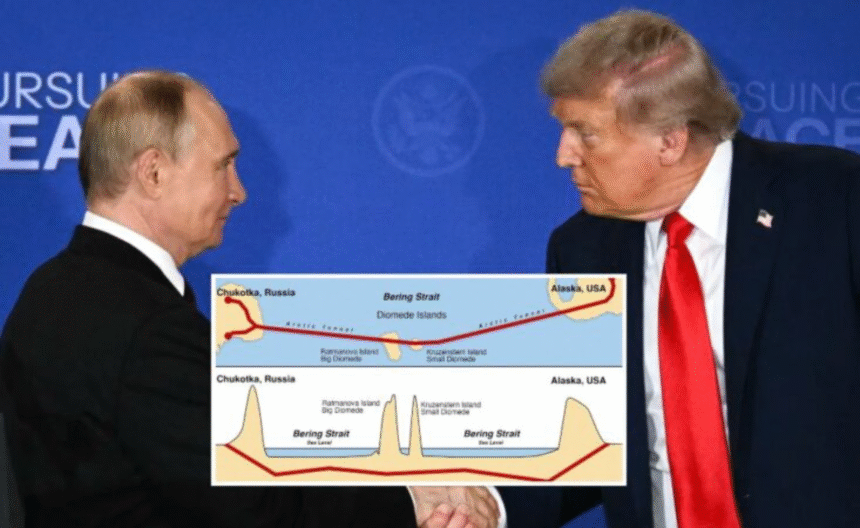
The proposal comes from Kirill Dmitriev, Putin’s investment envoy and head of Russia’s sovereign wealth fund RDIF (Russian Direct Investment Fund). He envisions an $8 billion construction project funded by Moscow and “international partners,” creating a 112 km (70-mile) rail and freight link within eight years.
Dmitriev floated the idea late Thursday, shortly after Putin and U.S. President Donald Trump spoke by phone and agreed to meet in Budapest to explore ways to end the war in Ukraine.
When asked about the idea during a meeting in Washington with Ukrainian President Volodymyr Zelensky on Friday, Trump called it “interesting” and jokingly asked Zelensky for his opinion. “I’m not happy with that idea,” Zelensky replied, drawing laughter from the American side.
“The dream of a U.S.–Russia connection through the Bering Strait reflects a long-standing vision—from the 1904 Siberia–Alaska railway concept to Russia’s 2007 plan,” Dmitriev wrote on X. “RDIF has reviewed existing proposals, including a U.S.–Canada–Russia–China railway, and will support the most feasible option.”
The Bering Strait, just 82 km wide at its narrowest point, separates Russia’s remote Chukotka region from Alaska. Ideas to link the two have existed for at least 150 years. In the middle of the strait lie the Diomede Islands—one Russian, one American—only 4 km apart.
Dmitriev, who has developed working ties with Steve Witkoff, Trump’s special envoy, suggested that major U.S. energy companies could join Russian Arctic projects. He proposed that the tunnel be built by Elon Musk’s The Boring Company, known for its tunnel construction technology.
“Imagine connecting the U.S. and Russia, the Americas and Afro-Eurasia, with the Putin–Trump Tunnel—a 70-mile link symbolizing unity. Traditional costs exceed $65 billion, but @boringcompany’s technology could reduce it to under $8 billion. Let’s build the future together,” Dmitriev wrote to Musk on X.
There has been no public response from Musk so far.
Beyond the tunnel itself, upgrading the infrastructure on both sides of the strait would require enormous additional investment, as Chukotka’s roads and railways are extremely limited.
Dmitriev noted that a similar concept—a “Kennedy–Khrushchev World Peace Bridge”—had been proposed during the Cold War. He posted a sketch from that era showing the proposed route, alongside a graphic depicting the potential path of the new tunnel.
“RDIF has already invested in and built the first Russia–China rail bridge,” Dmitriev said. “Now it’s time to do more—to connect continents for the first time in human history. It’s time to connect Russia and the U.S.”