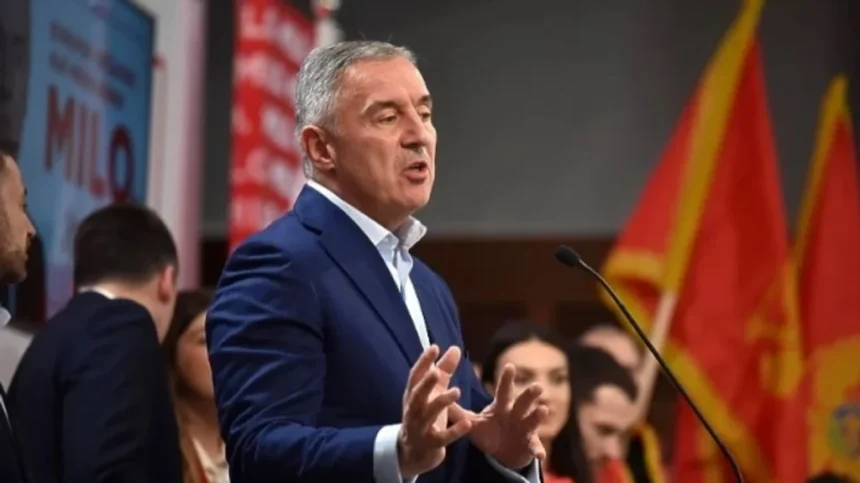
In a comprehensive retrospective broadcast, the former President and Prime Minister of Montenegro, Milo Đukanović, revealed explosive details regarding a multi-decade espionage plot orchestrated by Belgrade’s security apparatus.
Speaking on the special broadcast Traces in Time to mark the 20th anniversary of Montenegro’s independence, Đukanović asserted that powerful political and military intelligence circles in Belgrade launched the infamous “S.Č. Affair” in November 2002 with a dual goal: destabilizing Montenegrin statehood and subverting the military leadership of the NATO-led KFOR mission in Kosovo.
The Blueprint to Entrap and Compromise KFOR’s Military Leadership
According to the former Montenegrin leader, the scope of the conspiracy extended far beyond the borders of Montenegro, directly targeting the international military presence that stabilized Kosovo following the 1999 conflict.
Đukanović detailed a highly sensitive, state-sponsored entrapment scheme aimed at shifting the international community’s perspective on regional independence movements by systematically manufacturing high-level corruption and sex-trafficking scandals.
   [THE GEOPOLITICAL FRAMEWORK OF THE "S.Č. AFFAIR"]
   • The Ultimate Objective: To derail Montenegrin independence & delay Kosovo's sovereign recognition.
   • The Tactical Method: Human trafficking entrapment targeting top KFOR military leadership.
   • The Setup Venue: The Obilić Stadium complex in central Kosovo.
   • The Masterminds: KOS (Yugoslav/Serbian Military Counterintelligence) under Gen. Aca Tomić.
“The primary goal was to completely compromise KFOR in Kosovo and systematically ruin the credibility of its top military leadership,” Đukanović stated during the televised interview. “To achieve this, Belgrade’s agencies prepared a group of 27 young women who were explicitly trained to entangle and compromise high-ranking KFOR commanders.”
Among those deployed was “S.Č.,” a vulnerable Moldavian woman whose tragic personal hardships were weaponized by foreign intelligence handlers.
“The intelligence data we intercepted at the time confirmed she was being actively housed and trained within the premises of the Obilić Stadium,” Đukanović revealed. “Fortunately, KFOR and UNMIK intelligence units received our warnings just in time, neutralizing the operation before it could break out and inflict damage on the international command structures.”
The Brain Trust Behind the Anti-Western Pipeline
Đukanović placed direct blame on a highly organized network embedded within the cabinet of the former President of the Federal Republic of Yugoslavia, Vojislav Koštunica. This network represented a direct continuation of the authoritarian policies of Slobodan Milošević.
The former president explicitly identified key members of this political-security core:
- Rade Bulatović (Former national security adviser, later head of the BIA)
- Gradimir Nalić and Ljiljana Nedeljković (Senior legal and political aides to Koštunica)
- Aleksandar “Saša” Tijanić (Prominent media strategist and propaganda director)
“These individuals masterfully manipulated Koštunica’s nationalist convictions,” Đukanović explained. “They pushed him into direct, bloody standoffs with the reformist Serbian Prime Minister Zoran Đinđić to keep Serbia on its traditional, anti-Western trajectory. Simultaneously, they targeted me to prevent the dissolution of the state union and crush Montenegro’s European ambitions.”
The logistical muscle for this anti-Western apparatus was supplied by the Yugoslav Military Counterintelligence Service (KOS), then led by the hardline loyalist General Aca Tomić.
Internal Complicity: The Exploitation of Internal Ambitions
The plotters successfully exploited domestic political fractures inside Podgorica to transform a localized human trafficking case into a weapon against the government. Following a strong showing by the DPS-SDP coalition in the October 2002 elections, the KOS network found a vulnerable point in Montenegro’s own Minister of Internal Affairs, Andrija Jovićević.
   [THE DOMESTIC MOVES]
   1. The Purge: Jovićević intentionally bypassed the State Security Service (ANB) under Duško Marković.
   2. The Lobby: Jovićević used international anti-trafficking entities to protect his position.
   3. The Offer: Opposition parties offered Jovićević the presidency as a reward for enabling the scandal.
Đukanović recalled that Jovićević, embittered by missing out on the prime minister’s seat to Filip Vujanović, aggressively managed the legal file of the Moldavian victim to shield his own career and attract international backing. Jovićević went so far as to bypass the Montenegrin State Security Service, then commanded by Duško Marković, effectively giving the Belgrade network a free hand to execute its strategy.
“By locking out our primary national intelligence service—whose core duty was safeguarding the nation from subversion—Jovićević made the job of the Belgrade planners exponentially easier,” Đukanović noted.
A Fabricated Crisis Defeated by Truth
The ultimate design of the operation was to force the international community to view Montenegro as a lawless transit hub incapable of maintaining the rule of law or managing transnational crime, thereby invalidating its path to the 2006 independence referendum.
The smear campaign directly targeted the head of the Montenegrin prosecution and Đukanović himself. However, the former president immediately provided a formal deposition to the investigating magistrate, completely refuting the claims.
“I was an uncompromising advocate for taking that investigation to its absolute end,” Đukanović concluded. “When the dust settled, it exposed a massive, painful farce. It served as a stark warning that our state institutions must always remain professional, unified, and vigilant against hybrid threats designed to compromise our national interests.”