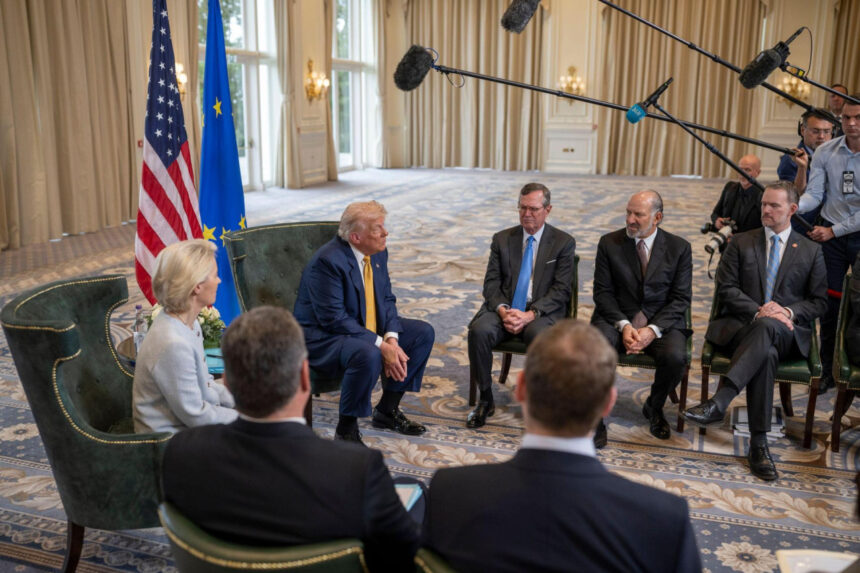
The European Union and the United States successfully averted a catastrophic, full-scale trade war early Wednesday morning. Following a grueling, five-hour negotiation session in Brussels, negotiators from the European Parliament, the Council of the EU, and the European Commission hammered out a legislative framework to implement the frozen trade pact originally brokered last summer at President Donald Trump’s Turnberry golf resort in Scotland.
The breakthrough comes at a critical juncture, directly neutralizing Trump’s aggressive ultimatum to impose a crippling 25 percent tariff on European automobiles by July 4 if Brussels continued to delay implementation.
A trade war of that magnitude threatened to destabilize a €1.7 trillion-a-year transatlantic commercial relationship, right as European economic growth struggles under the weight of an energy shock triggered by the ongoing conflict in the Middle East.
“The European Union has demonstrated once again that it is a reliable trading partner that respects its obligations,” stated European Commissioner for Trade Maroš Šefčovič as he emerged from the negotiating chamber at dawn.
The Terms: Industrial Reductions and the Turnberry Framework
Under the newly salvaged framework, the EU has agreed to eliminate import tariffs on a wide array of American industrial machinery and select agricultural products. In return, Washington is bound to cap its tariffs on the vast majority of European exports at 15 percent.
Transatlantic implementation had completely stalled earlier this year due to two major geopolitical disruptions:
- The Greenland Dispute: Transatlantic relations chilled in January after Trump renewed his highly controversial campaign to purchase Greenland from Denmark.
- The Supreme Court Factor: EU lawyers deliberately slowed negotiations after the U.S. Supreme Court struck down a substantial portion of Trump’s unilateral executive tariff-setting policies, leading Brussels to question the deal’s legal stability.
Key Protections: The 2026 Steel Clause and Safeguard Mechanisms
According to the final compromise text obtained and reviewed by POLITICO, European negotiators successfully inserted aggressive defense mechanisms to ensure the Trump administration plays by the rules:
- The Steel & Aluminum Ultimatum (End of 2026): In April, Trump signed an executive order pushing U.S. tariffs on European steel and aluminum up to 50 percent—a move European lawmakers argue blatantly violates the Turnberry caps. The new text dictates that the European Commission will monitor these levels and must report to Parliament by the end of this year. If Washington fails to roll back these steel and aluminum duties by the end of 2026, the European Commission holds the power, upon request by a member state or the Parliament, to completely suspend the entire trade agreement.
- The Industry Safeguard Trigger: The text introduces a protective mechanism enabling the Commission to launch an immediate commercial investigation—either independently or if requested by a coalition of at least three EU member states—to determine if surges in specific U.S. imports are causing material harm to local European sectors. This can trigger partial or total suspension of the deal.
The “Trump Sunset Clause”
To insulate European markets from future political volatility in Washington, negotiators successfully integrated a highly specific “sunset clause.”
Under this provision, the entire trade pact is legally scheduled to expire automatically in December 2029. This timeline ensures the deal concludes roughly one year after Donald Trump is constitutionally scheduled to finish his second term and vacate the White House, allowing the EU to renegotiate terms with the succeeding American administration.