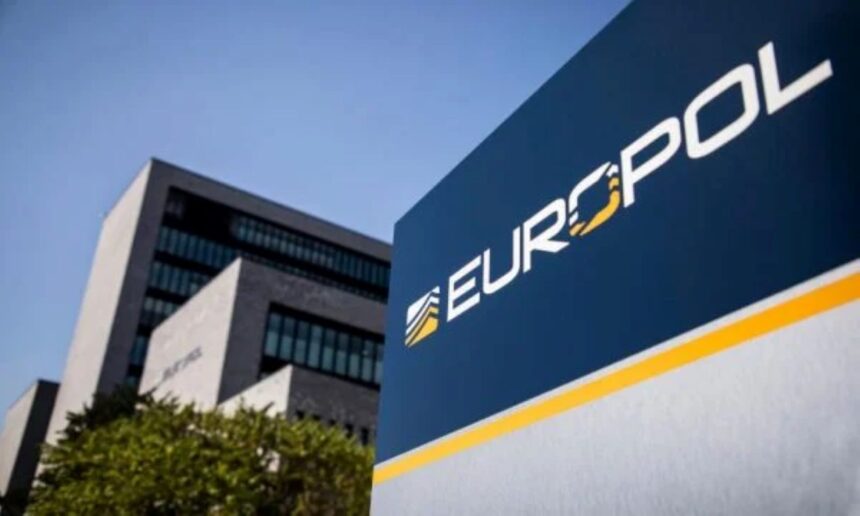
The European Union’s law enforcement agency, EUROPOL, has executed a sweeping, highly coordinated international cyber operation aimed at completely dismantling the digital footprint and terror-related online propaganda of Iran’s Islamic Revolutionary Guard Corps (IRGC).
The IRGC is formally designated as a terrorist organization by the United States, the European Union, and several allied nations, including Kosovo.
According to an official briefing from EUROPOL, the operation successfully flagged, mapped, and targeted 14,200 online posts and domains directly linked to the paramilitary group. The operational focus was to disrupt the IRGC’s weaponized digital infrastructure, which investigators note was actively being deployed to spread violent propaganda, recruit radical supporters, and launder illicit funds across Europe and the West.
A Global Coalition: 19 Nations Unify Cyber Defenses
The counter-terrorism initiative marshaled a coalition of 19 nations, uniting intelligence, judicial, and cyber-security units to scrub IRGC assets from the web:
   [THE ANTI-IRGC OPERATIONS COALITION]
   • EU Member States:   Austria, Belgium, Bulgaria, Czech Republic, Denmark, Estonia,
                         Finland, France, Germany, Greece, Hungary, Italy, Netherlands,
                         Portugal, Spain, Sweden.
   • Regional Partners:  Bosnia and Herzegovina, Ukraine.
   • Strategic Allies:   United States.
The operational phase ran continuously from February 13 to April 28, 2026. Under EUROPOL’s centralized command center, international intelligence analysts jointly aggregated raw metadata, verified structural targets, and systematically cross-referenced major global hosting platforms.
The targeted content spanned mainstream social media networks, video-streaming platforms, political blogging networks, and a constellation of independent, standalone websites.
AI-Generated Exploits, Crypto Funnels, and the Death of Khamenei
EUROPOL’s operational findings reveal a highly sophisticated multi-lingual media apparatus broadcasting in Arabic, English, French, Persian, and Spanish.
The targeted digital material included highly polished multimedia packets, ranging from traditional religious martyrdom narratives mixed with aggressive political messaging, to cutting-edge Artificial Intelligence (AI)-generated videos. These AI clips glorified the IRGC’s combat readiness and issued explicit, global calls for asymmetric vengeance following the death of Iranian Supreme Leader Ayatollah Ali Khamenei.
Geopolitical Context:
Supreme Leader Ali Khamenei was killed on February 28, 2026, during a devastating wave of airstrikes launched at the immediate outbreak of the ongoing U.S.-Israeli conventional military campaign against the Iranian regime.
   [ANATOMY OF THE IRGC DIGITAL NETWORK]
   1. Multi-Lingual Output (Arabic, English, French, Persian, Spanish)
   2. Generative AI Tools (Deepfake capabilities and automated revenge videos)
   3. Global Proxy Servers (Co-hosted networks spanning Russia and the U.S.)
   4. Crypto Laundering (Bypassing SWIFT/banking controls to purchase bot amplification)
Beyond standard radical messaging, cyber investigators uncovered extensive cryptocurrency transactions executed by IRGC front operators. These digital assets were transferred globally to purchase automated bot armies, rent foreign cloud servers, and amplify their digital operations while entirely evading traditional international banking checks and sanctions.
Immediate De-platforming and Structural Impact
Following the formal identification of the 14,200 toxic links, the EU moved to legally enforce a total block on the IRGC’s primary corporate account on the social media platform X (formerly Twitter), which maintained over 150,000 active followers. Hundreds of peripheral infrastructure links across major global tech companies have either been permanently expunged or remain frozen under active criminal investigation.
Established shortly after the 1979 Islamic Revolution to safeguard Iran’s hardline clerical leadership, the IRGC has grown into Teheran’s dominant ideological and military arm. Over the decades, it has completely monopolized the Iranian domestic economy, controlling multi-billion dollar conglomerates across the energy, construction, shipping, and telecommunications sectors.
EUROPOL officials emphasized that mapping out this multi-lingual network provides Western intelligence agencies with unprecedented data regarding how state-sponsored terrorist syndicates morph and operate in the digital age.