
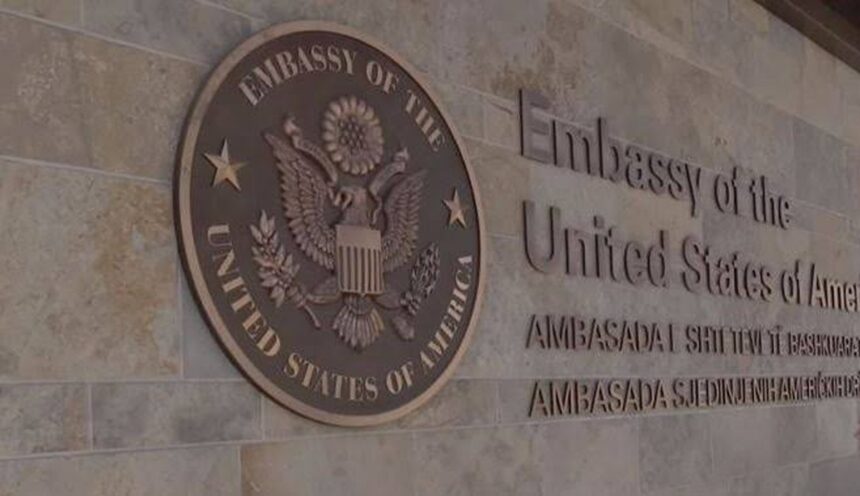
The United States expects that the Kosovo caretaker Government’s plan to establish a Gendarmerie force will be “in line with its commitments to preserving peace and security.”
This was stated to Radio Free Europe by a spokesperson for the US Embassy in Pristina, who added that they are “monitoring recent announcements regarding the proposal to create a gendarmerie force in Kosovo.”
On May 19, Kosovo’s caretaker Minister of Internal Affairs, Xhelal Sveçla, announced that the first steps had been taken toward the establishment of the Kosovo Gendarmerie. He said that a document had been signed creating a working group tasked with analyzing and proposing modalities for the functioning of the gendarmerie.
According to Sveçla, the force will have a clear mission focused on protecting borders, territorial integrity and sovereignty, combating terrorism, managing civil unrest, and safeguarding critical infrastructure.
Meanwhile, NATO — whose peacekeeping mission in Kosovo, KFOR, has been present since 1999 — told Radio Free Europe that it is closely monitoring statements made by Kosovo institutions regarding this issue.
“It is up to them to comment in more detail on this matter,” a NATO official said.
KFOR, which serves as the third security responder in Kosovo after the Kosovo Police and the European Union Rule of Law Mission (EULEX), is also responsible for security along the border line between Kosovo and Serbia.
The NATO official stated that the Alliance continues to cooperate with all security organizations in Kosovo and contribute to lasting security for everyone.
The official also noted that NATO’s Advisory and Liaison Team (NALT) has supported the development of the Kosovo Security Force (KSF) “in line with its original civil protection mandate through capacity-building, education, and training.”
“We expect Kosovo’s security organizations to continue this cooperative approach by coordinating with KFOR in contributing to security in Kosovo and regional stability, for the benefit of all communities living in Kosovo,” the NATO official said in a response to Radio Free Europe.
Meanwhile, the German Embassy in Pristina declined to comment on the matter.
The announcement regarding the first steps toward establishing the Gendarmerie was criticized by authorities in Belgrade, who stated that “KFOR is the only legitimate armed force in Kosovo responsible for controlling and patrolling along the administrative boundary line.”
Although details about the exact mission of the proposed Kosovo Gendarmerie remain unclear, the Executive Director of the Kosovo Center for Security Studies, Mentor Vrajolli, previously told Radio Free Europe that such a security force could assume competencies related to securing the border with Serbia, which currently falls under KFOR’s mandate.
According to him, Kosovo should prepare for any future changes in the role of NATO’s peacekeeping mission in Kosovo, KFOR, although he believes the mission will remain in the country for years, possibly even a decade.
In this context, he recalled that Kosovo and KFOR have an agreement under which the Kosovo Security Force — currently undergoing transformation into a military force — cannot enter northern Kosovo without prior approval from the peacekeeping mission. He argued that the Gendarmerie could fill this gap.
“As long as there is a gentleman’s agreement between KFOR and the KSF limiting its presence in the northern part of the country, the Gendarmerie would create a new structure that is not part of this gentleman’s agreement,” Vrajolli said.
According to him, this would enable border control responsibilities and other operations currently handled by KFOR to be jointly conducted with units within the Police or the Ministry of Internal Affairs, helping to accelerate the development of local capacities and expertise to jointly address threats alongside KFOR in northern Kosovo and other parts of the country.
The deployment of the KSF — currently in the process of transformation into an army — to northern Kosovo is only possible with prior approval from NATO’s KFOR mission, based on Kosovo’s 2013 commitment to NATO.
This commitment, formalized through a letter sent by former Prime Minister Hashim Thaçi to then-NATO Secretary General Anders Fogh Rasmussen, remains in force today despite changes to the KSF’s mandate.
Vrajolli assessed that Kosovo does not need a gendarmerie force to handle internal incidents, arguing that the Kosovo Police are fully capable of dealing with them.
“Precisely because the border line is protected by KFOR, and KFOR has expanded responsibilities in this area, we need to build our own institutions that are ready to replace KFOR whenever KFOR is no longer present,” he stated.
A gendarmerie is a security force with a military character that performs police duties. In some countries, it is part of the Ministry of Internal Affairs, while in others it forms part of the armed forces.
Many countries have their own gendarmerie forces, including Kosovo’s northern neighbor Serbia, where the gendarmerie operates within the police structure.
Other countries, including NATO members such as France, also maintain gendarmerie forces. In France, the Gendarmerie is part of the armed forces.