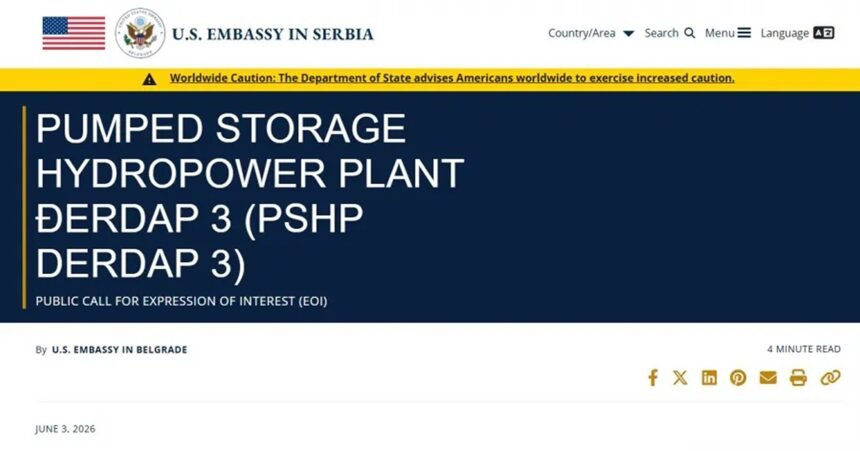
A public call issued by Serbia’s Ministry of Mining and Energy, aimed at U.S. companies interested in constructing the “Djerdap 3” hydropower plant, and published on the website of the U.S. Embassy in Belgrade on June 3, has triggered significant reactions in Serbia’s northern neighbor, Kosovo.
The deadline for applications under the public call expired on June 25. According to Minister of Mining and Energy Dubravka Đedović Handanović, six U.S. companies have expressed interest in constructing “Djerdap 3,” reported the newspaper Danas, as cited by KosovaPress.
According to her, there is no doubt that the current government has decided to entrust Americans with the construction of this hydropower facility.
As reported by Danas, this became somewhat clear as early as August 2022, when former Minister of Mining and Energy Zorana Mihajlović met with Stuart Jones, president of the U.S. company Bechtel.
At the time, Jones stated that Bechtel was interested in exploring further opportunities for cooperation with Serbia in the energy sector, including financing a preliminary feasibility study for the reversible hydropower project “Djerdap 3.”
Later, the U.S. company prepared the preliminary feasibility study for “Djerdap 3” at its own expense. However, according to the media outlet, the document has not been made public and its conclusions remain unknown. The study is said to have been completed in 2024.
Everything the public knows about the study comes from announcements and statements by representatives of the Ministry of Mining and Energy, Danas reported.
Based on available information, several installed capacity options were analyzed, including 1,200 MW, 1,800 MW, and 2,400 MW, as well as the characteristics of balancing power.
The construction of the hydropower plant will also depend on approval from Romania, as Romanian officials had expressed concerns years ago that “Djerdap 3” could potentially affect the operation of “Djerdap 1” and “Djerdap 2.”
However, the Ministry has stated that the preliminary feasibility study, together with the hydrological study, showed that the overall annual impact of “Djerdap 3” would be positive for electricity production at “Djerdap 1” and “Djerdap 2.”
The culmination of the process of entrusting the construction of “Djerdap 3” to U.S. companies, according to Danas, was the signing of the Strategic Energy Cooperation Agreement in September 2024 by Serbia’s Foreign Minister Marko Đurić and U.S. Under Secretary for Economic Growth, Energy, and the Environment José W. Fernandez.
“This agreement will expand opportunities for U.S. companies to invest in Serbia’s energy sector, including by promoting American investments that will strengthen the strategic partnership between the United States and Serbia,” the U.S. State Department said after the agreement was signed, according to Danas.
The newspaper reported that, so far, regarding the preparation of the “Djerdap 3” project, everything has developed exactly as outlined in the agreement.
Initially, Serbia established a working group. It then submitted the public call to the United States in order to inform interested American companies about the opportunity to compete for the project. The United States published the call. Everything was carried out according to the agreement, Danas wrote.
However, the statement that has attracted the most attention is the opening sentence of the agreement, which says that “this cooperation could play a vital role in improving Serbia’s energy supply security while simultaneously providing significant additional benefits for the energy security of the United States.”
The Danas report also raises the question of whether this means the United States could become the owner of the hydropower plant, strengthening its presence in Serbia’s energy sector, which is currently influenced by Russia and China, or whether the purpose of the agreement is simply to enable U.S. companies to participate in its construction.
Another important part of the document states that “Serbia exempts from value-added tax (VAT) and customs duties transactions carried out in connection with the projects.”
Plans for the construction of the “Djerdap 3” hydropower plant date back to the 1980s, following the completion of the construction of “Djerdap 2.”