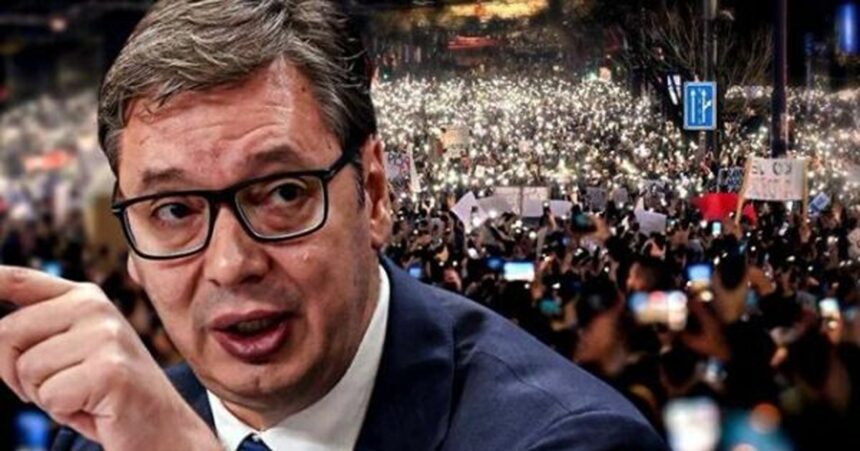
Serbian President Aleksandar Vučić’s rally in Užice has exposed the political difficulties facing the ruling Serbian Progressive Party (SNS) ahead of a planned gathering in Novi Sad, according to an analysis published by Radar.
The article argues that the events in Užice served as a test for the authorities before the planned Novi Sad rally, where the government would face a larger and potentially more organized presence of dissatisfied citizens.
According to Radar, the choice of Užice as a “dress rehearsal” was not accidental. The publication argues that the authorities were aware of Vučić’s declining popularity in the city and sought to tightly control access to the central square ahead of his appearance.
The rally was accompanied by heightened security measures, restrictions on movement and clashes involving government supporters and citizens protesting against the event.
Radar reports that some prominent local critics received police warnings before Vučić’s arrival, while citizens gathered at a café on the main square were allegedly forced out by men wearing either SNS insignia or black vests bearing images of convicted war criminal Ratko Mladić.
The publication argues that the authorities were particularly concerned about preventing a repeat of the problems encountered in Užice when organizing the Novi Sad event.
Claims of inflated attendance
Radar also questioned official and pro-government claims about the size of the Užice rally.
While a pro-government media outlet reportedly claimed that 300,000 people attended and police estimated the crowd at around 15,000, Radar said aerial footage suggested that the actual number was closer to 4,000–5,000.
The publication also argued that a substantial portion of those present had been brought in from other cities by bus.
According to testimonies cited by Radar and videos circulating on social media, some participants allegedly received payments ranging from 2,000 to 5,000 Serbian dinars.
Radar said the authorities’ preparations, including the removal of parked cars and the large number of buses brought into the city, suggested a significant effort to assemble the crowd.
Violence and clashes
The most serious aspect of the Užice gathering, according to Radar, was the violence surrounding the event.
The publication reported that citizens who refused demands to leave a café near the main square were allegedly attacked, with incidents including punches from behind, a chair being thrown and a man being kicked after being knocked to the ground.
Police later reported that five people were injured during the day, including two police officers.
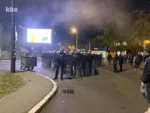
Tensions also escalated near the so-called Small Square, where protesters were separated from the main rally area by a police cordon. Radar said police pushed protesters toward the Đetinja River and used tear gas after clashes broke out.
Some protesters responded by throwing objects toward police, with one object reportedly striking an RTS cameraman.
The article also describes the presence of groups of men wearing black shirts as an apparent intimidation tactic, arguing that their deployment could further deepen resentment toward the authorities among local residents.
A difficult test before Novi Sad
Radar argues that the events in Užice raised serious questions about the feasibility of holding a large pro-government rally in Novi Sad.
The publication notes that Novi Sad is Serbia’s second-largest city and has become a major center of anti-government sentiment since the collapse of the canopy at the city’s railway station on November 1, 2024, which killed 14 people.
Radar argues that a gathering in Novi Sad would be more difficult to control because local civic groups had called on dissatisfied citizens from across Serbia to come to the city.
The possibility of confrontation, according to the publication, created a political dilemma for Vučić: proceeding with the rally risked renewed violence and images of unrest, while canceling it could be portrayed as a retreat in the face of public opposition.
Questions over the ruling party’s local strength
The article also questions whether the SNS can still claim strong grassroots support in Užice.
Radar points to what it describes as a subdued atmosphere in the city before the rally, with streets dominated by police and SNS activists while many residents remained indoors.
The publication also highlights remarks by SNS councilor Nina Trnavac from Sevojno, who said that a large majority of people from her generation despise the ruling party and that she had even lost a partner for her graduation dance because of her political affiliation.
Radar argues that the remark inadvertently contradicted the government’s broader narrative of overwhelming public support.
The publication also questioned the decision to give the main welcoming speech to Milan Stamatović, the long-serving mayor of neighboring Čajetina and a former opposition politician who later entered cooperation with the SNS.
What Užice revealed
Radar concludes that the Užice rally revealed more than the government’s difficulties in organizing a political gathering.
The publication argues that the authorities increasingly depend on police and informal groups to control public space and suppress opposition, while attempting to present organized rallies as demonstrations of popular support.
The experience in Užice, it suggests, also demonstrated the limits of that strategy.
For Vučić, the central challenge is no longer simply filling a square with supporters. It is ensuring that a carefully managed political spectacle does not become overshadowed by images of confrontation, coercion and public anger.
That challenge becomes particularly significant in Novi Sad, where the political symbolism of the city, the legacy of the railway station tragedy and the strength of anti-government mobilization make any large-scale ruling-party rally considerably more difficult to manage.