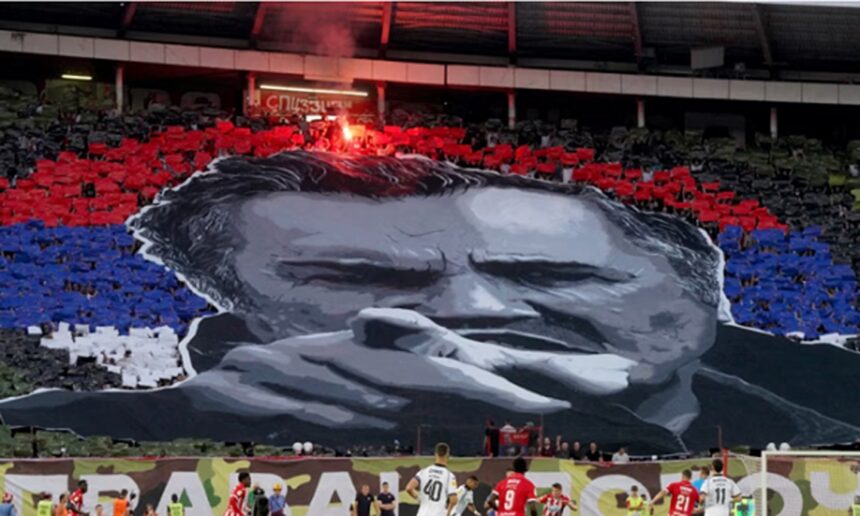
From stadium banners and chants to graffiti across Serbian cities, the glorification of Ratko Mladić is no longer simply a matter of extremist football supporters. It increasingly reflects a broader political environment in which the legacy of a convicted war criminal is tolerated, normalized and, in some cases, amplified.
Ratko Mladić, the former commander of the Army of Republika Srpska, was convicted and sentenced to life imprisonment by the International Residual Mechanism for Criminal Tribunals for genocide, crimes against humanity and war crimes committed during the war in Bosnia and Herzegovina.
Yet decades after the atrocities of the 1990s, his image continues to appear in Serbian football stadiums, on walls across the country and on social media, where he is portrayed by nationalist supporters as a hero rather than as a convicted perpetrator of genocide.
The latest incidents have once again placed the spotlight on the supporters of Red Star Belgrade, known as the “Delije,” whose groups have repeatedly displayed messages glorifying Mladić.
One of the most disturbing slogans appeared during a match in Belgrade: “To Potočari.”
Potočari is home to the Srebrenica-Potočari Memorial and Cemetery, where thousands of victims of the Srebrenica genocide are buried.
For survivors and families of the victims, such slogans are not football banter. They are direct references to one of the darkest chapters in modern European history.
From the terraces to the club itself
What makes the latest developments particularly troubling is that the glorification has not remained limited to individual supporters.
Red Star Belgrade has itself shared material connected to the glorification of Mladić on its official social media channels. Among the content was an image of graffiti dedicated to the convicted war criminal, accompanied by a military-style salute emoji.
That raises a fundamental question:
Where does the responsibility of the supporters end, and where does the responsibility of the club begin?
A football club may argue that it cannot control every action carried out by thousands of supporters inside a stadium.
But when material glorifying a convicted war criminal is subsequently shared through the club’s own official channels, the argument that the club is merely a passive observer becomes considerably harder to sustain.
And this happened despite UEFA already taking disciplinary action against the club.
Following incidents during a match in the Czech Republic on August 27, the day Mladić died, UEFA fined Red Star €100,000 over racist behaviour and inappropriate chanting. The club was also prohibited from selling tickets to its supporters for its next away match in a European competition.
During that match, supporters displayed banners praising Mladić and chanted his name.
Yet even after the UEFA sanction, content glorifying him continued to appear on the club’s official social media accounts.
The issue therefore goes beyond football discipline.
It becomes a question of institutional responsibility.
Silence from Serbian authorities
Equally significant is the apparent lack of reaction from Serbian state institutions.
According to Radio Free Europe reporting, neither the police nor judicial authorities responded to the “To Potočari” message displayed at the Belgrade stadium.
This is particularly striking because Serbian law provides for sanctions in certain circumstances involving the public approval or denial of genocide.
Yet there was no visible institutional response to the incident.
Neither the Serbian Football Association nor the Serbian authorities publicly distanced themselves from the messages.
That silence is difficult to separate from the broader political environment surrounding the issue of war crimes and historical memory in Serbia.
The glorification of Mladić has repeatedly appeared alongside nationalist political messaging, particularly among sections of the far right and organized football fan groups.
When football terraces become political platforms
Football and politics have long been closely intertwined in the Balkans.
In Serbia, major supporter groups possess influence that extends far beyond the football stadium. Their political symbolism, street presence and mobilization capacity have made them an important component of Serbia’s broader nationalist ecosystem.
Journalist Filip Švarm has pointed to strong connections between political power, football clubs and organized supporter groups.
According to Švarm, various forms of state financing and political influence over football clubs can create an informal support network among organized fans, some of whom have long been associated with violence and hooliganism.
The political value of such groups is clear.
They can mobilize large crowds, dominate public spaces and provide a highly visible platform for nationalist messages.
And when the authorities consistently fail to condemn those messages, the absence of condemnation itself sends a message.
It creates the impression that certain forms of nationalism, historical revisionism and glorification of convicted war criminals are politically acceptable.
A pattern that goes beyond Mladić
The glorification of Mladić is not an isolated incident.
In 2023, Red Star supporters displayed banners praising three members of an armed group who were killed following the September 24 attack on Kosovo Police in Banjska.
The slogan “Glory to the heroes of Banjska” subsequently appeared in numerous Serbian cities.
In the same year, during a friendly match against Italian club Fiorentina in Belgrade, Red Star supporters displayed another provocative message:
“When the army returns to Kosovo.”
These messages demonstrate how football stadiums can become spaces where historical grievances, territorial claims and nationalist political narratives are reproduced.
They also show that the issue is not simply about one individual or one football match.
It is about a wider culture in which war, nationalism and football fandom increasingly overlap.
The state, football and money
The relationship between Serbian football and political power also raises questions about public funding.
Radio Free Europe previously reported that, during 2026, the Serbian Football Association received more than €6 million from state budget reserves.
The Football Association said that the money was intended, among other purposes, to provide assistance to clubs at their request. However, it did not specify which clubs received the funds.
This makes transparency particularly important.
If football institutions receive public money, there should also be clear expectations concerning their responsibility toward the public, including their response to hate speech, extremist symbolism and the glorification of convicted war criminals.
A club cannot demand the benefits of public support while simultaneously presenting itself as entirely detached from the political and social consequences of what appears on its platforms.
The political ecosystem around football supporters
The issue of links between Serbian political power and organized football supporters gained renewed attention in 2021 following the arrest of Veljko Belivuk, a former leader of Partizan’s “Principi” supporter group, who was accused of leading an organized criminal group.
Opposition figures alleged that members of Belivuk’s group had on two occasions been involved in the personal security of Serbian President Aleksandar Vučić. Serbian authorities denied those allegations.
The Belivuk case nevertheless highlighted the complicated relationship between organized supporter groups, criminal networks and political influence in Serbia.
Against this background, the continued appearance of Mladić’s image in football culture becomes even more significant.
The question is not whether every supporter represents the Serbian government.
Clearly, they do not.
The question is why authorities, football institutions and political leaders repeatedly appear unwilling to draw a firm line when nationalist and pro-Mladić symbolism enters public spaces.
UEFA sanctions are not enough
UEFA has already demonstrated that such behaviour can have consequences.
The €100,000 fine imposed on Red Star shows that European football authorities are prepared to punish racist behaviour and inappropriate chanting.
But financial penalties alone cannot resolve a problem that extends beyond the stadium.
If a club is fined by UEFA while continuing to publish material glorifying the same figure, and if domestic authorities remain silent, then the punishment risks becoming little more than a cost of doing business.
The deeper issue is accountability.
Who is responsible when a football club becomes a platform for glorifying someone convicted of genocide?
Who is responsible when supporters display threats connected to Kosovo?
And who is responsible when public institutions choose not to respond?
Beyond football: the normalization of a war criminal
Ratko Mladić’s transformation from convicted war criminal into a nationalist icon is not merely a question of football culture.
It is a question of historical memory.
When his portrait appears on walls, when his name is chanted in stadiums, when supporters gather with torches beneath banners praising him, and when official club channels amplify such imagery, the message extends far beyond the football pitch.
It tells victims and survivors that their suffering can be pushed aside.
It tells younger generations that a man convicted of genocide can be presented as a symbol of national pride.
And when institutions remain silent, that normalization becomes even more powerful.
A football stadium should be a place for sport, not a sanctuary for the glorification of genocide.
The problem is therefore not simply what Serbian football fans are chanting.
The bigger question is why so many institutions appear unwilling to tell them that there is a line they cannot cross.
And when that line is repeatedly crossed without meaningful consequences, the silence surrounding it becomes part of the story.