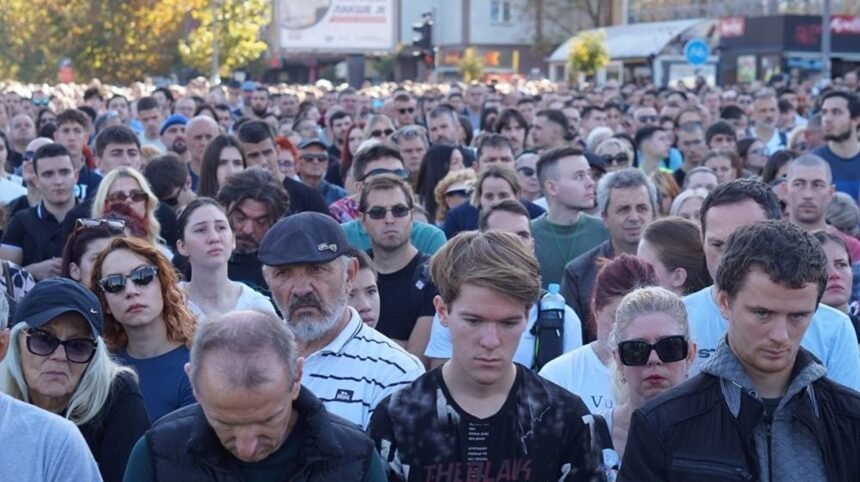
The commemorative meeting in Novi Sad, marking the tragic collapse of the train station canopy on November 1, 2024, has drawn sharp criticism from both international media and local observers for the inaction and mismanagement of the Serbian government. According to reports in Germany’s Tageszeitung and Rajniše Post, the event was a powerful political statement despite the absence of banners or overt political messaging, reflecting the public’s suppressed anger over the unresolved tragedy.
Journalist Andrej Ivanji described the scene in Novi Sad for Tageszeitung: “There is dead silence… Sixteen minutes of silence for sixteen victims. And before and after that, the vast area is shrouded in unnatural silence. It is interrupted only once by the siren of an ambulance. The city is wounded, the weight of sixteen deaths heavy on its inhabitants. But behind the somber silence lurks repressed anger, a longing for justice for their fellow citizens. No one has yet been held accountable for these deaths.”
Diana Hrka, mother of one of the victims, expressed her grief and outrage in conversations with German journalist Thomas Roser: “The canopy did not collapse on its own, but because of the corruption that kills. And instead of those responsible being called to account, the all-powerful president of Serbia, Aleksandar Vučić, arrests and beats students. Until all those responsible are charged and convicted, the president is to blame for me. After all, he killed my child.”
The reports underscore the government’s failure to ensure accountability and the deliberate use of state institutions to suppress dissent. Students who have organized protests across Serbia are facing intimidation and repression, highlighting the regime’s prioritization of power over justice.
In coverage by the Frankfurter Allgemeine Zeitung, journalist Mihael Martens examines the impact of the student protests and their achievements. While the protests have placed President Vučić—who has dominated Serbian politics for over a decade—on the defensive for the first time, they have accomplished little structurally: “A year ago, Vučić and his party controlled parliament, key government institutions, and most media outlets, including public television. In this regard, nothing has changed.”
The student movement, initially driven by emotion and blockade tactics, now aims to establish its own electoral list to challenge Vučić, avoiding traditional opposition parties. Yet the absence of a concrete plan or election date reflects both the formidable control of the current regime and the limitations imposed by government inaction. The German press notes: “To this day, no one knows what the students really stand for—probably not even themselves. The student movement has passed its easiest times; the greatest difficulties are yet to come.”
The coverage makes clear that the Serbian government under Vučić has systematically failed to address both the tragedy in Novi Sad and the broader demands for accountability and democratic governance. While citizens have learned to overcome fear, this resilience exposes the vulnerabilities of a regime more interested in consolidating power than upholding justice or the rule of law.