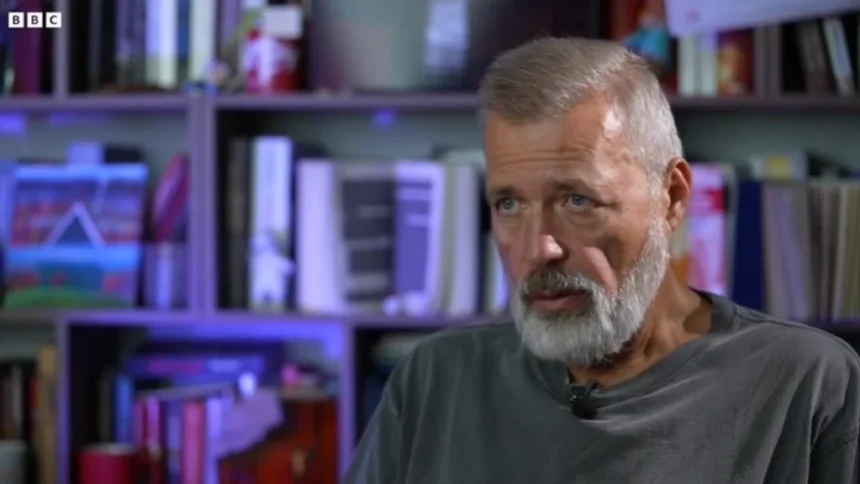
Nobel Peace Prize laureate and former Novaya Gazeta editor-in-chief Dmitry Muratov has warned that Russian President Vladimir Putin can no longer credibly claim victory in Ukraine, arguing that the consequences of the war have already made any notion of a Russian “victory” impossible.
Speaking in an exclusive interview with the BBC, Muratov described the near-total collapse of independent journalism in Russia and the growing repression faced by critics of the Kremlin.
The offices of Novaya Gazeta in Moscow are now largely silent. “There is no newspaper anymore,” Muratov said, describing how the publication he co-founded more than three decades ago was effectively dismantled by Russian authorities.
The newspaper became one of Russia’s leading independent publications, reporting on corruption, human rights abuses and abuses of power. In 2021, Muratov shared the Nobel Peace Prize for his efforts to safeguard freedom of expression.
But the Nobel recognition did not protect the newspaper. Muratov said Russian authorities revoked its registration and seized its printing facilities. Although Novaya Gazeta maintains an online presence, access to its website has been blocked inside Russia.
Muratov said the newspaper’s fate reflects a much broader crackdown on dissent since Russia launched its full-scale invasion of Ukraine in 2022.
“Hundreds” of prominent opinion leaders have been designated as “foreign agents,” extremists or terrorists, he said. According to Muratov, at least 1,500 people are currently imprisoned for opposing the government’s policies — a figure he described as significantly higher than during some of the harshest periods of Soviet repression.
“There can never be a victory”
Muratov rejected Putin’s repeated claims that Russia will ultimately prevail in Ukraine.
“There will never be a ‘victory’,” he said, arguing that the scale of destruction and casualties means the conflict cannot be presented as a success regardless of how it ends.
“You cannot call it a victory when two Slavic nations have torn apart a million people,” Muratov said.
He argued that Russia may be able to continue destroying Ukraine but cannot ultimately conquer the country.
Asked about the possibility of Russia using nuclear weapons, Muratov cautioned against pretending to know what Putin is thinking.
“All those political experts who say ‘Putin thinks this’ or ‘Putin is afraid of that’… are all charlatans,” he said, stressing that nobody knows what is happening inside the Russian president’s mind.
However, Muratov said he was increasingly concerned by the frequency with which nuclear weapons are discussed in Russian public discourse, including on state television and at state-sponsored events.
“Has Russia become safer?”
Muratov also challenged the Kremlin’s justification for the invasion, recalling Putin’s claim in February 2022 that the operation was intended to guarantee Russia’s security.
“Tell me, has security increased?” he asked, pointing to Ukrainian drone attacks, fuel shortages, disruptions to mobile internet and the growing number of political prisoners.
Despite reports of declining domestic support for Putin, Muratov said he did not believe the Russian leader was close to losing control.
“I believe the country is run by Vladimir Putin. They are afraid of him,” he said, adding that this fear is reinforced by Russia’s Federal Security Service, the FSB.
Muratov also expressed skepticism toward claims of divisions or secret plots within Russia’s political elite.
“Nobody in the world is interested in political prisoners”
Muratov, who himself has been designated a “foreign agent” by Russian authorities, said his greatest concern is not his own situation but the fate of Russians imprisoned for opposing the war.
“What worries me most now is that nobody in the world is interested in the political prisoners who were the first to speak out against the seizure of territory in our neighboring country,” he said.
During the interview, Muratov showed photographs of imprisoned Russian journalists, activists and other critics of the authorities.
Among them were journalists Antonina Favorskaya, Konstantin Gabov, Sergey Karelin and Artyom Kriger, who were convicted in cases involving alleged links to the organization of late opposition leader Alexei Navalny.
He also showed a photograph of Alexei Gorinov, a municipal lawmaker imprisoned after speaking publicly against Russia’s war in Ukraine.
Another photograph showed pianist Pavel Kushnir, whom Muratov described as an exceptional performer of Rachmaninoff and Schubert. Kushnir was arrested after publishing anti-war videos and later died in detention while on hunger strike. He was 39.
The stories, Muratov said, illustrate the risks faced by Russians who openly criticize the authorities and the war.
“We live in a time when you have to be silent”
Muratov also described continued pressure on Novaya Gazeta and its staff, including a police search of the newspaper’s offices that lasted 13 hours.
He said the newspaper’s lawyers were prevented from entering the building during the operation, while administrative editor-in-chief Oleg Roldugin is currently under house arrest.
Yet Muratov said there are still signs that independent journalism retains support among ordinary Russians.
“We live in a time when you have to be silent,” he said. “But so many people support what we do.”
He recalled hearing words of gratitude from people on the streets of Moscow, often spoken quietly or in whispers.
“But what people think is very important,” Muratov said.