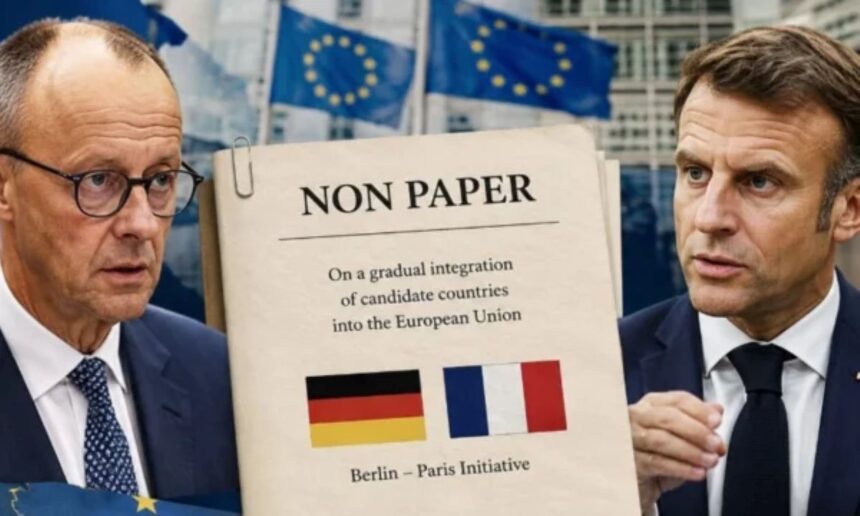
The joint Franco-German initiative calls on the European Commission to structurally dismantle traditional enlargement bureaucratic gridlocks. It offers candidate states early Single Market access and observer seats in Brussels’ decision-making circles.
In a highly coordinated diplomatic move designed to reshape the geopolitical architecture of Europe, Germany and France have authored an explosive, informal policy blueprint—a “non-paper”—aimed at fundamentally transforming the European Union’s expansion methodology.
The joint strategic document, unveiled on Thursday, June 4, 2026, explicitly commands the European Commission to draft aggressive legislative proposals to facilitate the “gradual integration” of Western Balkan candidate nations and Moldova long before they achieve full, formal bloc membership.
The timing of the leaked document is deliberately calculated. It arrived less than 24 hours before European Council President Antonio Costa and European Commission President Ursula von der Leyen land in Montenegro for the EU-Western Balkans Summit in Tivat, which is slated to be followed by a parallel EU-Moldova summit on June 22.
The Franco-German axis argues that amidst a volatile global arena characterized by intense transactional great-power competition, the traditional merit-based accession system has broken down, leaving vulnerable European democracies languishing in Brussels’ waiting room for too long.
“The enlargement policy needs a new momentum,” the non-paper explicitly states. “The upcoming summits are an opportunity that must not be missed. The shared goal is to finalize the European Union as a truly European union. To turn this vision into reality and give a new dynamism to the process, additional incentives must be created within a merit-based, gradual integration framework.”
Unlocking the Common Market: The ‘EEA+’ Blueprint
The centerpiece of the plan authored by German Chancellor Friedrich Merz and French President Emmanuel Macron is a radical proposal to decouple absolute membership from economic integration.
Under the proposed model, candidate countries that demonstrate tangible progress on structural reforms will be granted early, comprehensive access to the EU Single Market under an expanded framework dubbed “European Economic Area Plus” (EEA+). This would mimic the market privileges currently enjoyed by highly integrated non-EU nations like Norway, Iceland, and Liechtenstein.
┌────────────────────────────────────────────────────────────────────────┐
│             The EEA+ Blueprint: Early Access Framework                 │
├────────────────────────────────────────────────────────────────────────┤
│ • Market Privileges: Elimination of non-tariff trade barriers and      │
│   exemption from aggressive safeguard measures on local exports.       │
│ • Statutory Prerequisite: Candidates must fully adopt and execute the   │
│   entirety of the EU's "acquis communautaire" across Clusters 1 to 5.  │
│ • Enforcement Mechanism: Binding integration requires the successful, │
│   provisional closure of relevant technical negotiation chapters.      │
└────────────────────────────────────────────────────────────────────────┘
The document emphasizes that this “pseudo-enlargement” is not designed to permanently replace full membership or extend an already lengthy timeline. Instead, it seeks to introduce powerful financial and economic incentives to motivate local politicians to execute highly complex judicial and economic overhauls.
Observer Seats and Political Synchronization
Beyond economic integration, Paris and Berlin are pushing to formally invite candidate nations into everyday EU decision-making processes. The non-paper outlines several key political building blocks:
- Institutional Observer Status: Accredit representatives from candidate nations to sit in on specific, unclassified agenda items during informal European Council and Council of the EU ministerial meetings—granted as observers without voting rights.
- Biannual Plenary Summits: Establishing mandatory, twice-yearly joint summits gathering the European Commission, members of the European Parliament (MEPs), and regional heads of state.
- Legislative Twinning: Forcing joint parliamentary committees to convene at a significantly higher frequency to solidify inter-institutional bonds.
Streamlining the Bureaucracy
To make the process efficient, the non-paper calls for an immediate simplification of the EU’s convoluted negotiation methodology. It suggests compressing several tedious procedural steps and bundling separate technical reviews into unified assessment waves. The objective is to force the candidate countries, the Commission, and the Council to focus heavily on the substance and enforcement of domestic rule-of-law reforms rather than getting bogged down in endless procedural red tape.
Crucially, the document maintains a strict line on the preservation of EU autonomy, stating that any advanced integration will operate under ironclad conditions to protect the bloc’s independent decision-making structures from external gridlock. With Western Balkan frontrunner Montenegro currently racing to close all its remaining chapters by the end of 2026, the Franco-German non-paper provides the exact political blueprint required to ensure that the broader region is not left behind in a fast-changing continental security environment.