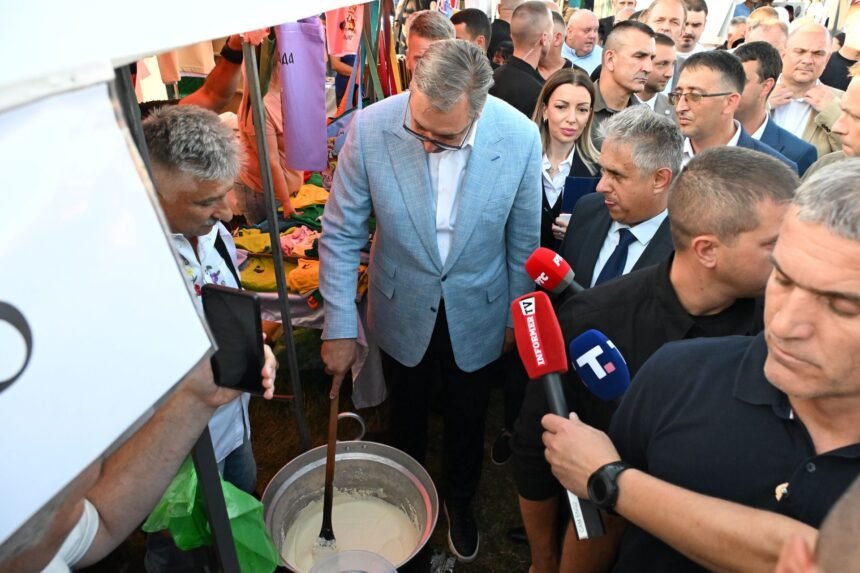
Although elections in Serbia have not yet been formally called, the country is already effectively in a permanent campaign, with President Aleksandar Vučić and the ruling Serbian Progressive Party (SNS) using state announcements, financial assistance and public promises to shape the political environment ahead of the next vote.
The government has announced one-off payments, increases in salaries and pensions, cheaper medicines and new vouchers. Among the most prominent measures are a planned payment of between 20,000 and 35,000 dinars to pensioners, depending on the size of their pensions, as well as 6,000 dinars for adult citizens who are shareholders in the Akcionarski Fond.
The government presents the measures as evidence of economic progress and a gesture toward citizens. Critics and opposition parties, however, describe them as an attempt to secure political support through public funds or money from the Akcionarski Fond, which ultimately belongs to citizens themselves.
The strategy, according to critics, is aimed at reducing public dissatisfaction and calming the electorate before voters eventually go to the polls.
At the same time, Serbia’s parliamentary opposition has struggled to capitalize on the growing dissatisfaction with the government. Opposition parties have maintained a relatively low-profile presence on the ground, while the largest source of political energy has come from the student movement known as “Students in Blockade.”
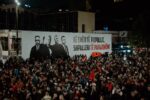
The student-led demonstrations against corruption and demanding institutional accountability have developed into one of Serbia’s largest and longest-running expressions of civic dissatisfaction since October 5, 2000.
Yet the protests have also exposed a significant weakness within the opposition. Rather than fully embracing the movement’s independent character, opposition parties have often appeared uncertain about how to work with a political force that rejects traditional party leadership and operates through local assemblies and direct-democracy mechanisms.
The concept promoted by the student movement goes beyond simply winning the next election. Its stated objective is to restore institutional normality before holding fully competitive elections.
Under this vision, the fall of Vučić’s government would be followed by a transitional, technical government tasked with dismantling what critics describe as media domination, restoring institutional independence and revising the voter registry.
Only after such reforms, the argument goes, could Serbia hold genuinely free and democratic elections in which voters would choose between competing political programs rather than what critics portray as a choice between political survival and collapse.
This approach also highlights the central role of voters themselves.
In an environment characterized by significant media and institutional asymmetry, electoral abstention or a boycott could ultimately benefit the ruling party, critics argue. A high voter turnout, by contrast, could weaken mechanisms of patronage, pre-election financial incentives and the advantages enjoyed by incumbents.
The political challenge facing Serbia therefore extends beyond the question of when elections will formally be called. It is also about whether opposition parties can translate widespread civic dissatisfaction into an organized electoral alternative capable of competing with the ruling establishment.
The argument advanced by critics of the current system is that a captured or heavily imbalanced political environment cannot be changed simply by observing events from the sidelines. Mass civic participation and high voter turnout, they contend, remain among the most effective democratic tools available to challenge entrenched political power.
With elections still officially unannounced, Serbia is already experiencing many of the dynamics of an election campaign — from government spending and promises of financial assistance to intense political mobilization and growing pressure for institutional reform.