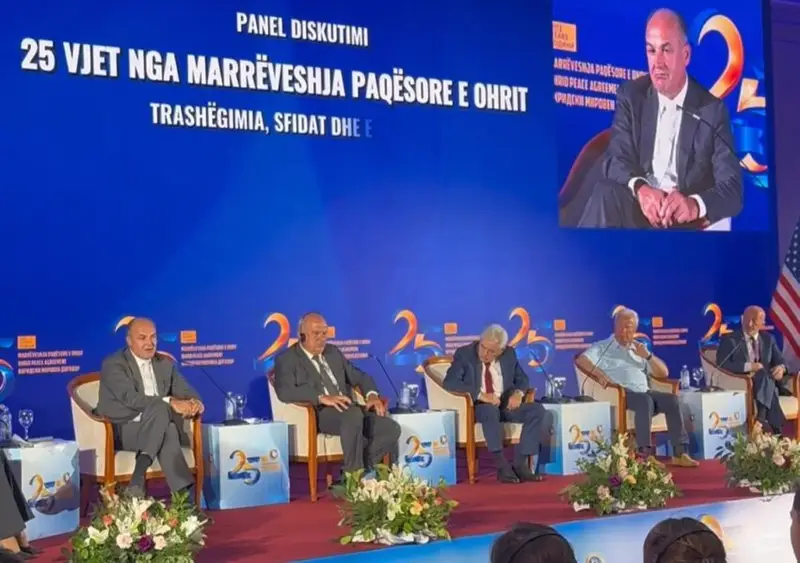
Former Kosovo Foreign Minister and Democratic Party of Kosovo (PDK) MP Enver Hoxhaj has described the 2001 Ohrid Framework Agreement in North Macedonia and the Ahtisaari Plan in Kosovo as historic and irreversible arrangements that represent broader commitments between the two countries and the West.
Hoxhaj made the remarks Thursday in Skopje during events marking the 25th anniversary of the Ohrid Agreement.
He participated in a panel alongside Ali Ahmeti, former North Macedonian Prime Minister Vlado Bučkovski and former Albanian Foreign Minister Paskal Milo. The discussion focused on the historical significance of the agreement and its role in North Macedonia’s future.
Hoxhaj said the Ohrid Agreement represented a major historic development that could not be reversed or rewritten.
“The Ohrid Agreement, just like the Ahtisaari Plan in Kosovo, is a document that closes an era and is the foundation of a state for regulating relations between its two largest ethnic groups,” Hoxhaj said.
He argued, however, that the agreement goes beyond relations between ethnic communities, describing it as a broader commitment between North Macedonia and Western countries.
“It is also a contract that North Macedonia has with the West, just as we have a contract with the West through the Ahtisaari Plan,” Hoxhaj said.
According to Hoxhaj, both agreements represent political frameworks whose significance extends beyond the circumstances in which they were negotiated.
He said attempts to reverse, rewrite or reframe the Ohrid Agreement would be a mistake and argued that continued implementation of the agreement could contribute to North Macedonia’s progress toward European Union membership.
Hoxhaj also praised what he described as the commitment of North Macedonia’s political and intellectual elites to preserving the agreement rather than returning to historical divisions.
He said the Ohrid framework does not take rights away from anyone but instead strengthens the state by establishing a sustainable framework for relations between its communities.
“The Ohrid Agreement is a historic development that is irreversible,” Hoxhaj said, emphasizing that its continued implementation should be viewed as part of North Macedonia’s broader European path.